
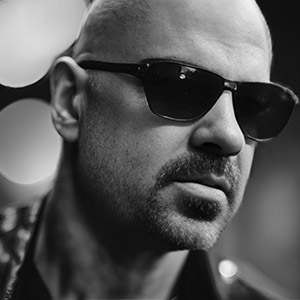
Listening back to this decade-old tape from our archives, a conversation with Edwin from Jul. 30, 2013, feels like unearthing a time capsule. The Canadian rock scene was in a strange place. The aftershocks of the digital revolution were still levelling the landscape and veteran players were trying to figure out where they fit. Enter Crash Karma, the so-called supergroup featuring members of I Mother Earth, Our Lady Peace and The Tea Party, who were gearing up to release their second album, Rock Music Deluxe.
The project was no longer a novelty. After their 2010 debut, the four members knew each other’s rhythms and expectations. This second record was meant to be a more focused and cohesive statement. A progression. But the process of creating that statement was anything but cohesive. It was a brutal, scattered affair that speaks volumes about the challenges of making music in the modern era, even back then.
Edwin is brutally honest about the experience. The band, all busy with their own lives, recorded their parts separately. Files were emailed back and forth. Drums were tracked in a few days with legendary producer Terry Brown, who then departed the project. Guitars were done in a home studio. And Edwin’s vocals? They were recorded all over the map, in whatever studio he could find time in.
It was a logistical nightmare. The lack of immediate feedback, the endless chain of emails, the digital misplacement of crucial tracks. It nearly broke him. “I hated it. I’ll never do that again, actually,” he says, the frustration still palpable in his voice. “I just didn’t like the scattered approach with tracks here, tracks over there, things getting misplaced, things getting lost. What happened to that track I did last week? I’m not hearing it. Stuff like that. It was very frustrating for a while.”
The situation only stabilized when he insisted bassist Amir Epstein join him in the studio to provide a real-time sounding board. It’s a critical detail. For a band built on the premise of live chemistry, the reliance on disjointed, digital assembly was a creative contradiction. And you can hear it. While Rock Music Deluxe is a professional and muscular record, it lacks some of the spontaneous combustion that happens when four players are in a room, pushing and pulling against each other in the moment. It’s a technically proficient album that sometimes feels more assembled than born.
And yet, that friction fuelled the album’s central thesis. The title itself was a defiant statement. In an era where more and more bands were leaning on backing tracks to replicate their studio sound live, Crash Karma was planting a flag for old-school integrity. Jeff Burrows, the drummer, threw the name out, and it stuck. It was a direct shot across the bow.
Edwin explains the sentiment clearly. “Rock music nowadays isn’t very often rock music, it’s everything but rock music, but it’s always referred to as rock music,” he says. “We were a little put off, to say the least, about those bands being called rock bands because those aren’t the rock bands we grew up listening to. So we felt that it was a bit of a cheat.”
The title was their response. “Rock Music Deluxe is a bit of a statement in the sense of, this is rock music. These are people that actually play their instruments live, sometimes even better than the record, and that’s sort of the vibe behind the title.” It was a bold, if slightly on-the-nose, declaration of principles from a band of lifers.
Nowadays, if you get one single, one record, if it doesn't make the splash and the money that the record company was hoping to make, then you're just, thank you very much. Take care. Goodbye.
Of course, you can’t talk about a band like this without addressing the elephant in the room: the “supergroup” tag. It’s a label that has sunk more bands than it has elevated, creating expectations that are almost impossible to meet. Edwin and his bandmates clearly bristled at it, preferring a different moniker.
“We prefer Dream Team,” he says with a laugh, before getting serious about the perception. “We never really looked at it as a supergroup, to be honest with you. I know other people look at it that way, and I understand why. But we never really looked at it that way because, you know, when you’re in there with four guys and you gotta create a record that is going to stand up against all the other records out there... you’re just another band.”
He’s right. The pedigree gets you in the door, but the music has to keep you in the room. “If nobody ever hears it and nobody ever plays it... you’re not a supergroup,” he argues. “You’re just a bunch of guys that made a record. And we’ve always approached it that way.” It’s a grounded, pragmatic perspective born from decades of navigating the industry’s hype machine.
That sense of perspective colours his reflections on his own career, from the freewheeling prog-rock explorations of I Mother Earth to his more pop-oriented solo work. With IME, the mission was purely artistic. “We weren’t gonna try and impress anybody. We were just going to try and impress ourselves,” he recalls. “That’s why there’s so many songs in I Mother Earth’s records that don’t have choruses or just one verse after another.”
His solo career was a conscious pivot towards accessibility. He wanted to write hooks, get on the radio and connect with a broader audience without the creative democracy of a four-piece band. Crash Karma, then, became the synthesis of those two impulses. It was the heavy foundation of his past combined with the pop sensibility he’d honed on his own, a perfect storm of his musical identities.
But the most telling part of this entire conversation is Edwin’s sharp analysis of the industry itself. He mourns the collapse of artist development, the system that allowed bands to grow over several albums. He remembers the old A&R pitch perfectly.
“If your first record doesn’t sell, as long as you’re out touring, building a solid fan base, then your second record, it’ll sell more, and your fan base will be bigger,” he says, outlining the now-extinct model. “By your third record, you’ll explode... A lot of bands were developed that way. There’s a lot of bands that if it was up to their first record only, we would never talk about them today.”
By 2013, that patience was gone, replaced by a demand for immediate, viral success. “Nowadays, if you get one single, one record, if it doesn’t make the splash and the money that the record company was hoping to make, then you’re just, thank you very much. Take care. Goodbye.” This wasn’t just an old-timer complaining; it was an accurate diagnosis of a systemic failure.
The irony is that Crash Karma experienced this pressure firsthand with this very album. After delivering what they thought was a finished 10-song record, their radio promoter told them he didn’t hear a lead single as strong as their previous hit. The band was insulted but ultimately pragmatic. They went back into the studio and cut two more songs, one of which was “Tomorrow,” the track that would lead the album’s campaign.
It proves his point perfectly. Even for a “Dream Team” of established rock stars, the relentless demand for a hit single trumped all else. The machine had changed the rules for everyone.
Looking back, this interview captures a band of veterans fighting a war on two fronts. They were battling a frustratingly modern recording process to create a defiantly traditionalist rock album, all while navigating an industry that no longer valued the very career path that had made them famous in the first place.
Rock Music Deluxe was their answer to all of it. A loud, unapologetic album from four guys who still believed in the power of turning up their amps and playing for real. It was a stand, not just for their own music, but for an entire idea of what a rock band should be.
519 Magazine Archive: We are thrilled to officially unearth the Rockstar Weekly Digital Vault. This isn't just a re-post; it's a high-fidelity restoration of a pivotal era in music journalism. By pairing original print dates with modern retrospectives, we’re bridging the gap between historical rock-and-roll grit and the lightning-fast performance of today’s web. These stories—once locked in physical print and lost URLs—are now back, fully searchable, and optimized for a new generation of fans.
We are thrilled to officially unearth the 519 Magazine Digital Vault. This isn't just a re-post; it's a high-fidelity restoration of a pivotal era in music journalism. By pairing original print dates with modern retrospectives, we're bridging the gap between historical rock-and-roll grit and the lightning-fast performance of today's web. These stories—once locked in physical print and lost URLs—are now back, fully searchable, and optimized for a new generation of fans.