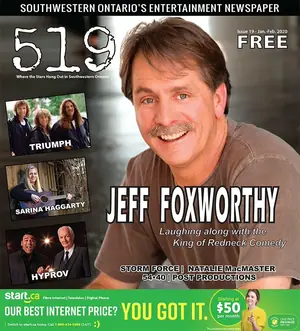


Looking at the raw transcripts from this late 2019 conversation with Jeff Foxworthy is like unearthing a time capsule. It’s from a moment just before the world shut down—a moment when the cultural anxieties he was navigating felt like a low simmer rather than a boiling rage. Foxworthy wasn't just a comedian by this point; he was a cultural institution, an entire cottage industry built on a single perfectly honed catchphrase. But what this interview reveals is a man acutely aware of the shifting sands beneath his cowboy boots, wrestling with his own legacy and the new unspoken rules of comedy.
It all began not in the deep south but in the industrial heartland. The genesis of the entire “You might be a redneck” phenomenon is a story of pure observational genius. He was in a club just outside Detroit, a city not exactly known for its southern charm. And the criticism he kept getting was that he was just a country boy. But he saw something universal. He saw a shared blue-collar aesthetic that transcended geography.
The lightning strike moment came at a venue that perfectly embodied this truth. “The club we were playing in was attached to a bowling alley that had valet parking,” he recalls. That was it. The glorious contradiction. The collision of high-falutin service with a working-class pastime. It was the key that unlocked everything. “And I said, Okay. I said, If you don't think you have rednecks in Michigan, go look out the window. People are valet parking at the bowling alley.”
That night he went back to his hotel and scribbled down the first ten jokes. It was never meant to be a hook or a brand. It was just material. But the audience reaction was explosive. “Not only were people laughing on half of them, they're pointing at each other,” he says. “And so that's what stand-up is all about, is making that connection.”
And what a connection it became. The initial list of ten jokes swelled to 300, which he thought might make for a “cute book.” The industry disagreed. Fourteen publishers passed. The fifteenth took a chance, predicting a modest 5,000 copies sold. The final tally? A staggering 4.5 million. Add to that a page-a-day calendar that has been a top seller for 30 years, and you’re looking at an empire built on a joke format he basically invented.
The magic was its relatability. The jokes weren’t conjured from thin air; they were pulled from reality. “A few nights ago, I'm on the interstate, I'm in bumper to bumper traffic, and the person in front of me, their bumper is like half hanging out,” he explains. “Somebody's taken their belt off, and they've got it wrapped around holding the drooping part of the bumper on the car.” He pulls out his phone, takes a picture, and a new joke is born. It was a formula rooted in truth.
But let’s be direct. For all his insistence that he was “laughing with somebody,” not at them, the premise walked a fine line. The humour derived its power from a shared recognition of a specific cultural archetype, one defined by a “glorious absence of sophistication.” He never received a single complaint, he claims. People would bring his books to shows with checkmarks next to the jokes they’d personally lived out. Still, it’s a brand of comedy that would be infinitely harder to launch in today’s climate, where labels and archetypes are scrutinized with surgical precision.
Foxworthy was already feeling that pressure back in 2019. He notes how his act had evolved out of necessity. “In 1990, I could have done a bit about, hey, men do this and women do this... Now somebody's gonna get offended by that. So now I say, I do this and my wife does this.” This is a crucial distinction. It marks the retreat of observational comedy from broad generalization to the safer ground of personal anecdote. It’s a defensive crouch against a culture he sees as increasingly brittle.
We kinda live in a world where everybody is screaming for tolerance and diversity, but the minute somebody doesn't think like you or vote like you, you crucify them, which is neither tolerant or diverse.
His frustration is clear when he talks about a new joke his wife flagged as too risky. “She said, It's funny, but you probably can't do it now. Somebody will be offended. And I thought, man, this is it's almost like trying to write with one hand behind your back.” He laments a world where people have forgotten how to laugh at themselves, a world screaming for tolerance while simultaneously crucifying dissent.
“We kinda live in a world where everybody is screaming for tolerance and diversity, but the minute somebody doesn't think like you or vote like you, you crucify them, which is neither tolerant nor diverse,” he says. It’s a sharp critique from a man who made his living uniting disparate crowds under the banner of a single joke.
Despite his massive success in television, books, and games, his heart remains tethered to the stage. This makes him an anomaly. “Most people get into stand-up because stand-up is a great springboard to get into TV or movies,” he observes. “And then once they get into TV or movies, they never go back and do stand-up.” But for Foxworthy, like Seinfeld or Leno, the live show is the entire point. It’s the adrenaline, the immediate feedback loop, the visceral connection. It’s his native habitat.
He speaks of his affection for Canadian audiences with the seasoned perspective of a road warrior. Ahead of a show in Windsor, Ontario, he notes that crowds north of the border are “not as uptight” and “laugh a little more readily.” It’s a small detail, but it speaks volumes about a performer who has spent decades reading rooms and understanding regional temperaments.
Another pillar of the Foxworthy brand is his unapologetic faith. It’s not preachy, but it’s foundational. He hosts a weekly Bible study for homeless men in downtown Atlanta. This conviction informed his decision to host the American Bible Challenge. He initially said no. He only agreed on one condition: “The people that win, they've got to take the money and do something kind for somebody else because that's biblical.” It was a savvy move that perfectly aligned his public work with his personal values.
The cancellation of that show, which was a ratings hit for the Game Show Network, still baffled him. It’s part of a career-long lesson in the whims of television. “Every time I think a show is gonna keep going, it gets canceled. And every time I think it's gonna get canceled, they bring it back again. So I know nothing about television.”
Behind the seemingly simple humour is a relentless work ethic. His wife once posted a photo of his creative process: a kitchen table buried under notecards, notebooks, and printouts. He’s not just winging it; he’s a craftsman, trimming the fat and checking the facts. “You don't wanna just go out there and half-ass it,” he says. “You want it to be good because, you know, people are paying money to hear you.”
He’s also a student of his own history, keeping every notebook from his long career. Sometimes he’ll flip through old material and find a bit that didn’t work then but, with the wisdom of experience, might work now. It’s a continuous process of refinement and rediscovery.
But the weight of his own creation is undeniable. The anecdote about a fan being genuinely disappointed that he doesn’t live in a trailer is both hilarious and telling. “I was like, well, isn't the idea after, you know, thirty-something years of busting your hump to maybe buy a house that's not on wheels?” he muses. He’d built a persona so powerful and so beloved that some people struggled to separate the artist from the archetype.
Ultimately, this 2019 interview captures a comedy legend at a fascinating inflection point. He was actively working on a new hour of material, moving his act further into the territory of marriage, family, and aging. Yet he was still inextricably linked to the catchphrase that made him a household name. He was a man who understood the old rules of entertainment better than almost anyone, just as a new generation was busy rewriting the entire rulebook.
519 Magazine Archive: We are thrilled to officially unearth the 519 Magazine Digital Vault. This isn't just a re-post; it's a high-fidelity restoration of a pivotal era in music journalism. By pairing original print dates with modern retrospectives, we’re bridging the gap between historical rock-and-roll grit and the lightning-fast performance of today’s web. These stories—once locked in physical print and lost URLs—are now back, fully searchable, and optimized for a new generation of fans.
We are thrilled to officially unearth the 519 Magazine Digital Vault. This isn't just a re-post; it's a high-fidelity restoration of a pivotal era in music journalism. By pairing original print dates with modern retrospectives, we're bridging the gap between historical rock-and-roll grit and the lightning-fast performance of today's web. These stories—once locked in physical print and lost URLs—are now back, fully searchable, and optimized for a new generation of fans.