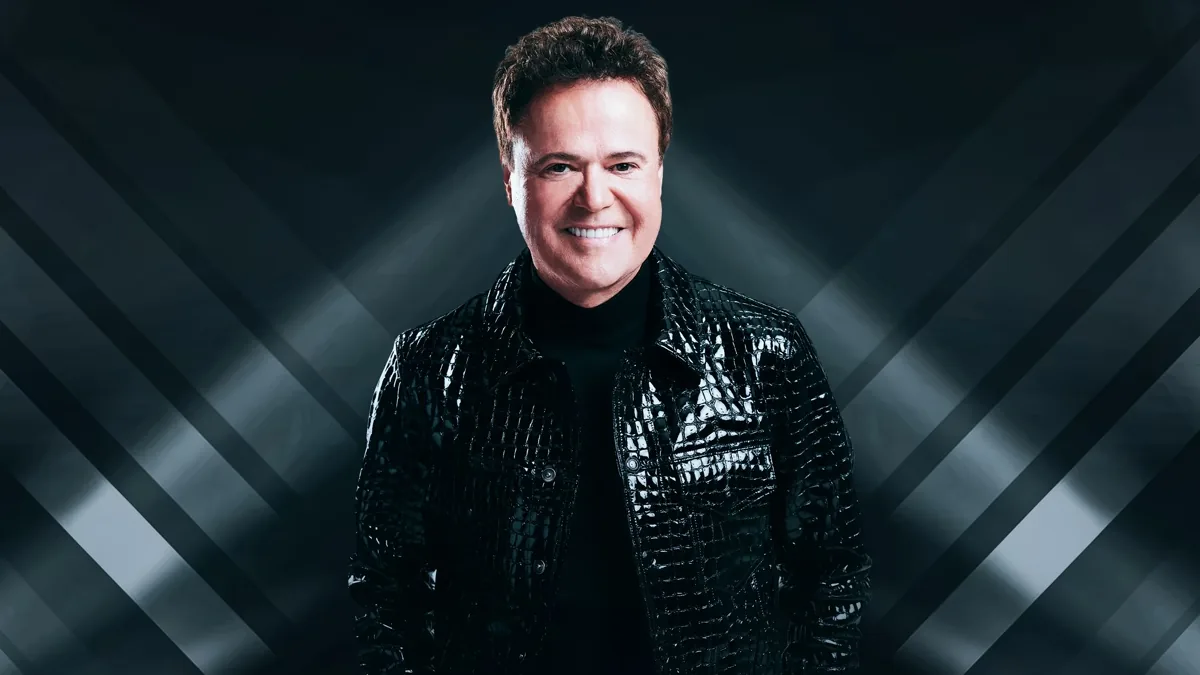
Listening back to this raw 2011 archival tape with Donny Osmond feels like cracking open a time capsule. Here he is, deep into the surprise success of his Las Vegas residency with Marie, yet still hungry, still strategizing his next move. The voice on the line from Utah is relaxed but surgically precise. He’s a man who has lived several lifetimes in show business and forgotten none of the lessons.
At the time, the Donny & Marie show at the Flamingo was a phenomenon. What started as a planned six-week run had exploded into a multi-year behemoth. “We thought how are we gonna fill seats for six weeks,” he says on the tape, the disbelief still audible. “And here we are going on our fourth year.” But this interview wasn't about Vegas. It was about him hitting the road solo for the first time since 2007, a prospect that clearly energized him.
He was prepping a tour that, even by today’s standards, sounds ambitious and borderline insane. An interactive, request-driven show. He laid out the concept with the confidence of a master showman who also happens to be a tech geek. “The audience is gonna dictate what the show is,” he explains. “If somebody wants to see, say, the Weird Al Yankovic video, the ‘White & Nerdy’ video. Boom. It's right there behind me on the screen immediately.”
It’s a high-wire act. A flex. It’s also a direct challenge to the pre-packaged, playback-heavy concerts that were becoming the industry standard. Osmond was betting on his own catalogue and his crew’s flawless execution. “I'm the technical geek behind it, to be honest with you,” he admits. This isn't just a performer; this is a producer with absolute narrative control over his own legacy.
But you can’t talk about Donny Osmond’s legacy without talking about the image. The squeaky-clean, purple-socked teen idol persona that was both his golden ticket and his creative prison for decades. He confesses that the jokes and the typecasting used to get under his skin. It wasn't until a fateful encounter in the early nineties that his perspective completely shifted.
He had just clawed his way back onto the charts with “Soldier of Love” and was actively running from his past. During a show in New Jersey, he refused to play “Puppy Love” until the audience demanded it. He finally gave in, but mockingly. “I made fun of it. And I just, you know, ruined it,” he recounts.
After the show, a woman confronted him at the stage door. Her words stopped him cold. She said, “Yes, you had a hit with it, but it was a big part of my childhood memories and you have no right to mess with my memories.” It was a revelation. A gut punch of truth. “It just stopped me in my tracks because I realized right there. She was right,” he says. That moment reshaped his entire understanding of his career.
He learned that an artist doesn't fully own their hits. The audience does. They become the soundtrack to first loves, high school dances and innocent times. To disrespect the song is to disrespect their memories. It’s a profound lesson in artistic stewardship that many of his peers never grasp.
Yes, you had a hit with it, but it was a big part of my childhood memories and you have no right to mess with my memories.
From that point on, he embraced it all. The good, the bad and the schmaltzy. “I sing it with respect,” he says of the song now, “because it was a great time of my childhood and it really changed my whole paradigm about my image.” It’s a healthy, earned perspective.
This insight made his comments on the teen idol du jour of 2011, Justin Bieber, particularly sharp. He saw the storm on the horizon for the young Canadian superstar. “I know Justin Bieber's gonna go through it,” he says with the certainty of a man who has the scars to prove it. “So many teeny bopper idols have gone through it.”
His advice was simple and bleak. “Hang in there. You know, just it's gonna happen. You can't have enough without a down.” He knew the showbiz machinery was designed to build them up and then discard them. Survival is the exception not the rule. Osmond is the ultimate exception.
His career is a masterclass in the art of the pivot. When his pop career stalled post-seventies, he didn't just fade away. After a devastating Broadway flop in 1982, he spent nearly a decade in the wilderness, rebuilding. He collaborated with figures like Peter Gabriel and Jeff Beck to craft a new sound, culminating in the 1989 comeback hit “Soldier of Love.”
It was a moment of supreme vindication, especially against industry gatekeepers like promotions man Ben Scottie, who had once dismissed him. “He told me, ‘You're a teeny bopper. You always will be. You're a has been. Find another line of work’,” Donny recalls. Years later, after the song hit number one, they ran into each other at a convention. Scottie grabbed him and admitted, “You proved me wrong.”
And just as his recording career was white-hot again, he made another shocking left turn. He accepted the lead role in a Toronto production of *Joseph and the Amazing Technicolor Dreamcoat*. “Everybody thinks you're crazy,” he says of the decision. But he knew what he was doing. Theatre was the ultimate credibility play. It proved his talent was real, not some studio-concocted fad.
A six-month contract turned into a six-year, 2,000-performance run. It cemented his status as a true entertainer, not just a former pop star. It was a calculated risk that paid off, redeeming his earlier Broadway failure and setting the stage for everything that followed, from talk shows to game shows to his win on *Dancing with the Stars*.
That win, he notes, was one of the hardest-fought victories of his life, achieved with a broken toe and a broken rib. He keeps the trophy in a glass case at the Flamingo, joking it's to keep Marie from stealing it. The friendly sibling rivalry that defined their careers is still very much alive.
Through all the reinventions, the one constant has been family. He’s candid about the hard times, including losing everything financially in the early eighties. But he credits his parents for holding the family together. “They were the real deal,” he says simply. It’s that foundation that allowed him to weather storms that have shipwrecked countless others.
As the interview winds down, he shares a story that perfectly encapsulates the absurdity and grind of live theatre. During his long run in *Joseph* in Chicago, a friend brought him a chocolate eclair before a show. He resisted until the final moments, thinking he had time before his last cue.
He didn't. “I jammed the entire thing in my mouth thinking I can get this thing down,” he says, the memory still vivid. As he was hooked into a harness to fly over the crowd for the finale, he realized his mistake. “I start flying over the audience and here comes my vocal cue and I spray chocolate eclair all over the audience.”
It’s a hilarious, humbling and deeply human moment. A reminder that behind the consummate professional and the fifty-year veteran of stage and screen, there's a guy who can still make a gloriously messy mistake. Looking back, this 2011 conversation captured Donny Osmond at a critical juncture: no longer running from his past, but leveraging every part of it to build an unshakeable future.
519 Magazine Archive: We are thrilled to officially unearth the Rockstar Weekly Digital Vault. This isn't just a re-post; it's a high-fidelity restoration of a pivotal era in music journalism. By pairing original print dates with modern retrospectives, we’re bridging the gap between historical rock-and-roll grit and the lightning-fast performance of today’s web. These stories—once locked in physical print and lost URLs—are now back, fully searchable, and optimized for a new generation of fans.
Get Tickets

We are thrilled to officially unearth the 519 Magazine Digital Vault. This isn't just a re-post; it's a high-fidelity restoration of a pivotal era in music journalism. By pairing original print dates with modern retrospectives, we're bridging the gap between historical rock-and-roll grit and the lightning-fast performance of today's web. These stories—once locked in physical print and lost URLs—are now back, fully searchable, and optimized for a new generation of fans.