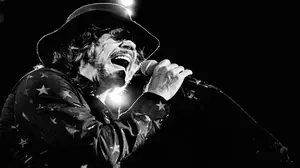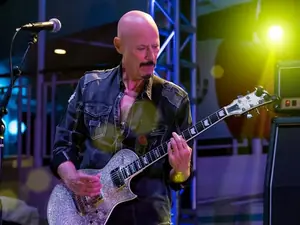


Looking at the raw transcripts from this conversation on Feb. 13, 2020, is an exercise in dramatic irony. Matthew Good was on the line to discuss Moving Walls, an album whose title would prove eerily prescient for a world just weeks away from a global lockdown. At the time it was just another record cycle. But in retrospect, this conversation captures a specific moment of artistic recalibration for Good right before the industry and life itself was forced to do the same.
Moving Walls was a stark departure from the arena-ready alt-rock that defined his early career. It was moody, atmospheric, and deeply introspective. When asked if there was a specific theme, he is characteristically blunt. Not really. But his explanation reveals more than the initial dismissal. He compares the process to the grand concept albums of Pink Floyd, not in ambition but in function.
He says art is simply “a filter for something that in their life, whether intellectually or emotionally, is something that is consuming them.” He believes most albums with a clear through line are just “a product of that reality.” For Good in early 2020, that reality was one of quiet contemplation and acoustic textures, a sound that felt earned rather than forced.
Nowhere is this more apparent than on the track “Selling You My Heart.” It’s a devastating piece of music. Good explains its inspiration with a raw metaphor. It’s like “being drunk and then you wake up the next morning you’re next to some stranger and you kinda stand up. And it’s like this reflection of kind of like your life in a bottle.” He’s quick to clarify it’s not a literal commentary on his career but something far more personal. It’s the quiet moment of reckoning in front of a mirror, seeing the full weight of your choices reflected back.
Of course, no conversation with Matthew Good is complete without touching on his legendary and often brutal honesty. This has been his brand since day one. He’s been remarkably open about his mental health journey, and he quickly corrects the interviewer’s reference to anxiety. “I don’t really suffer from an anxiety disorder. I have bipolarity,” he clarifies. “I have type two bipolarity.”
There was no hesitation in making his diagnosis public. It was never a source of shame. “I was diagnosed in 2007. I was in a psych ward, and three months later I was on George’s show talking about it,” he recalls, referring to his appearance on George Stroumboulopoulos’s program. “I don’t think it’s something that’s embarrassing or anything at all. It’s like diabetes.” That single sentence cuts through decades of stigma with surgical precision. For Good, it’s a simple biological fact: “I have neurotransmitters that misfire at the nucleic level in my brain. I was born that way.”
This intrinsic sense of self fuels his entire artistic philosophy. Honesty isn’t a goal, it’s a default setting. “I think you’re just... that’s what you... if, as a person, if that’s what you are, that’s what you are,” he states. He has no patience for the strategic self-censorship that plagues the music industry. His logic is unassailable.
I was diagnosed in 2007. I was in a psych ward, and and three months later, I was on George's show talking about it. I don't think it's something that's embarrassing or anything at all. It's to love diabetes.
“We all live a very finite time on this planet, and then we’re gone,” he says. “So it seems to me that just not being yourself is a waste of time. It’s a huge waste of time.” It’s a worldview that prioritizes authentic expression over careerist maneuvering. He’d rather live with the regret of saying the wrong thing than the regret of never saying anything at all.
This commitment to his art has come at a physical cost. He discusses collapsing on stage a few years prior, an incident that was far more serious than simple exhaustion. “I had pneumonia, and I suffer from a disease, a chronic illness, called sarcoidosis,” he reveals. “It’s a lymphatic disorder… Our immune systems are compromised.” The collapse, which he says was followed by a seizure, was a brutal reminder of the body’s limits. Yet he still finished the tour.
The shift to a more acoustic sound on Moving Walls wasn’t just a whim but a conscious evolution tied to his age and artistic restlessness. And he isn’t shy about naming names to make his point. “I’ll watch someone like Dave Grohl still doing the same f***ing thing, and I’ll just be like, ‘I’m f***ing almost 50. I’m way... I’m just... I’m beyond that. I don’t wanna do that.’”
It’s a sharp critique but it’s aimed inward as much as outward. He admits to being pulled back into his rock wheelhouse in the past. He saw 2011’s Lights of an Ancient Species as his true path forward but then course-corrected with the “pure rock and roll” of Arrows of Desire. He calls Chaotic Neutral “very split” and dismisses Something Like a Storm as a record he “had to make,” writing it quickly to fulfill an obligation.
But Moving Walls was different. “This was just, you know, a very, you know, calculated decision to go, ‘This is exactly what I’m doing,’” he insists. “And I think, given where I am in my life, this is, you know, this is the tone I wanna set.” It was a declaration of artistic independence from both fan expectation and his own history.
That history includes 1995’s iconic Last of the Ghetto Astronauts, an album that launched the Matthew Good Band into the Canadian rock stratosphere. But fans hoping for an anniversary nod on the 2020 tour were out of luck. When asked if he’d play songs from it, his answer is a swift “Oh no. No.” He has no nostalgia for it. “It’s not... it’s not... it’s not a record I particularly like.”
It’s a statement that perfectly encapsulates the artist’s paradox. He is fiercely dedicated to his muse but seemingly indifferent to the monuments he’s built along the way. He’s an artist moving forward, leaving his own history in the rearview mirror, even if his audience is still trying to read the historical markers.
The grind of the road has blurred the specifics. Asked for memories of playing cities like London, Kitchener, and Sarnia, he draws a blank. “The memories that always stick out are the ones from the way back in the old days when you’re touring across the country in a van.” It’s the familiar story of an artist for whom the early struggle holds more romance than the professional routine that follows.
So what keeps him going through the health scares, the industry pressures, and the creative wrestling matches? His answer is the most honest thing he says in the entire 18-minute interview. It’s not about fame or money or even the fans. It’s simpler than that.
“I’m an artist. It’s what I do,” he says. “It’s what I’m compelled to do. So it’s not really something I chose to do… It’s just what I am.” It’s a compulsion, a fundamental part of his being. He makes music because he has to. It is the only real explanation required.
519 Magazine Archive: We are thrilled to officially unearth the 519 Magazine Digital Vault. This isn't just a re-post; it's a high-fidelity restoration of a pivotal era in music journalism. By pairing original print dates with modern retrospectives, we’re bridging the gap between historical rock-and-roll grit and the lightning-fast performance of today’s web. These stories—once locked in physical print and lost URLs—are now back, fully searchable, and optimized for a new generation of fans.
We are thrilled to officially unearth the 519 Magazine Digital Vault. This isn't just a re-post; it's a high-fidelity restoration of a pivotal era in music journalism. By pairing original print dates with modern retrospectives, we're bridging the gap between historical rock-and-roll grit and the lightning-fast performance of today's web. These stories—once locked in physical print and lost URLs—are now back, fully searchable, and optimized for a new generation of fans.