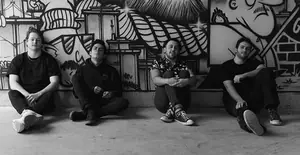

Montreal has always been a city of sonic contradictions, a place where indie-sleaze and high-art experimentalism often crowd out the raw, unadulterated power of a Marshall stack. But Yester Daze does not care about your art-house sensibilities. This trio is hunting for something much larger—specifically, the kind of rafters-shaking energy that usually requires a pyrotechnics budget and a sold-out Bell Centre.
The band recently dropped their debut EP, *Yours To Follow*, and it is a loud, unapologetic statement of intent. Formed in 2018, the group has spent the last few years fine-tuning a brand of stadium rock that feels both vintage and vital. It is a sound built on the backs of singer Brandon McShad, Zach Lemay on bass and Matt Ware on drums. Together, they have cooked up a record that balances heavy-hitting crunch with the kind of hooks that stay stuck in your head long after the ringing in your ears fades.
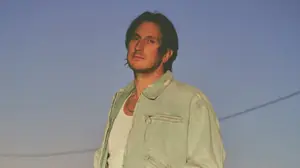
I caught up with McShad over a Zoom call recently. He sat in front of a wall plastered with the ghosts of rock history—posters and memorabilia that suggest his musical education started long before he picked up a pair of drumsticks. We talked about the transition from a solo project to a democratic unit and why Montreal needs a dose of high-octane rock and roll right now.
The origin story of Yester Daze is a classic tale of a solo artist realizing that rock is rarely a lonely business. McShad started with a vision, but he quickly found that the weight of a full band was necessary to carry the melodies he was hearing in his head.
"It starts actually with me being a solo artist," McShad says. "At the time, I just left another band, where I was the drummer. I always had this vision of recording an EP, just completely by myself, but I needed a band to play with live. So I called Zach my bassist, just because I’ve known him since high school and I’m used to jamming together. I was like, 'Hey, do you want to do a couple of shows with me?' And he was like, 'Yeah, sure. I’m all for that.' But we didn’t have a drummer. And so that’s when Matt came in. I never actually knew Matt, but we all went to the same school. So Zach brought him in. He’s just perfect and he has the same influences as us. And he’s just an insane drummer. We did that for a bit."
But playing live was only half the battle. There is a specific kind of stigma attached to solo acts in the rock world—a sense that it is a performance rather than a collective force. McShad felt that friction early on.
"I was a solo act with a backing band," he explains. "But one of the main reasons I would say that I opted for the band thing was because no one was really taking us seriously. A lot of people took me as whoever it was, it was named after me, I get it. But I was very much an advocate for Prince who had The Revolution, and you knew the members too. Then you had Bowie with all his musicians, over time that everyone knew. I was trying to do the same thing. I would always describe us as a band, but obviously was just under my name, because we already had music out. So we didn’t feel like rebranding."
And yet, the rebranding became inevitable. When the creative process shifts from one person’s dictate to a three-way conversation, the name on the marquee has to change to reflect the new DNA of the music.
"Long story short, we ended up rebranding because we started writing together as a band more, and I felt bad putting it on my name," McShad notes. "I was just tired of having all the attention just on me. I just messaged the guys one night asking if we wanted to jump ship and become a band. Everyone was for it. The longest process was finding a name that didn’t suck. So that’s where we ended up with Yester Daze. And even that, it was a name that took a while to sink in because we just shortened another name we had."
The result of that cohesion is *Yours To Follow*, which arrived in Feb. 2021. It is a four-song sampler that refuses to stay in one lane. Many bands use their debut to establish a singular "vibe," but Yester Daze decided to showcase their range instead. It is a risky move—throwing everything at the wall can sometimes result in a mess—but here, it feels like a curated gallery of what they are capable of.
"Yeah, that’s exactly why we opted for four songs actually because we didn’t want to repeat what we did," says McShad. "We really wanted to choose the four different corners of what we can do, and put it out and wanted to give a sample to people and say, 'Hey, this is what we can do, this is what we do and this is where we can go, in any of these directions.' We like dipped our toes in different things. And at least then in the future, it’s like, we did this once, and if we want to go a bit deeper into that, and maybe switch it around a bit, we can still do that too versus a solid punk or a really rock sound for the first EP and then the next EP is this. We just put all our fruits in a bowl and then just mixed it and then here you go. I like saying, we threw stuff at the wall and saw what sticks. So that’s basically how we write as a band."
It’s a call to everyone “Hey, we’re yours”. We belong to the people, we’re not one of those bands, who is separated by us and the fans.
There is a distinct "old soul" quality to the record. While the production is crisp and modern, there are echoes of the 1970s and 1990s floating in the mix. It is a byproduct of a band that grew up on the classics but lives in the digital present.
"I think it’s just because we all have vastly different influences to a degree as well," McShad says, gesturing to the posters behind him. "We all have the similar ones as well, but I grew up listening to a lot of them, as you can see for my wall, I have like a bunch of old school bands on my wall. That’s what I grew up listening to. Zach is very modern and so is Matt. They’re both actually really into metal. I grew up liking metal as well. When I became a musician, I started on drums and was super into Slipknot and Metallica. I grew afterwards, once I started expanding genres. So I guess no matter what, it’s always inside me, there’s always gonna be pop melody and it’s always in my head. So that’s probably why our songs will sound modern, like instrumentally and have that feel, but then I naturally just always write songs that are reminiscent of people I’ve grown up listening to. It’s hard for me not to do it. I can hear a Beatles harmony here, and I can hear a falsetto like Prince or something there, so it’s very, very hard for me not to throw in that spice that I have to offer."
Even the title, *Yours To Follow*, carries a weight that suggests a connection to the audience that goes beyond mere consumption. It was a title born of necessity and aesthetic choice, avoiding the clichés of the pandemic era.
"We didn’t know what we wanted to call it, so we got artwork from a really good artist and he just had a title already there," McShad explains. "He was willing to switch it for us, and we didn’t know what we wanted to put. We didn’t want anything super cheesy or 'Everything is Going to be Okay' or something like that, to really tip off with the whole COVID and quarantine. We really wanted it to still feel like it fits, but it doesn’t define that it as clearly that time. 'Yours To Follow' is a line taken directly from the opening track. In the bridge there’s a part where I say 'Don’t look back we’re yours to follow', which is a thing I always liked when you're being at odds with the past, but trying to lead the future. So that’s exactly it. So, dialing back readers to follow. It’s a call to everyone 'Hey, we’re yours'. We belong to the people, we’re not one of those bands, who is separated by us and the fans."
The opening track, "Light It Up," serves as the mission statement. It is a high-energy burst that sounds like it was written for a festival stage, even if it was born in a cramped rehearsal space during a moment of frustration.
" 'Light It Up' was a happy accident," McShad says. "I was really into My Chemical Romance at the time—I still am. But at the time, I was really hoping to have an opener because I always envision how our songs will sound live. I can always dream that we’re playing stadiums or festivals—I know that’s not really happening anytime soon, but I always envisioned what it would it sound like. I always wanted a song that had that same vibe. I just started humming it as a joke, then I was like, 'Wait, it’s got something.' I went to my room did a quick demo and the next day I had practice with the guys. It was a really bad practice and we weren’t getting anything done. We just didn’t feel motivated. So I was like, 'Screw it, I’m gonna pull this one out and be like, let’s see what we could do with that.' It’s just one of the songs, it’s very straightforward and don’t overthink it—it works. It’s meant to be a really solid opener and get everyone’s attention, but still egg them on and make them want to hear more. So, it leaves them satisfied, but still wanting more."
Lyrically, the song plays with surrealism and the weight of history, but McShad is careful not to pin down a single meaning. He wants the listener to find their own ghosts in the music.
"I just like writing songs that have lyrics that you can interpret in multiple ways," he continues. "So at the same time, the song does talk about looking back on the past and how people from the past are still trying to stay relevant today. At the same time, the bridge, 'Are We Alive? or Are we Dead', we tend to talk a lot about surrealism in our lyrics. I always write lyrics that I love to leave it to people to interpret it for themselves. So if they’re going through their own experiences, they could still hear it and be like, 'I relate to this.' They don’t hear it and assume it’s an anti-police song or something like that. That’s not why I wrote it. I just wrote it and then realized with everything happening around, I’m like, 'Oh, this can apply to that, too.' "
Then there is "Backseat Bingo," a track that leans heavily into the band’s glam rock tendencies. It is the kind of song that feels like it belongs in a smoke-filled club in 1974, even though the riff came to McShad while he was hopping off a bus.
"That one’s very simple," he says. "Same thing, I was on my way home from work at the time. I didn’t have my license yet. I got off the bus and I just started humming a riff as a joke, which was the opening riff. And I was like, 'I’ll record it for fun.' When I got home and played it, I was like, 'There’s something to it.' Up until the chorus I had all of it planned. Then I found the vibe felt very vintage rock and roll. The idea was just to get out a straightforward rock and roll song."
The title itself is a deep cut of mid-century slang, perfectly fitting the swaggering, hyper-confident persona McShad adopts for the vocal performance.
"I’m a huge fan of the 50s and 60s, so I was looking for slang that would work with what I wanted to go for," McShad reveals. "I found Backseat Bingo in a dictionary of 50s and 60s slang, which is just literally defined as sex. I wrote a whole song essentially about sex. And it’s me in a character pretending to be on top, like, I’m King Shit, but I’m really not like that. Anyone who knows me knows I’m super humble. I don’t have confidence like that. But it was very much meant to be that glam rock vibe at the same time. So I wrote a song in that kind of character. And it works. It’s currently our biggest song. Everyone likes it, which we all kind of saw coming. You can kind of hear songs like this and know right away that this is the one that’s going to catch people’s attention. And if it’s not your cup of tea genre wise, you won’t turn off the radio if it comes on."
If "Backseat Bingo" is the swagger, "Otherside" is the groove. It is a track where the bass takes the lead, creating a dark, rhythmic atmosphere that feels like a departure from the stadium-sized choruses of the earlier tracks.
" 'Otherside' was an accident," McShad says. "Zach had gotten a new pedal and he just started riffing around and making weird sounds on his bass and then he started playing that opening riff. But he didn’t mean to play it, it was an idea that he had learned and started playing on. I literally just turned, I was like, 'Wait, no, no, no, stop, do that. Do that again.' And he’s like, 'What?' Like, whatever you did that riff you were playing and he started playing it. I point to Matt and tell him to come in with a sick kinda groove to start building it. So the song is really just the bass is carrying the song. I’m just there and I’m not doing anything crazy. I’m just playing a root note here and there. Whereas the bass is doing these crazy riffs and these crazy kind of grooves, and it’s really carrying the song and giving it that rhythm. The song was just an accident. It wasn’t meant to be."
The spontaneity of the track reminds McShad of some of the most famous moments in rock history, where a simple warm-up exercise turned into a career-defining hit.
"I always compare the story to 'Sweet Child o' Mine' and how Slash was just messing around playing warm up and Axl was like, 'No, that’s sick, I like it,' and then they just kind of went with it," he says. "So it’s the exact same thing. And then lyrically, it’s very similar to 'Light It Up' where at that point, I was just writing and trying to experiment with writing outside my comfort zone. It goes back to that surrealism that nothing feels like it should be anymore and then there’s very edgy lyrics in the pre-chorus, 'I need a doctor, some medication.' "
The EP closes with "Beautiful Day," a track that wears its Britpop influences on its sleeve. It is a sunny, optimistic anthem that serves as the perfect counterpoint to the grit of the previous three songs.
"That was the last song I wrote before we became Yester Daze," McShad recalls. "I wrote it while we were still under my name. I took a shot and brought it to the guys with an idea I had. I knew exactly how the song was gonna go. So that song we didn’t have to touch it at all. I’m super into Oasis right now. I want to write that kind of 90s British pop, so we did exactly that. Without being a song, it was really like, 'Okay, we get it, you like Oasis.' When I wrote the song, I was just like, 'Oh, what would Liam Gallagher write? Or what would Liam Gallagher say? Or how would he sing it?' So I like to do that, to whatever I’m listening to at the time. I like to challenge myself as a writer to see if I could do something like that. And if I could do it in my way. It’s like, I’m wearing my influence on my shoulder."
It is a bold way to end a debut—leaning into a specific influence so heavily—but it works because the band’s enthusiasm is infectious. It is a reminder that rock and roll does not always have to be brooding or complex. Sometimes, it just needs to be a "Beautiful Day."
"Lyrically, it’s meant to be super positive and how, no matter how bad your day gets, everything’s gonna be okay, which is a common theme in Oasis’s songs," McShad concludes. "It was very much meant to be like that. It’s a very, very simple, straightforward pop song. But it works really well with the EP, which is pretty crazy, because you got scream on the first half, and then you got that ending it."