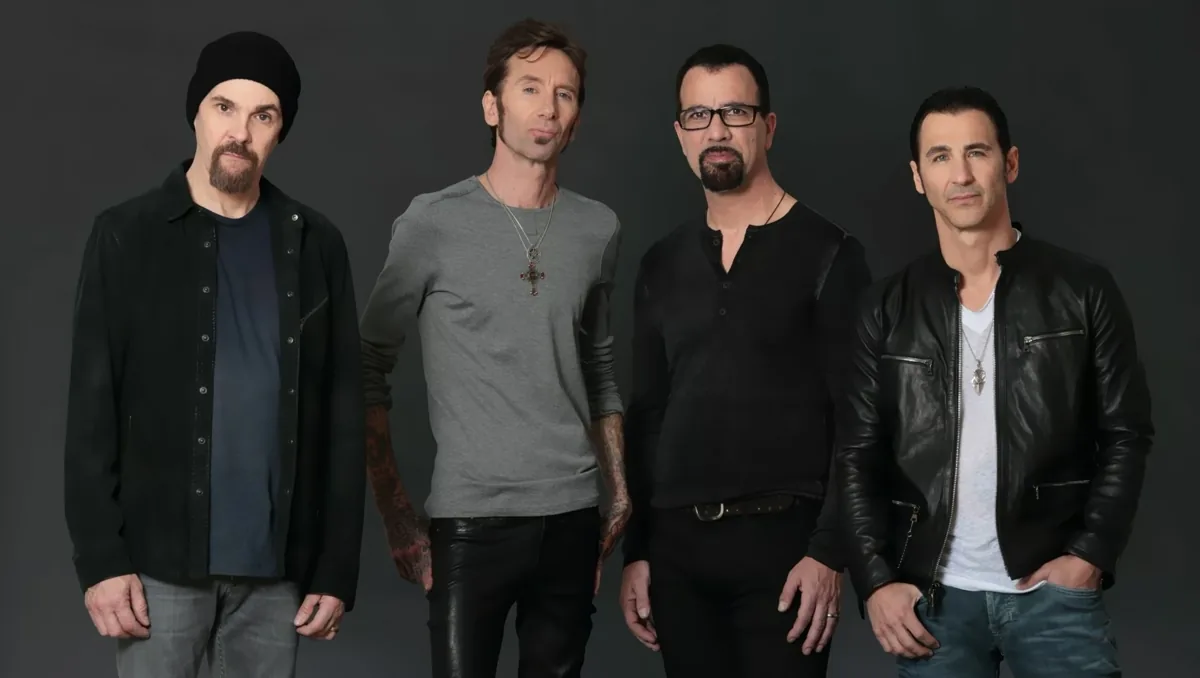

Looking at the raw transcripts from this Mar. 22, 2019 conversation with Godsmack’s Shannon Larkin is to see a band at a genuine crossroads. They were deep into a European tour supporting When Legends Rise, an album that represented the most significant sonic pivot of their career. And Larkin, ever the candid journeyman, was ready to unpack the brutal calculus of aging in a genre that fetishizes youth and rage. He was in Hamburg, Germany, a rare sunny day on a dreary run, and the mood was reflective. This wasn't just another phoner. It was a mission statement.
The band was staring down the barrel of a new era. But to understand their future, Larkin first had to excavate the past. He immediately dives into the unglamorous realities of the industry machine—a world of compromises and political manoeuvres. No story illustrates this better than a scarring experience in Los Angeles. A radio festival demanded the band close the show to get their new single played. The catch? They had to follow the Foo Fighters.
Larkin’s retelling is a masterclass in industry realism. “That meant going on after Foo Fighters which if you know anything about the LA concert scene well that's called the cleanup act,” he says. The pressure was immense. Management and the label pushed hard. The promise of radio play was the carrot. But Godsmack knew the score. “Of course we said hell no because everyone knows that there's certain bands you just can't go on after like Chili Peppers or Foo Fighters and Metallica.”
They relented. And the result was exactly what they predicted. A nightmare. “It was fucking uncomfortable. And like you know half Foo Fighters fans in LA are they were leaving walking out as we're playing. And so that is the only show that I've ever felt uncomfortable doing in Godsmack world,” he admits. It’s a raw confession about the power dynamics between artists, radio, and labels, a reminder that even for a multi-platinum band the game is often rigged.
This friction between authentic performance and industry demands is a recurring theme. Larkin contrasts the jaded major-market American crowds with the palpable energy they find in Canada and smaller European cities. He argues that audiences in places like Malmö, Sweden, or the Canadian prairies aren't oversaturated. They aren't spoiled for choice. The appreciation feels different, more visceral.
“When you play in the major cities in America I mean they get literally you know probably five great shows a week in like Los Angeles or New York, so when you come through, it's not really anything that's super special,” he explains. “But in Canada man it just every show just feels like super special, and people seem super appreciative of us.” He astutely points to the internet’s role in demystifying the concert experience, killing the spontaneity when fans can watch the entire show online before it even hits their city.
Sixteen years in Godsmack at that point, the drummer insists the time has flown by. The band’s rigid four-year album cycle—three years of writing, recording, and touring followed by one year off—creates a time-distorting whirlwind. That year off, however, is the secret ingredient to their survival. It’s not about relaxation. It’s about creative sanitation. For Larkin and guitarist Tony Rombola, that means retreating to their side project The Apocalypse Blues Revue.
This isn't a vanity project. It’s a necessity. It’s a way to reconnect with the pure joy of being a bar musician free from the corporate weight of the Godsmack machine. “It lets us kind of become, you know, normal bar musicians again to where we're just doing something that's pure,” Larkin says. “It takes away that business aspect and reminds one of who you are, your roots, how you came up, why you started playing your instrument or singing in the very first place.”
When people say, oh, you know, what's your proudest accomplishment in Godsmack or whatever? To me, it's one word, longevity.
And that leads to the central thesis of the entire conversation: longevity. When asked about his proudest accomplishment, Larkin is unequivocal. It’s not the gold records, the number one hits, or the industry awards. “To me it's one word: longevity,” he states firmly. “All that we appreciate but the main badge of pride that we wear is the fact that we can sit there and say that we've been a successful band putting out records since 1998.” This endurance he credits entirely to the band’s discipline in taking time apart to pursue other creative avenues.
That hard-won perspective is what set the stage for When Legends Rise. The album’s slicker, more melodic hard rock sound was no accident. It was a conscious decision driven by a biological reality. The entire band had crossed the 50-year-old threshold. Frontman Sully Erna, who had been pushing for a new direction for years, finally insisted it was time for a change—a maturation.
The solution was to do something Godsmack had never done: work with outside writers. For a band that prided itself on its self-contained creative process, this was a seismic shift. Larkin is brutally honest about the initial reaction. “It was kind of a, you know, a little kick in the balls there, you know, that knowing our guy wanted to go and write with other dudes. That's almost like a jealousy thing,” he confesses. But ego had to be checked at the door. They trusted Erna’s vision.
Erna went to work with producer Erik Ron and others, returning with “Bulletproof.” The band was floored. It was still Godsmack but it was bigger, broader, and built for modern rock radio. The gamble paid off. The anger that fueled their early work had dissipated, replaced by the stability of family mortgages and a successful career. Faking it was not an option.
“The last thing I wanna do is stand on the stage at fifty, fifty-one years old and pretend like I'm 30 and I'm still angry and pissed off at the world when I'm not,” Larkin declares. “We didn't feel real screaming ‘I fucking hate you’ like we did on the Faceless record or whatever, now at the age of 50 when we don't hate you. We're really happy.”
This is the critical pivot. Godsmack chose to evolve rather than cosplay as their younger selves. It’s a move that legacy acts from Metallica to Aerosmith have all navigated with varying degrees of success. For Godsmack, it was about aligning their music with their reality. “People can say what they want about how we've changed the sound of the band or whatever. But in honesty, we're trying to be real with ourselves,” he says. If it meant alienating some old-school fans, so be it. The goal was to age gracefully.
The shift also had a very practical physical benefit. The less aggressive music was easier on the body. As a drummer who has played a physically demanding style for decades, Larkin felt the difference immediately. “When we got this new set of music I noticed that it doesn't beat my muscles and bones up as much playing a less aggressive style, but yet I can still express myself,” he explains. It’s a pragmatic admission that the human body has its limits even for a rock star.
This new approach also changed the dynamic of their live shows. The ferocious mosh pits of their early days began to be replaced by a sea of fists in the air. For Larkin, the change was profound. A mosh pit is chaos—an internal experience for the participants. But a crowd with its eyes fixed on the stage creates a unified connection between the artist and the audience.
“When I'm looking out there and I'm seeing a big mosh pit, I know all those people are getting off, and they're there for that reason—to release that energy. But they're not really watching the band,” he observes. “Now when we play big shows, and the mosh pit doesn't break out, but everybody's got their fist in the air, and I look out and all the eyes are on us, not just all the ears. It feels more like we are one with the crowd.”
Even the recording process in their New Hampshire studio felt different yet comfortable. With Erik Ron at the helm, they embraced new techniques and sounds. The moment they heard synthesizers on “Bulletproof” was their equivalent of Metallica hearing a proper bass guitar on The Black Album. It was a shock to the system, but one they quickly embraced as the path forward.
The interview concludes with a look at the relentless schedule ahead—a multi-year global campaign of touring, touring, and more touring. There was no illusion about the labour required to support a record and maintain their status. This conversation from 2019 captures a band fully aware of who they were, who they are, and who they needed to become. It’s a document of a band choosing evolution over extinction, authenticity over nostalgia.
519 Magazine Archive: We are thrilled to officially unearth the 519 Magazine Digital Vault. This isn't just a re-post; it's a high-fidelity restoration of a pivotal era in music journalism. By pairing original print dates with modern retrospectives, we’re bridging the gap between historical rock-and-roll grit and the lightning-fast performance of today’s web. These stories—once locked in physical print and lost URLs—are now back, fully searchable, and optimized for a new generation of fans.
Get Tickets








We are thrilled to officially unearth the 519 Magazine Digital Vault. This isn't just a re-post; it's a high-fidelity restoration of a pivotal era in music journalism. By pairing original print dates with modern retrospectives, we're bridging the gap between historical rock-and-roll grit and the lightning-fast performance of today's web. These stories—once locked in physical print and lost URLs—are now back, fully searchable, and optimized for a new generation of fans.