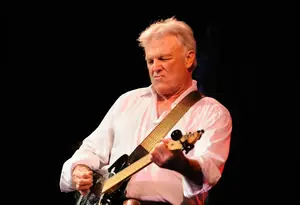


Listening back to these archival tapes from Apr. 1, 2010, is a trip. The digital hiss can’t mask the raw grit in Alan Frew’s voice. He had just returned from his second tour of Afghanistan, the dust of Kandahar barely settled. And Canada was still basking in the afterglow of the Vancouver Olympics, a national moment defined by a song he co-wrote. This wasn't the polished frontman of Glass Tiger on the line. This was a man juggling multiple, seemingly contradictory, identities: rock star patriot songwriter and budding motivational guru.
The conversation immediately turns to his military tours. It’s a subject he speaks on with an unguarded passion that cuts through the routine of a press interview. This was his eighth military tour overall, but the second to Afghanistan. He’s quick to correct any assumption that this was just a grip-and-grin concert series. Frew saw it as something more fundamental. It was about connection and a reminder that the home front hadn’t forgotten.
“It's a lot more than just singing to them,” Frew says, his voice earnest. “It's like interacting with them and bringing them a little touch of home to them and listening and just making sure that they know that Canada cares.”
But he goes deeper. At a time when public support for the mission was complex and often divided, Frew offered a clear, humanistic justification that sidestepped political rhetoric. He saw the mission through the lens of liberation not war. It was a perspective forged on the ground, talking to soldiers and civilians alike.
“I would try to impress upon Canadians that we didn't go there to fight a war,” he explains. “We went there to try and help liberate women and children, primarily women and children. And then those male adults stand up and say to the rest of the world, we just want some of the human decencies that the rest of you have.”
He recounts the visceral reality of the danger. Nothing drives the point home more than the waiver he had to sign. “When somebody gives you a contract to sign that says, ‘Now if you're killed when we go inside the wire, it's not our fault and there's no insurance,’ it sure drives it home that anything can happen,” he recalls. It’s a chilling detail, a stark reminder of the stakes for everyone there, performer or soldier.
Then the conversation pivots, almost jarringly, from the battlefields of Afghanistan to the podiums of the Vancouver 2010 Winter Olympics. Frew co-penned the anthem “I Believe” which became the inescapable soundtrack to Canada’s gold medal haul. The origin story is pure industry insider stuff, a perfect storm of connections and timing involving Keith Pelley, then head of the Olympic broadcast consortium, and composer Stephan Moccio.
Frew’s entrepreneurial brain, as he calls it, saw the opportunity. He had a connection to Pelley and had worked with Moccio on a song for John Candy. When he learned Moccio had a theme he dreamed of getting into the Olympics, the pieces clicked into place. “It's just that kind of universal power bringing all three of us together at the right time,” Frew muses.
We laugh, we call it kind of like Billy Connolly meets Wayne Dyer, where you can actually read a good old fun story from Scotland, meat and potatoes, or maybe there's about a sex and drugs and rock and roll aspect of the rock star guy.
He convinced Moccio to let him work with the instrumental theme, slowing it down on his piano. The result was “I Believe”. The creative process itself, however, remains a mystery even to him. “The songwriting process is something that I can't even really answer you on,” he admits. “Where the words came from, it's where ‘Don't Forget Me (When I'm Gone)’ came from. I have no idea. Maybe Leonard Cohen has an answer. I don't know.”
While he was happy with the final recorded versions by Nikki Yanofsky and Annie Villeneuve, he notes his own interpretation would have been different. “If I sing it, I sing it quite differently,” he says, hinting at other possibilities for the song. “Maybe if I was recording it tomorrow, I would record it more with, I don't know, maybe more of an upbeat groove or something.” This is the songwriter talking, always seeing the different angles of a composition.
The critique, if there is one, is that “I Believe” was perhaps too universal. It was a song engineered for a purpose, sanded down to fit a global broadcast. It lacked the specific rock and roll ache of a Glass Tiger classic. But that was its strength. It wasn't written just for the Olympics; it was a song about planetary struggle and triumph, a message that could resonate from a podium in Vancouver to a village in Afghanistan.
Of course, the inevitable Glass Tiger question comes up. In 2010, the band was already a legacy act, but Frew insists they were far from done. He mentions recent sold-out shows and new material in the works. But his analysis of the industry they now inhabited is what’s most fascinating. He doesn't rage against the machine. He sees the digital disruption as a force of nature.
“I look at the music industry the way we'd look at global warming,” he states, a truly brilliant and bleak analogy. “It's the people and the creatures that are caught in the middle of the change that always tend to suffer... it's a bit confusing for the ones caught right now in the middle of the change where we're switching from having all these venues to downloading.” Looking back, his foresight was sharp. He saw the pain points and the unstoppable shift long before many of his peers.
Beyond the music, Frew was carving out a third act as an author and motivational speaker. It’s a field littered with clichés, a fact he’s acutely aware of. He readily admits that much of the self-help industry is filled with “hypocrisy”. His approach, born from his own reading of Napoleon Hill and Tony Robbins, was to ground the theory in raw, real-life experience.
His book, he says, was a blend of storytelling and life lessons, a unique hybrid he cheekily describes as “Billy Connolly meets Wayne Dyer.” It’s a fantastic line, perfectly capturing the blend of Scottish grit rock and roll excess and genuine searching that defined his public persona. He wasn't just selling positive thinking; he was selling a story of survival and intention.
This belief in a “universal element” is the thread connecting all his ventures. He sees the convergence of people and events that led to “I Believe” as too powerful for coincidence. “The people who tend to believe in that kind of thing tend to be more successful at what they set out to do than those who do not,” he argues. It’s the core of his message, the engine behind his relentless drive.
As the tape winds down, Frew talks about the future: more music, another book, an acting role in the film The Gravy Train, and a potential one-man show. The man is a perpetual motion machine. This recording from over a decade ago doesn't capture a legacy artist resting on his laurels. It captures a creator in mid-flight, fully engaged with the world and utterly unapologetic about his diverse passions.
He was a rock star who could talk geopolitics, a songwriter who could write a national anthem, and a speaker who could dissect the architecture of belief. It’s a complex and compelling portrait. And it proves that Alan Frew was, and remains, far more interesting than just the guy who sang “Don’t Forget Me (When I’m Gone)”. He never let anyone forget him because he was already busy working on the next thing.
519 Magazine Archive: We are thrilled to officially unearth the Rockstar Weekly Digital Vault. This isn't just a re-post; it's a high-fidelity restoration of a pivotal era in music journalism. By pairing original print dates with modern retrospectives, we’re bridging the gap between historical rock-and-roll grit and the lightning-fast performance of today’s web. These stories—once locked in physical print and lost URLs—are now back, fully searchable, and optimized for a new generation of fans.
Get Tickets


We are thrilled to officially unearth the 519 Magazine Digital Vault. This isn't just a re-post; it's a high-fidelity restoration of a pivotal era in music journalism. By pairing original print dates with modern retrospectives, we're bridging the gap between historical rock-and-roll grit and the lightning-fast performance of today's web. These stories—once locked in physical print and lost URLs—are now back, fully searchable, and optimized for a new generation of fans.