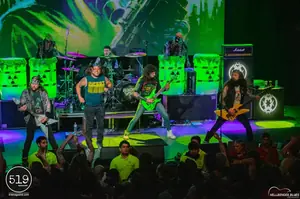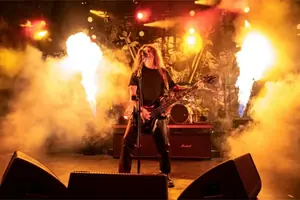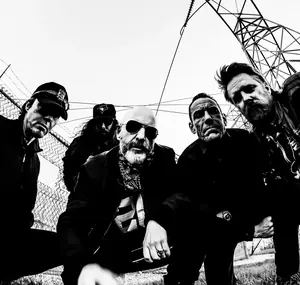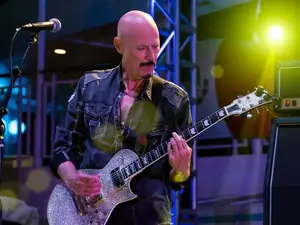

Listening back to these raw archival tapes from Sept. 11 2009 is a strange kind of time travel. Here is Trevor Strnad, frontman for The Black Dahlia Murder, just days away from unleashing Deflorate upon the world. He’s at home, comfortable in his pajama pants but in the middle of a press marathon, what he calls “spreading the gospel about the new album.” And there was a lot of gospel to spread. This wasn't just another album cycle. This was a moment of reckoning.
The band was coming off the monumental success of Nocturnal, a record that cemented their place at the apex of American melodic death metal. But they were also walking a high wire. Longtime guitarist John Kempainen was out and the virtuosic Ryan Knight was in. Lineup shuffles can kill momentum. For a band built on intricate twin-guitar harmonies and blistering speed, a change in that department was a seismic event. You can hear the chip on Strnad’s shoulder, a defiant energy simmering under his typically affable demeanor.
“We have some stuff to prove with this album,” he says, the words cutting through the faint tape hiss. “To some fans that may be skeptical about our changing guitar players, you know, to people that maybe just believe we can’t keep people interested for four albums.” He knew the stakes. He understood that in the hyper-critical world of extreme metal, a single misstep could be perceived as the beginning of the end. It was a prove-it moment, and they were staring it right in the face.
But the anxiety was clearly tempered with a powerful, almost giddy confidence. The source of that confidence was a fundamental shift in the band’s creative process. For the first time, the songwriting nucleus was expanding. Brian Eschbach, the band’s creative engine, was no longer labouring alone. This new configuration was breathing life into the machine.
Strnad sounds genuinely thrilled when he details the change. “Bart, our bass player, actually co-wrote two songs, which is his first contribution musically to the band, and he did a great job. And the new guy, Ryan, who we brought into the fold, also wrote the bulk of two songs.” This wasn’t just about delegating. It was about evolution. It was a validation of the new lineup before they had even played a single show together on the new album cycle.
This decentralization of songwriting, he explains, was a massive weight off Eschbach’s shoulders. “Everything has to go through Brian’s filter, you know, of quality because he’s been the creative force behind the band in the past, you know, almost solely.” The result, Strnad argued, was their most varied and professional album yet. Looking back, he was right. Knight’s neo-classical flair and fluid legato brought a new colour to their palette, a perfect counterpoint to Eschbach’s razor-sharp riffing.
The band’s methodology was maturing alongside its music. Strnad talks about a more “educated approach” to recording, building songs meticulously in Pro Tools from the ground up. This was a departure from the old days of jamming things out in a room, a process he admits was slow and often inefficient. Sending a member home “into the laboratory” was yielding better, more complex results. This professionalization was key to their consistency.
One of the most telling moments in this conversation comes when discussing the album’s production, specifically the drums. The late 2000s were the height of the over-produced, hyper-quantized drum sound. Everything was sample-replaced, triggered and compressed into a sterile, robotic punch. The Black Dahlia Murder consciously swam against that tide.
We have some stuff to prove with this album, you know, to some fans that may be skeptical about our our changing guitar players, you know, to people that maybe just believe we can’t keep people interested for four albums.
“I think the trend has been to make these drums that just sound so robotic and just use samples that just aren't believable,” Strnad critiques. “We wanted to kind of just take it back to the roots and just get, like, a really nice just live sound on the drums.” This desire for a more natural, energetic feel was a bold choice. It gave Shannon Lucas’s incredible performance room to breathe, retaining the human element in a genre increasingly obsessed with digital perfection.
The only valid critique one could levy in retrospect is that while they aimed for a more organic sound, the final product from producer Jason Suecof was still incredibly polished and tight. It wasn't exactly a raw, garage recording. But their intention was clear: to favour musicality over machine-like precision, a philosophy that undoubtedly contributed to the record’s lasting power.
This dedication to a specific vision extended to the band’s entire aesthetic, an area Strnad personally helmed. The album cover for Deflorate was a deliberate shock. After the deep blues and gothic horror of Nocturnal, the new art was a blast of lurid, bright colour, depicting a bizarre alien queen. It was a calculated risk designed to keep their audience off-balance.
“We really wanted to separate it from Nocturnal,” he explains, “and also, you know, just make a statement to our fans that, like, you don’t know everything that we’re gonna do yet. Even though it’s the fourth album, it’s still full of surprises.” He was the band’s creative director, the mind behind the lyrics, the themes and the all-important merch designs. It was this holistic approach that made The Black Dahlia Murder more than just a band; they were a complete and terrifyingly coherent brand.
Strnad possessed a sharp awareness of the band's place in the broader metal ecosystem. He knew they were often the first point of contact for kids dipping their toes into heavier music. He embraced this role as a shepherd into the extreme, a responsibility he took seriously. He saw the band as a conduit for the genre's core tenets.
“I realized that we’re, like, a gateway band to a lot of kids getting into more fast music and more extreme music,” he reflects. “We’ll be in a magazine next to Killswitch Engage or something, whereas we’re much more extreme and less acceptable than them. So a lot of the stuff we do and the choices we make... is just, in my mind, just a tried and true tribute to what I love so much about it in the first place.” Necrophilia, zombies, horror—it wasn't for shock value. It was about carrying a torch.
That torch was carried across the world, including through the brutal Canadian winters. Strnad speaks fondly of Canada, expressing a feeling that the band hadn't toured there enough. He recounts a harrowing but classic road warrior story from their last trip through Quebec.
“We flipped our trailer up there last time, actually,” he says with a casualness that belies the danger. “When we were leaving Quebec City, we hit some ice and the trailer, like, we started to spin. And the trailer snapped off from the van and, like, went into the median and rolled a few times.” Miraculously, no one was hurt. It was a testament to their resilience and their Michigan roots, which he credits for being “very, very well versed in snow and ice.”
The upcoming Canadian tour with Children of Bodom and Skeletonwitch was a chance to make good, to return at full strength. He sounds genuinely excited to bring the new five-piece lineup to a country he felt had a “really rich metal scene.” It was a market they valued, and they were ready to deliver.
Listening now, all these years later, his words are layered with a profound poignancy. He speaks of the band being older and wiser, of hitting a new peak, of having no signs of slowing down. He was right on all counts. Deflorate was a triumph that kicked off a new golden era for the band.
But what resonates most is the pure, unadulterated passion. Even on his eighth interview of the day, talking from home in his pajamas, Trevor Strnad’s love for death metal, for his band and for the entire culture is utterly infectious. He found his happiness in a “happy world of of metal,” a world of skulls, chains and gore lyrics. And he made that world a better, more vibrant place for everyone else.
The gospel he was spreading back in 2009 became scripture for a generation of metalheads. And it still rips.
519 Magazine Archive: We are thrilled to officially unearth the Rockstar Weekly Digital Vault. This isn't just a re-post; it's a high-fidelity restoration of a pivotal era in music journalism. By pairing original print dates with modern retrospectives, we’re bridging the gap between historical rock-and-roll grit and the lightning-fast performance of today’s web. These stories—once locked in physical print and lost URLs—are now back, fully searchable, and optimized for a new generation of fans.
We are thrilled to officially unearth the 519 Magazine Digital Vault. This isn't just a re-post; it's a high-fidelity restoration of a pivotal era in music journalism. By pairing original print dates with modern retrospectives, we're bridging the gap between historical rock-and-roll grit and the lightning-fast performance of today's web. These stories—once locked in physical print and lost URLs—are now back, fully searchable, and optimized for a new generation of fans.