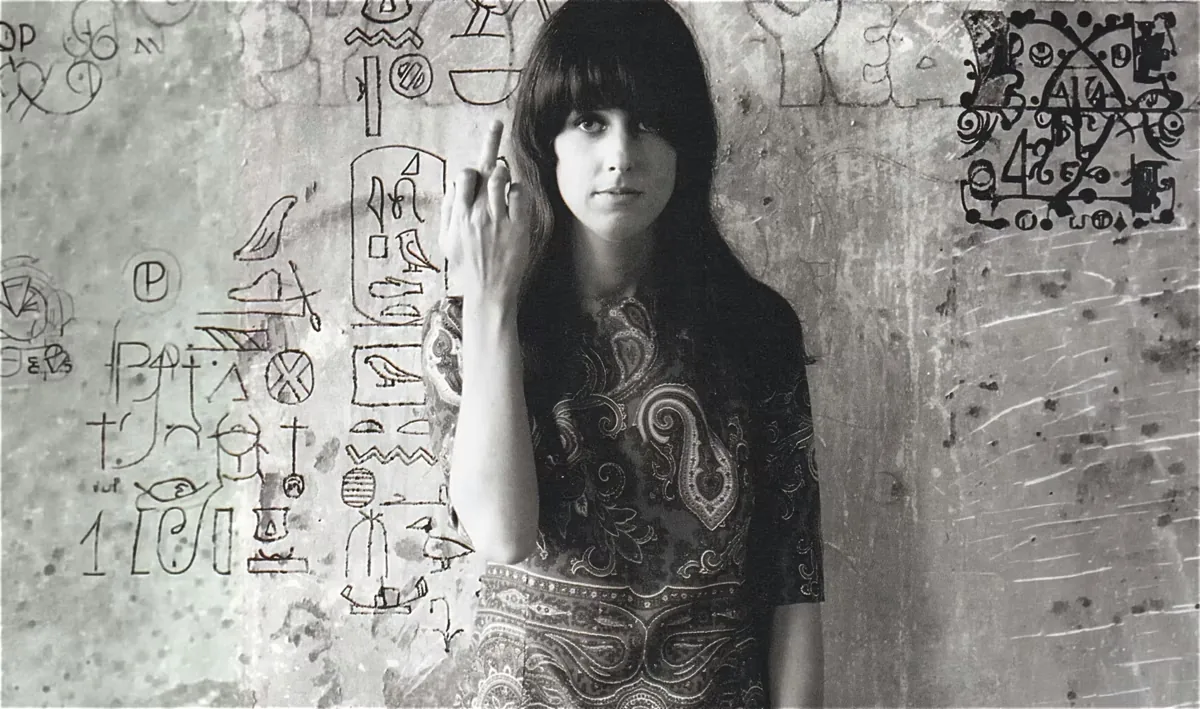

Looking back at these archival tapes from our 2010 interview with Grace Slick is a jolt. The call catches her at home in Malibu, nursing a freshly broken arm and a healthy dose of righteous indignation. Even with a spiral fracture and the creeping reality of being nearly 72, the voice crackling through the line is unmistakable. It’s the same incisive, take-no-prisoners instrument that sliced through the Summer of Love and defined a generation of psychedelic rock. But this isn't a nostalgia trip. This is Grace Slick, the painter and activist, proving that the fire never really goes out.
The interview opens with a bit of gallows humour about her injury. She’d tripped, slammed her arm into a metal fixture, and was now facing a slow healing process. “Your body is basically rotting,” she says with a deadpan delivery that’s both hilarious and brutally honest. But the physical confinement became a creative catalyst. Unable to hold a canvas, she turned back to her original weapon of choice: words. And she had a target.
The BP oil spill in the Gulf of Mexico was the flashpoint. This is where the old Slick, the political agitator, fully materializes. She saw the disaster as another symptom of a government with criminally misplaced priorities. “When I get pissed off about something, instead of going to a therapist and paying them to listen to me, I used to write whatever I'm pissed off about in lyrics and have people pay me to listen to me talk,” she explains. The result was “Edge of Madness” a charity song conceived to funnel money directly to the people of Louisiana.
Her analysis is a raw, unfiltered stream of consciousness. She connects the dots between the neglected Gulf Coast and the unending war in Afghanistan with blistering logic. “Instead of paying a bunch of soldiers to go try and conquer a country that has never been conquered... we ought to be bringing those guys home from Afghanistan, send them to Louisiana, and have them help do the cleanup.” It’s a classic Slick polemic, cutting through political rhetoric with a simple, powerful idea. The nuance might be debatable, but the conviction is absolute.
She laments what she sees as the dilution of protest culture since her heyday in the 1960s. Back then, the targets were clearer, the movements more focused. Now, in 2010, she sees a world overwhelmed by information and inaction. “Now it's just a stunning mess,” she states, dismissing the nascent power of social media as just “twittering” and “yapping.” For a woman who stood on stage at Woodstock, the digital picket line felt toothless, a poor substitute for tangible action.
This frustration extends to her view of the Obama administration. It's a fascinating snapshot of that era's political disillusionment. She expresses a deep sympathy for the man in the Oval Office, seeing him as a leader shackled by an intractable system. “I feel sorry for Obama because he walked into this stew pot of trouble everywhere, climate, wars, disasters, you know, economy, you name it,” she says. “He walked into this mess, and he can't get anything done. He'll propose something, and then Congress shoots it down.”
Her solution? Look abroad. She champions the social democracies of Scandinavia, praising their ability to care for their citizens with housing, education and medical support. It’s an idealistic vision, for sure. Her critique of the American system’s bureaucracy and fear of “isms” is sharp, even if her proposed solutions feel imported from a political brochure. The point, for her, is that a government's primary job should be helping its own people, not waging endless wars.
When I get pissed off about something, instead of going to a therapist and paying them to listen to me, I used to write whatever I'm pissed off about in lyrics and have people pay me to listen to me talk.
Of course, no conversation with Grace Slick is complete without a trip back to the psychedelic trenches. The story of her attempt to dose President Richard Nixon with LSD at the White House is rock and roll legend, and hearing her recount it is priceless. Invited to a tea for her alma mater, Finch College, which Tricia Nixon also attended, she planned the ultimate political prank. She brought activist Abbie Hoffman as her date and a pocket full of powdered acid.
“I figured I could gesture, you know, over his teacup, and it's tasteless. So he'd be seriously loaded within half an hour,” she recalls, the amusement still evident in her voice. “And I thought maybe they'd get him out of office that way.” Security recognized her from an FBI list and turned her away at the gate, hilariously ignoring Hoffman, who was the far more public agitator. The plan failed, but as she notes with a wry laugh, Nixon got himself out of office anyway.
When the conversation turns to the great festivals, her perspective is pure insider baseball. She dismisses Woodstock, the event that cemented her band’s place in history, as being significant only for its size. The mud, the chaos, the helicopter flights in and out—it was a logistical nightmare, not a creative peak. “The best of those things,” she says definitively, “was Monterey Pop Festival in 1967. That was amazing.”
For her, Monterey was about the music and the community. It was the first time many of these now-legendary artists saw each other perform live. “We were as impressed as the audience was,” she says, remembering the thrill of seeing Jimi Hendrix, The Who and Ravi Shankar. It was a moment of genuine artistic discovery, a stark contrast to the bloated spectacle Woodstock would become. It’s a vital correction to the historical record from someone who was at the centre of it all.
The final act of her career, as a visual artist, is discussed with a surprising lack of preciousness. She fell into it, really, encouraged by agents who saw a commercial opportunity. This is the one area where the revolutionary seems to have made peace with the marketplace. She is, in her own words, a commercial artist. She paints what sells, which often means white rabbits, a direct nod to her most famous song.
But her pragmatism is its own form of rebellion. She actively tells people to buy the affordable lithographs instead of the expensive originals. “Why pay that much for it? Who cares if it's an original? What, you like lumps?” she scoffs. “You're gonna pay $25,000 for something because it has lumps? Please.” It’s a wonderfully democratic, anti-elitist take on the art world, perfectly in character.
And yet, the old weirdness is still there. She talks about her current project, a rabbit caught in a spider web, a combination of “the one that sells” and her own surrealist impulses. She mentions paintings that seemed to predict future events, like a chaotic abstract piece she finished just before a major health crisis. She muses on precognition and the nature of time, proving the psychedelic explorer is alive and well.
Her thoughts on organized religion are as sharp and unforgiving as ever. She respects the original prophets—Jesus, Buddha, Muhammad—but despises what institutions have done to their messages. “Did Jesus say anything about real estate?” she asks, skewering the Catholic Church's wealth. “Did he say anything about, ‘Oh, you are to wear funny outfits to separate yourself from the common man’?”
This interview, from over a decade ago, captures a living legend in transition. She was no longer a rock star, but she hadn’t mellowed or faded away. She was still grappling with the world, still using her art as a weapon, and still refusing to be anything other than herself. The arm eventually healed. But the voice, thankfully, remained unbroken.
519 Magazine Archive: We are thrilled to officially unearth the Rockstar Weekly Digital Vault. This isn't just a re-post; it's a high-fidelity restoration of a pivotal era in music journalism. By pairing original print dates with modern retrospectives, we’re bridging the gap between historical rock-and-roll grit and the lightning-fast performance of today’s web. These stories—once locked in physical print and lost URLs—are now back, fully searchable, and optimized for a new generation of fans.
We are thrilled to officially unearth the 519 Magazine Digital Vault. This isn't just a re-post; it's a high-fidelity restoration of a pivotal era in music journalism. By pairing original print dates with modern retrospectives, we're bridging the gap between historical rock-and-roll grit and the lightning-fast performance of today's web. These stories—once locked in physical print and lost URLs—are now back, fully searchable, and optimized for a new generation of fans.