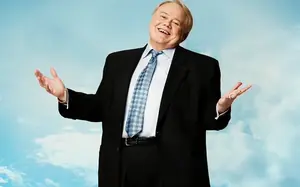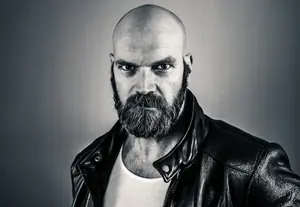


Looking at the raw transcripts from this early 2018 exchange with Louie Anderson is an exercise in perspective. At the time, he was riding an incredible wave, a late-career resurgence powered by his breathtaking performance as Christine Baskets. He was vibrant, thoughtful and at the absolute peak of his second act. But reading his words now, knowing he would be gone just four years later, lends them a different kind of weight—a quiet poignancy that underscores a career built on resilience and a deep well of empathy.
He was in an airport, heading to Los Angeles, but his mind was on the work. Anderson had been in the business for over three decades, a survivor of the 80s comedy boom who had carved out a unique space with his gentle, family-focused humour. Yet he wasn't coasting on nostalgia. He was more relevant than ever.
The key, he insisted, was a simple but profound commitment to the moment. “I think the main key thing you have to do is make sure that you stay current,” he says. It wasn't about chasing trends. It was about engagement. “Be present for the people you’re talking to, including you. Be present when you’re doing an interview. Don’t phone it in.”
This philosophy was the engine behind his stunning turn in the FX series Baskets. The show, a surreal and often melancholic comedy co-created by Zach Galifianakis, was a critical darling. Anderson’s role as Christine, the mother of twin sons played by Galifianakis, was its soul. It was a performance that had already earned him a Primetime Emmy for Outstanding Supporting Actor in a Comedy Series in 2016, and his conviction in the project was palpable.
He knew it was special from the jump. “I did actually because I've been working with Zach Galifianakis, and the director is really well known,” Anderson explains. And he had nothing but praise for his co-star. “Zach is a reluctant movie star. You know, he's good at it. Like, he is just like a superstar, but he is such a genuine down to earth human being.”
The real magic, however, was in the on-screen relationships mirroring the off-screen camaraderie. “The cool thing is that as the three years have gone on, we've gotten closer. And the relationships on the show have grown.” It was the kind of environment that made the punishing hours of television production feel less like labour. “It's the only job I ever had where I had to be there at 05:30 in the morning that I had a smile on my face.”
The role of Christine Baskets was more than just a performance; it was a channelling. Anderson famously based the character on his own mother and his five sisters, tapping into a lifetime of observation and affection. Playing a woman, he found, was an education in empathy. It fundamentally shifted his perspective.
You don't realize when you're in it, you're making one of the most iconic movies ever.
“I've come to appreciate my mom and five sisters a lot more,” he reflects. “Because, you know, even though I'm playing a character, people treat you as if you're a woman.” The daily ritual of costume and makeup became a portal into another experience. “It changes the way you think and the way you act towards people. And so I guess the thing I learned is that you appreciate my parents more, but my mom especially and my sisters. And I see how life is more difficult for women than we talk about.”
This wasn't method acting in the traditional sense. It was something deeper, a form of tribute. He wasn't simply mimicking mannerisms; he was trying to embody an essence, a spirit of maternal perseverance he had witnessed his entire life. He confesses, “I steal from everybody, mostly my mom and my sisters... I've thought, 'How would my mom do it? How would my sisters do it? How would they feel about this particular thing?'”
The result was a character study of immense pathos and humour. Christine was no caricature. She was a woman of substance, flawed and funny and deeply relatable. “The thing I get from people is, you know, Christine, just like my mom. Christine is just like my aunt,” he notes with pride. His ultimate goal was total immersion, for the audience and for himself.
“I try to make Louie Anderson disappear when I play the character so you don't notice him at all,” he says. The challenge wasn't pushing himself away but rather letting the character take over completely. He had to become a real mom with a complicated life, one who “keeps persevering.”
Despite the acclaim he was receiving for his acting, his first love remained the raw, immediate connection of the stage. When asked what he enjoys more, his answer is swift and certain. “I say stand up. That's my first thing,” he declares. “Just an audience. We got the audience, the microphone, the lights. You know, just pure, no director, no script. It's your stuff. It's all you.”
Even with his demanding television schedule, he was still touring relentlessly. At the time of this interview, he was promoting a new special, Big Underwear. The title came from a moment of pure, unscripted domestic comedy. “I was holding my clothes and I held my underwear up, and it brought out the sun,” he laughs. “I lifted them up... you don't realize how big they are until—at least I didn't—I folded them, and I went, oh my god. And it just made me laugh out loud.”
It was a perfect Louie Anderson bit: self-deprecating, observational and born from the mundane. It was also emblematic of his brand. For decades, he stood as a bastion of clean comedy in a landscape that often prized shock value. It was a conscious choice. “It always fit me better to be clean,” he explains. “So you could bring your parents, you could bring your kids, you know, to my shows.” He rejected the notion that clean meant boring, seeing it instead as a craft that required precision and hard work.
His career was also dotted with memorable film roles, none more iconic than his part as Maurice in the 1988 classic Coming to America. He still seemed awestruck by the scale of that production and the sheer force of its star. He recalls the moment he understood Eddie Murphy’s fame. “He would open his door and his trailer and the fence would bow in... it was kinda like almost a little frightening because the whole fence would bow in. And that's why I realized how famous Eddie was.”
It’s a classic story from a bygone era of Hollywood. And like so much of Anderson’s career, it came full circle. He mentions a rumour about a sequel, which would indeed come to pass. He reprised his role as Maurice in Coming 2 America, released in 2021, one of his final screen appearances.
“You don't realize when you're in it, you're making one of the most iconic movies ever,” he says. The same could be said for his work on Baskets. In that moment in 2018, he was just a man happy to have a job that made him smile at 5:30 in the morning. Looking back, we see a master craftsman delivering the performance of a lifetime, a beautiful and heartfelt final act that cemented his legacy not just as a comedian, but as a truly great actor.
519 Magazine Archive: We are thrilled to officially unearth the 519 Magazine Digital Vault. This isn't just a re-post; it's a high-fidelity restoration of a pivotal era in music journalism. By pairing original print dates with modern retrospectives, we’re bridging the gap between historical rock-and-roll grit and the lightning-fast performance of today’s web. These stories—once locked in physical print and lost URLs—are now back, fully searchable, and optimized for a new generation of fans.
We are thrilled to officially unearth the 519 Magazine Digital Vault. This isn't just a re-post; it's a high-fidelity restoration of a pivotal era in music journalism. By pairing original print dates with modern retrospectives, we're bridging the gap between historical rock-and-roll grit and the lightning-fast performance of today's web. These stories—once locked in physical print and lost URLs—are now back, fully searchable, and optimized for a new generation of fans.