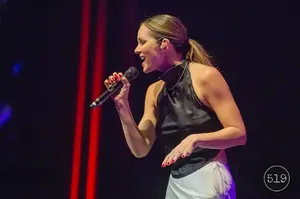


Looking at the raw transcripts from this Mar. 16, 2022 conversation with Katie Bell, you get a portrait of an artist grappling with the strange machinery of modern fame. It’s a study in contrasts. Here is a singer defined in the public eye by a stint on American Idol, yet one who was a veteran of the studio grind long before the golden ticket. And here is a social media presence who, by her own admission, finds the entire enterprise profoundly unhealthy.
It starts with the name. The industry has a long and storied history of sanding down the edges of its talent for mass consumption and for Katie Bell, that started with her surname. She was born Katie Bell Aiken, a name she felt had a certain rhythm. The business disagreed. “I always personally loved going by my my full name, last name included,” she says. “And I always thought that Katie Bell Aiken had, like, a really cool ring to it. But, honestly, throughout the years, the managers, the producers, everyone's like, it's too long. You need to drop your last name.”
This wasn’t a creative choice. It was a marketing decision handed down from on high. “I have to say that I really did it because everybody else told me to,” she admits. It’s a small but telling concession, the kind of compromise countless artists make on their way up the ladder. A prelude to the much larger compromises and pressures that were just around the corner.
Then comes the American Idol of it all. The show is a cultural monolith, a star-making machine that often chews up its participants in the process. Bell’s retrospective on the experience is clear-eyed and unflinching. She speaks of it not as a magical journey but as a brutal test of will. A trial by fire. “I could have never prepared for really what I had to go through no matter, like, how many hours I practice,” she reflects.
It was less about hitting the notes and more about surviving the psychological gauntlet. The pressure was immense. The hours were punishing. And the stakes were impossibly high. “It was almost more of a mental game once you really start getting into the competition,” she explains. “On top of having to focus on my technical abilities... there is a lot of mental strength that went into being on the show.”
She doesn’t sugarcoat the intensity. It was an absolute pressure cooker. “It was so intense. It felt like boot camp,” Bell says. “It was really intense, but it was such a great learning experience.” Despite the hardship, and a bizarre exit where her entire group was eliminated en masse during the Hollywood round, she recommends it. But with a critical caveat: “It's not for the weak.”
And of course, there was the Luke Bryan moment. The country star’s over-the-top reaction to her performance became a viral footnote to her run on the show. On television, it played like a judge with a comical crush. In the room, Bell’s first reaction was genuine panic. She thought she was witnessing a medical emergency. “I genuinely thought he was, like, going into cardiac arrest or, like, having a seizure,” she confesses. “I was, like, worst case scenario, oh my god. Luke Bryan's dying. No one's doing anything.”
The absurdity of the situation only dawned on her when no paramedics arrived. Bryan later apologized off-camera for the theatrics, a moment of professional courtesy behind the curtain of reality television. But the incident underscores the manufactured drama inherent to the format, where genuine moments are often sacrificed for something that will play well on screen.
It was so intense. It felt like boot camp. It was it was really intense, but it was such a great learning experience, and I I can't say enough good things about it, honestly.
The crash after the show was real and immediate. “I couldn't leave my bed for, like, ten days when I came home,” Bell says. “I was sad. I was exhausted. I was just overall exhausted physically, emotionally, just everything.” It was the comedown from an adrenaline high that had sustained her for weeks. She had to lick her wounds before getting back to the business of her actual career.
And that’s the key distinction. Unlike many contestants, Idol wasn’t the beginning for her. She was already an established artist in Atlanta, working with producers and releasing original music. The show was a detour not a genesis. “I was kind of already doing stuff beforehand. So I kind of just went back to my regular life,” she states. But then the world changed. Her 2019 was a “fever dream” of post-Idol opportunities, which came to a screeching halt with the pandemic. Like everyone else in the live music business, her career was turned upside down.
Her post-show singles, “Daughter” and “Back to California,” showcase an artist defining her own lane. “Daughter” is a powerful ballad, a sad girl anthem that taps into her love for artists like Adele. But the song’s power comes from its origin story. It was penned by the incredible Jax, another artist who knows the reality TV circuit well. The song was shopped to Bell and the connection was instantaneous and deeply personal.
The track resonated with a traumatic, abusive relationship from her past. “I listened to it, and I was like, oh my god. Like, this is my life. Like, who wrote this song about me and didn't tell me?” she recalls. “I had chills down my spine. I knew immediately I was like, whatever we have to do for this song to be mine, like, please, like, let's get it done. I need this song.” It’s a perfect example of how a song can find its rightful owner, regardless of who wrote the words.
Juxtapose that with the breezy, summery vibe of “Back to California.” Its video was a last-minute, hectic affair, partially shot on an iPhone. The video for “Daughter,” by contrast, was a meticulous production helmed by her best friend, filmmaker Joe Crognale, shot with a cinematic camera in her own childhood neighbourhood. This duality speaks volumes about the hustle of an independent artist: creating art with whatever tools are available, whether it’s a high-end camera or the phone in your pocket.
Before the music career took centre stage, Bell was deep in the modeling world. It’s an industry she has purposefully stepped away from, citing its unhealthy pressures. But the skills she honed there have proven invaluable. It gave her a comfort in front of the camera and an innate understanding of her angles, a crucial asset in the visually-driven music industry.
Her modeling career had significant high points, from a campaign with Morphe makeup that gave her an official foundation shade to being flown to Paris for a bridal shoot. “I don't know if you can ever top that,” she says of the Paris job. “It blew my mind.” That experience also made her a world-class traveler, unafraid of navigating new cities alone—a skill that serves any touring musician well.
But the most telling part of this conversation is her relationship with social media. She’s built a significant platform and uses it as a primary source of income, yet she is candid about its corrosive effects. “I wouldn't have social media if I wasn't in this industry,” she states plainly. “I think it's ridiculous. It stresses me out. It makes me sad. I genuinely think it gives me depression.”
It’s a stark admission of the toxic bargain many modern creators are forced to make. To combat the burnout, she’s implemented a strict policy of taking weekends off, of disconnecting from the digital world that is both her stage and her cage. Her advice to aspiring influencers is born from experience: only work with brands you genuinely believe in. Chasing money or free products for partnerships that don’t align with your identity is, in her words, “a waste of time.”
Ultimately, this look back reveals an artist defined by resilience. Katie Bell has navigated the manufactured chaos of reality TV, the isolating pressures of the modeling industry and the existential dread of a global pandemic that silenced live music. She’s emerged not unscathed but wiser, with a firm grip on her artistic vision and a healthy skepticism of the industries she inhabits. She’s playing the game, but she’s doing it by her own rules.
519 Magazine Archive: We are thrilled to officially unearth the 519 Magazine Digital Vault. This isn't just a re-post; it's a high-fidelity restoration of a pivotal era in music journalism. By pairing original print dates with modern retrospectives, we’re bridging the gap between historical rock-and-roll grit and the lightning-fast performance of today’s web. These stories—once locked in physical print and lost URLs—are now back, fully searchable, and optimized for a new generation of fans.
We are thrilled to officially unearth the 519 Magazine Digital Vault. This isn't just a re-post; it's a high-fidelity restoration of a pivotal era in music journalism. By pairing original print dates with modern retrospectives, we're bridging the gap between historical rock-and-roll grit and the lightning-fast performance of today's web. These stories—once locked in physical print and lost URLs—are now back, fully searchable, and optimized for a new generation of fans.