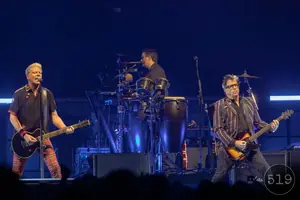


Sitting in the back of a dimly lit theatre, watching Brad Roberts command a stage, you realize his voice doesn’t just fill the room. It vibrates in your marrow. It has been more than three decades since the Canadian staples, Crash Test Dummies, unleashed their debut effort, *The Ghosts That Haunt Me*. It was an era defined by neon windbreakers and the slow death of hair metal, yet here came this group from Winnipeg with a sound that felt like it belonged in a centuries-old pub.
The record was an anomaly. It featured haunting lyrics that felt far too literate for the 1991 airwaves and a baritone vocal delivery that felt like a tectonic shift. It didn't just capture an audience; it held them hostage. The industry took notice, too, handing the band multiple Juno Awards and critical accolades that usually go to much older, more grizzled songwriters.
But Roberts isn't one to get misty-eyed over his early work. He’s a realist, perhaps to a fault. When he looks back at that 1991 debut from the vantage point of 2023, he sees the cracks in the foundation that fans usually ignore.
"I like the track 'Superman’s Song',” Roberts reveals. “I also think the first track on the record, 'Winter Song', and 'The Ghosts That Haunt Me' are good strong songs, but some of the other tracks on that record I'm not so nuts about now in retrospect. That was the first time I'd ever written an album, so it should come as no surprise that it's not my best effort because I just didn't have that much experience at that point. I think our next record turned out vastly better and I was extremely grateful that it did as well as it did."
It is a jarring bit of honesty. Most legacy acts will try to sell you on the idea that every note they ever recorded was divine intervention. Roberts, however, treats his debut like an old high school yearbook photo—something he respects but wouldn't necessarily want to recreate.
And yet, that lack of experience he mentions is exactly what gave the record its charm. There was a certain raw, unpolished intellectualism to it. The "next record" he refers to, *God Shuffled His Feet*, certainly had more polish and global hits, but *The Ghosts That Haunt Me* set the table.
Roberts' modesty is a bit of a smoke screen. You can’t deny the sheer weight of the impact that first record had on the Canadian cultural fabric. It was the birth of a specific kind of folk-rock-classical fusion that simply didn't exist elsewhere.
The album birthed "Superman's Song", a track that shouldn't have worked on paper. A mid-tempo ballad about the funeral of a fictional superhero? In the middle of the grunge explosion? It seemed like commercial suicide.
But the song defied the odds. It rocketed to the top of the charts in Canada and secured massive airplay across the United States. It was the kind of song that forced you to pull the car over and actually listen to the words.
The sonic profile of the album was a complete departure from the distorted guitars and pop sheen dominating the dial. It was a weird, beautiful mix of Celtic influences, chamber music and rock sensibility. It felt grounded.
As a matter of fact, when one grows older, one’s voice grows deeper. My vocal teacher when I was a young man told me this, and he was right. It's actually easier for me to get those notes down than ever and between you and me and the fence post, my voice is stronger than it's ever been and that's not just me blowing my own horn, although I am clearly blowing my own horn at the same time.
And then there is the voice. That C2-range baritone is the band’s true north. Roberts admits that the passage of time hasn't diminished his primary instrument; if anything, the physics of aging have worked in his favour.
"As a matter of fact, when one grows older, one’s voice grows deeper,” he explains. “My vocal teacher when I was a young man told me this, and he was right. It's actually easier for me to get those notes down than ever and between you and me and the fence post, my voice is stronger than it's ever been and that's not just me blowing my own horn, although I am clearly blowing my own horn at the same time. That's what I'm hearing from the fans - they've all gone to shows and noticed the lack in the vocals that you're just mentioning now and the multiple times I've had people claim to me that I sound better than ever. I think it's largely got to do with exactly what you're talking about. The voice does deepen as one ages and if you're singing songs way up in the top of your range then it's going to get tougher as you get older, but I write in a deeper range to begin with and because the human voice gets lower over time I don't have any problems. The only problems that I have are with high notes, but I haven't, because I write my own songs I don't write any notes that I can't sing."
It is a pragmatic approach to artistry. While his peers are out there struggling to hit the high screams of their youth, Roberts is leaning into the natural gravity of his vocal cords. He isn't fighting biology. He’s using it.
There is a technical brilliance in knowing your limits. By writing within his natural tessitura, Roberts has preserved the integrity of the live performance. He doesn't need backing tracks or lowered keys to get through a set list.
Standing in the wings of a theatre, you can hear that depth. It’s a rich, resonant colour that most singers spend a lifetime trying to emulate through processing and EQ. Roberts just wakes up with it.
Surprisingly, the 30-year-old debut has found a second life. It isn't just the Gen X crowd showing up to the merch table anymore. There is a whole new crop of listeners discovering the band through streaming algorithms and social media.
Younger generations are latching onto the unique sound. They don't have the baggage of the 90s, so they hear *The Ghosts That Haunt Me* as something fresh and avant-garde rather than a nostalgic relic.
For the older fans, the album is a vessel for memories. It represents a specific moment in time when Canadian music started to feel like it could take on the world without losing its soul.
Roberts might not consider it his finest hour, but the fans disagree. The record remains a beloved classic, a piece of art that continues to haunt the speakers of those who value substance over spectacle.
The band isn't just living in the past, though. They recently dropped a new single titled "Sacred Alphabet", which proves the Dummies still have plenty of ink left in the pen. It carries that same intellectual weight but with a modern production edge.
They are hitting the road again soon, too. The band has a string of dates lined up across the United States starting around May 15. It is a chance to see that deepening voice in action.
If you haven't checked in with them lately, you're missing out on a rare second act. The band is tighter than ever, and Roberts seems more comfortable in his skin than he did three decades ago.
But don't expect him to start gushing about his early lyrics anytime soon. He’s already looking at what comes next, even as the ghosts of his debut continue to follow him.
The legacy of the Winnipeg quintet is secure, whether Roberts likes the deep cuts on that first record or not. The impact is written in the charts and the voices of the fans who still sing along to every word.
For those looking to catch the tour or hear the new material, you can find everything at crashtestdummies.com. It is worth the click.
And if you happen to be at a show, pay attention to those low notes. They are the sound of a man who knows exactly who he is and what he can do. It’s a rare thing in this business.