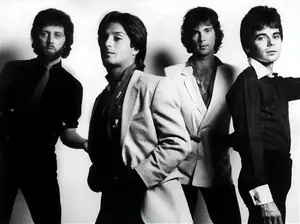


The red leather is tucked away in a closet somewhere, but the swagger remains entirely intact. Holding the original 1980 pressing of Loverboy’s self-titled debut, you can almost smell the hairspray and the ambition. It is a record that defined a specific Canadian frequency—polished, heavy and unashamedly aimed at the cheap seats. Mike Reno, the voice that launched a thousand headbands, does not do nostalgia with a heavy heart. He does it with the grin of a man who got away with it.
We are looking at four decades of "Working for the Weekend" and the kind of arena-rock longevity that usually requires a deal with the devil. In 2020, the math finally caught up with the myth. It was the 40th anniversary of that debut album, a milestone that Reno acknowledges with the casual confidence of a veteran who has seen the industry burn down and rebuild itself three times over.
"You’re exactly right. That is a major anniversary. It’s a milestone for sure," Reno says.
But milestones are rarely reached without a fair amount of blood on the floor. Before the multi-platinum plaques and the private jets, there was the indignity of the late 70s hustle. The band was a collection of hungry Vancouver musicians trying to convince suits that their brand of melodic muscle had a market. It was not an easy sell. The industry was distracted by the dying gasps of disco and the frantic energy of punk.
Reno recalls the grind of the early sessions and the rejection that preceded their ascent. "Well, it was a long time ago, April, but I can tell you this, we were super excited to get a record deal, that’s for sure. It’s never easy getting a record deal, but it’s especially not easy getting a record deal back in 1979, 80. It was an up and down thing, because we didn’t get the first group that came to see us. They didn’t think it was something they wanted to do. So, the second group came by and they didn’t think it was right for whatever reason, then another group. This is all record companies. And they came and saw us and they didn’t think it was going to work. And finally, Jeff Burns from Columbia records said, 'I can see this. I can hear this. I can feel that this is happening. I’m going to give you the okay to cut a record.' And we were just over the moon, over the moon!"
The signing was just the beginning. The band ended up at Little Mountain Sound Studios, a facility that would eventually become the Vatican of 80s rock production. At the time, however, the team was just a bunch of guys trying to find a snare sound that could punch through a car radio. Bruce Fairbairn was at the helm, a producer who understood that you do not over-edit a band that already knows how to swing.
Reno pauses as an airplane roars over his location, a reminder of the constant motion of his life. "And we’d lined up the producer who was just getting started. Oh, airplane going by. I’ll let that plane go by ‘cause it’s hard to hear. You can tell a guy’s busy if he’s staying at the airport," he laughs.
He continues, detailing the light touch Fairbairn used to capture the band's raw energy. "We got our first producer, who was Bruce Fairbairn and he was just getting started in the business. He’d produced Prism. And he was one of these guys that just let us do whatever we wanted because he could hear the potential. Some of the producers like to change everything and make everything different with a lot of suggestions. In our case, I think Bruce Fairbairn heard that the band was just playing live off the floor and just rocking. And he didn’t really want to do anything, but say, 'Go boys, go have some fun and let me record it. Then, we’ll fix it all up and get it all out there.' He was one of those kinds of guys. He came up with a few suggestions here and there that was very helpful. He kept everybody feeling good, kept the process rolling and he kept it on budget."
What is striking about those sessions is the sheer density of future talent in the room. This was the incubator. You had Bob Rock behind the board, long before he became the man who helped Metallica find their black-album groove. You had Mike Fraser, the future architect of the AC/DC wall of sound, probably fetching coffee. It was a high-concentration environment of technical expertise.
"But as far as making a lot of musical changes, it’s where Bob Rock got his start as an engineer. And he’s now one of the biggest producers in the world. This is an exciting time for us. And in 1979, when we were recording that, we didn’t put out till 80. So this is actually our anniversary for that. But when we were recording it, we didn’t know that Bruce Fairbairn was going to be one of the biggest producers in the world. We didn’t know that Bob Rock was going to be one of the most successful producers in the world. We didn’t know that our assistant engineer and coffee guy, Mike Fraser, was going to turn out to be one of the biggest producers in the world, after producing and recording and mixing all the AC/DC albums, just to name a few. You know, AC/DC, that’s pretty much all you got to say, and then you’re done with that conversation. You know they’ve done well," Reno says.
The discipline in the studio was uncharacteristic for the era. While their peers were drowning in excess and late-night sessions that bled into the following afternoon, Loverboy operated with a blue-collar efficiency. They treated the studio like a job site.
Reno explains the routine. "So we were already at a cutting-edge when everybody was coming up at the same time and super excited. I remember we would record and then we’d go grab a quick dinner and we’d come back. And Bruce wanted us to knock off early so that we wouldn’t be burned out for the next day. A lot of bands will stay till three, four in the morning, but the next day doesn’t start till three, four in the afternoon. So it just gets later and later and later. In our case, we wanted to be at the studio at 10 in the morning and just get kicking, you know, morning coffee buzz, let’s get rolling. And have a dinner break at a normal dinner time and then come back and work until like 11. And that was a neat thing that he set up, because it gave us a chance to have a bit of a life. Go home, where you can relax a bit, you get up and have some coffee, go back to the studio. We would have stayed in there 24 hours a day if it was up to us, but the producer said, 'No, let’s just do these hours and we’ll get’er done.' And I thought it was pretty cool."
There is a technical honesty to those early Loverboy tracks that digital recording simply cannot replicate. Today, you can fix a flat note or a late beat with a mouse click. In 1980, you had to be able to actually play. The tape does not lie, and it certainly does not forgive. Reno is a staunch defender of the analog era, citing the "Turn Me Loose" session as proof of the magic that happens when you stop thinking and start feeling.
"Well, I’m glad you mentioned that, because that’s a big deal for me. In our case, analog recording was our only option. We just started off and rolled the tape and there it was. But when you roll the tape back in the old days, you never had the chance to change anything. Nowadays everything is digital, you can change the sound of something, you can change the timing on it, you can change the pitch. You could change anything with just a couple strokes on the computer. But, back then you had to be spot on. So we prided ourselves on playing well, which I don’t know if a lot of groups do that anymore. I mean, the new groups coming up, they can play it anyway they want and the producer and the engineer can fix it. And that’s just the way it’s become," he says.
Jeff Burns from Columbia records said, “I can see this. I can hear this. I can feel that this is happening. I’m going to give you the okay to cut a record.” And we were just over the moon, over the moon!
The story of "Turn Me Loose" is a piece of Canadian rock lore. It was a second-take miracle fueled by a restless energy and, apparently, a celestial event.
Reno details the moment: "But we’re proud of the fact that we recorded in time when you really needed to know what you were doing. And there were times when we’d do a song and it would be put away and then we’d come back. I got a good example. One night, I’d finished singing and I had a few days off just to give my voice a rest, and I’d done a bunch of songs. And I came by the studio and I asked him if I could sing Turn Me Loose again. And they went, 'Whoa, we’re not doing Turn Me Loose right now. You know, we got Paul playing some guitar tracks and it would take a long time to change the tape and put the new tape on, align the machines and get them mixed up. This is two hours worth of work, just so you could sing the song again.' And I said, 'Come on, man. I really want to sing the song again.' And the song was Turn Me Loose. And when I sang it the second time, I changed a bunch of the inflections. I changed the way I sang it. I changed a few words and I put the scream in. And it changed the whole song. The guys looked at me like, Holy Christ, what is going on with this guy? And I walked out and I was all sweaty and I looked up at the sky, I was going to take a big breath of fresh air. And, I realized it was a full moon and I think that definitely had a big effect on how I was feeling that day. And that’s why Turn Me Loose came out so great. And that’s why it’s still one of our number one songs."
Before the studio, there was the road. Loverboy did not emerge fully formed; they were forged in the rougher corners of Vancouver Island, playing to crowds who did not care about record deals. They used these shows as a laboratory for their songwriting.
"Well, we’d recorded, I’m going to say, Turn Me Loose, The Kid Is Hot Tonight, Prissy Prissy, Little Girl. We recorded quite a few of the songs on like 16-track demo studios for cheap. And we’d go in and cut the demos and make them sound pretty good. And really not a lot changed except for the fact that we had a professional producer sitting in the seat and a professional engineer recording us. And we were taken a little more seriously and the equipment was better. Microphones are better. The studio was better. The tape was 24-track. You know, we’d really hit the big leagues. We were pretty impressed with how it happened," Reno says.
He adds, "But to be honest with you, not a lot of it was that different, because of the fact that we’d been playing so hard and we’d been doing nightclubs and we’d try out the new songs. We’d book a bunch of shows over in Vancouver Island to get away from Vancouver, to get away from the big city and all our friends coming down. And we’d go over to the Island and we try out a batch of new songs on people that had never seen us before. And if we could get them tapping their toes and standing up and dancing, we knew that we’d had something. So we were doing a lot of trial and error back then. And a lot of it was just because we were so gung ho, young kids with the dream."
The band's first major live test was a trial by fire. They were tossed onto a bill with KISS, a band whose fans are notoriously hostile to anyone not wearing face paint. Loverboy did not even have a permanent bass player at the time.
"That’s funny you should say that, because it was so nerve-racking. We didn’t even have a record out or anything. The only thing we’d done were some demos. It was the early days of demos. Blue Frog Studios with Al Rempel as our engineer. We got called to do a concert only because the band that was warming up KISS on tour wasn’t allowed into Canada that particular day. And the band was the New York Dolls. And I don’t know why they wouldn’t let them in, but they have their reasons I’m sure," Reno recalls.
The situation was desperate enough that they had to borrow talent from another Canadian heavyweight. "So we ended up getting called last minute. We didn’t even have a bass player. We had to use the bass player, a friend of ours from April Wine, Jim Clench. He played bass with us because we didn’t have Scotty in the band yet. He was still deciding whether or not he wanted to join the band or stay in university in Winnipeg. So we had basically the four of us minus Scott Smith. And we go, without even really a rehearsal, we had Jim Clench come in and I remember he walked over to me, Turn Me Loose was supposed to start. And he went, 'How’s this one go?' And I went, 'Dum, dum, dum' in his ear and he goes, 'Oh yeah. Oh yeah. Okay. Yeah. I like this one.' And then he’d play it. But the audience, no, they didn’t boo us, which is good because a lot of concert groups that play for Kiss, they don’t get a very good response. And I imagine it would have been pretty strange because a lot of young kids came to see Kiss at the beginning and that might have been a little weird seeing the New York Dolls walk on stage before them too. So maybe we did them all a favor."
The KISS connection persists. Paul Dean eventually recorded a Paul Stanley track on a solo project, and Reno has maintained ties with the Gene Simmons camp over the years.
"Yeah, we’re friends. I actually know Gene better than anybody. And I know Tommy Thayer, the guitarist, over the years. We’ve done things together, charity events and other things. There a connection. I don’t know if it’s a huge connection, but it is a connection of sorts," he says.
Then there are the pants. You cannot talk about Mike Reno without mentioning the red leather. It is a visual shorthand for 80s excess, but the origin story is surprisingly mundane—a result of a local connection and a store credit.
"I sure do, they’re in the closet right now. Protected by the Brink’s guards. The people that take care of banks. No, I’m just kidding. I got the pants. The pants will always be with me," Reno laughs. "You know, what’s funny about the red pants is they could have been any color. We had a publicist named Alison, and Alison’s husband owned a leather shop in Gastown in Vancouver, called Nettle Leather. It was a nice thing for her to do. She said, 'My husband said, you guys can go down and pick out some nice leather clothes if you want, and just put them on the charge. And when you guys start making some money, we’ll just pay it off.' And we went, 'Are you kidding?' So we all went down and grabbed about four or five pairs of pants each, you know what I’m saying? We thought this was like the best thing that had ever happened to us. And the pair that fit me the best and the softest were the red leather ones."
The aesthetic choice eventually cemented their place in pop culture history via the *Get Lucky* album cover. "And that’s how it all got started, because Paul used to wear red leather all the time. We wore blue and yellow and black, and we had all kinds of leather pants. But the red ones are the ones that really caught on and I’m assuming it’s probably because of the album Get Lucky and the whole theme of that album by the artist. And he took a lyric from one of our songs and did the hand-behind-the-red-leather-pants thing. And that turned it into one of the top thousand best album covers ever designed. And it made the catalog of the book that came out, a coffee table book, which we were quite proud of as well. So it was funny how it turned out."
Breaking out of Canada has always been the ultimate hurdle for domestic bands. Loverboy succeeded where others faltered, largely due to the management of Bruce Allen and a strategic tour with Kansas.
"I think it’s all in who you know and who’s working with you. At the time, well, we strived to get Bruce Allen working for us as a manager. And he had just finished a big, long run, years with BTO. BTO was an international group. Bruce Allen had international connections, especially in the United States. And he asked a promoter friend of his named Don Fox from Beaver productions, who started groups like Kansas, ZZ Top, and Cheap Trick. He got them all world tours. So Bruce called Don Fox and said 'I want to put this young band of mine on your next tour.' And he goes, 'Well, I’m sending Kansas out.' And he says, 'Do you think did work well with Kansas?' And Bruce just basically said, 'Oh, they’d be great. Yeah, they’d be great.' You never really know, right?"
The gamble paid off, even if the logistics were a mess. "And so they put us on tour with Kansas. So I don’t even think the United States even knew we were coming, because nobody could find any records. Except for the radio stations. The radio stations had found the record and were playing it and the crowds every night were going crazy. But the rumor was they couldn’t find any records in the store. So a big kerfuffle came up and Rolling Stone magazine got involved, and CBS records in New York took over the whole project. And then millions of records started flying out the door. It was pretty amazing, really."
Reno’s journey to Loverboy was not a straight line. It involved a stint in Toronto with Moxy, a band that gave him his first taste of the industry but ultimately left him frustrated by a lack of ambition and poor management.
"Well, when I was in Toronto with Moxy, I was given a great opportunity to come in and help with an album. So I came in and helped write an album, sang the album. They did it really quickly, they wouldn’t even let us redo a song. And they would tell us to do the song once and that was the end of it. And I just went, 'that doesn’t really work like that', in my mind. So Moxy was abandoned. It was a big deal for me. I got a chance to write songs and sing and work with an internationally famous record producer, Jack Richardson, who’d worked with a lot of big bands, including The Guess Who, millions of bands, Lighthouse, The Guess Who, a lot of bands from Canada in the early days. But this was my first foray into it. And I liked it. I was really great. I was honored. We played lots of shows. We did lots of traveling and touring. But there was a point where I wanted to take it further and I didn’t feel they had the same attitude as me about what I wanted to do. I wasn’t happy with the management. I wasn’t happy with the record company. They were almost like an accessory record company that sold hats and sunglasses. And they had a record every once in a while they funded, but it wasn’t a real record company. And I just didn’t like that. And so I wanted something better. I decided to pack it in and go across the country, which is interesting why I decided to do that. But I had to keep looking for something else," he explains.
A chance meeting in Calgary changed everything. "And my intention was to drop my girlfriend off in Calgary and then go to California to visit my brother and see how the music scene was down in California. But I met Paul Dean on my trip to Calgary and I never ended up leaving. We ended up writing songs and it just started working. And I went, 'Holy smokes.' The deal was, we didn’t want to do anything unless we could get a good manager, a really good one. And unless we could get a record company interested that could help us pay for the recordings and stuff. So we had some things in common. We both wanted certain things. We were writing these songs that we thought were pretty happening. And people we knew were saying, 'yeah, great songs.' So we ended up staying together and we’ve been together ever since. That’s since 1978, now. So we’re talking 42 years. And that’s Paul and I, we’re still the best of friends and work all the time."
That longevity has led to some surreal moments, including a chance encounter at the Sunset Marquis with The Boss himself.
"Absolutely. I had a Mike Reno moment in a hotel called the Sunset Marquis in Hollywood. And I was staying there and I was going out for the evening and I was waiting for my ride at the front. And there’s a little bar with two tables. Just a little place to sit and have a Corona or something, a beer. So I’m sitting here having a beer. It’s high top tables. So I’m just casually sitting, half-standing, and in walks this guy, and I just nodded at him, minding my own business. And after a few minutes, he reaches over with his hand. He goes, 'Aren’t you Mike Reno from Loverboy?' And I went, 'Yeah, aren’t you Bruce Springsteen?' He laughed. We both left. That was kind of a cool moment. I never thought he would have recognized Mike Reno, but we were with the same record company. So I guess he might’ve seen a picture or two of us along the way. And I mean, that’s pretty cool, huh?"
The ultimate validation, however, came at home. When Loverboy was inducted into the Canadian Music Hall of Fame at the Junos in Vancouver, it was a hometown victory that felt earned.
"Well, it was pretty spectacular time. We were honored by everyone in the music business that we’ve ever worked with, and met along the way. The video put together from all the people who we had contact with over the years was pretty humbling. And it was live television and there was 15,000 people in the arena, Rogers Arena in Vancouver, our hometown. Pretty big deal. I was nervous, but I was so grateful. And it was just one of those things. Loverboy’s never been really great at award shows, but we’re pretty good at the concert," Reno says.
As for the future, the band is not chasing the charts anymore. They are content to dig through the archives and share the results with the fans who have been there since the Nettle Leather days.
"Well, we may release some stuff from the vault. We’ve got a vault full of stuff that’s fun and Paul loves mixing them again on all the new equipment. And he has a good time with it. We have a webpage loverboyband.com that shows all kinds of fun things. I’m sure you’ve been on it. We’ve been putting songs out every once in a while. Just basically offering them up to our friends and family and fans, to enjoy them for nothing. So that’s what we’ve been doing now. We had good luck selling records back when people were buying them. Now that people aren’t buying them anymore, we’ll just give them away," he concludes.
Reno looks back at the 40-year run with no regrets. "Absolutely. I didn’t think it would last 40 years. We were just hoping to get a box of beer at the end of the week and have a chance to meet some pretty girls. But that turned into a whole lifestyle. I mean, this is what we’ve done, recorded, toured, sang, live concerts, interviews, TV shows. It’s been great. Hey, it’s been a dream come true!