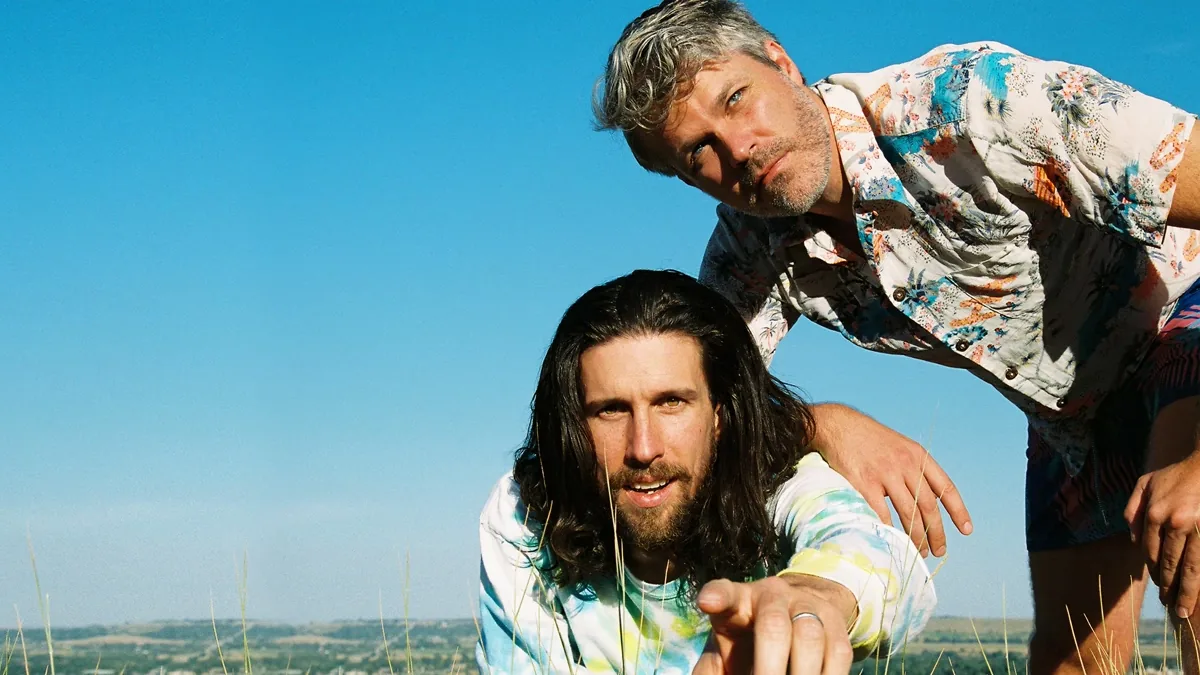

Listening back to these raw archival tapes from Aug. 18, 2012, is a trip. It’s a snapshot of a very specific moment in pop music, a time when the neon-splattered hedonism of the late 2000s was just starting to curdle into something else. And right there, caught in the middle of it all, was 3OH!3. Speaking with Sean Foreman from a noisy restaurant patio, you can hear the ambition and the anxiety of a band trying to prove they were more than a one-trick pony.
They were coming off the commercial highs of Want and Streets of Gold, records that cemented their place as the court jesters of crunkcore. But the scene was changing. The bloghouse party was winding down and the monolithic force of EDM was taking over. This interview captures Foreman on the cusp of releasing Omens, an album he sounds intensely proud of, one he believed would redefine them.
Hindsight is a brutal critic. But at the moment, Foreman’s excitement was infectious. He spoke about the band’s evolution, particularly their live show, which had become a beast of its own. “We've done a lot with our show,” he explains. “It's kinda ridiculous, but we have, like, five computers on stage. Everyone different, you know, different settings for keyboards and synthesizers. We have a three-person band.”
This wasn't just about making noise. It was about control. It was about proving their bona fides as musicians and programmers, not just two guys from Boulder with a knack for shout-along hooks. The added personnel and tech were a clear signal that they were taking their craft seriously, trying to build a spectacle that matched the scale of their radio hits.
The real heart of this conversation, though, is the album itself. Omens was their declaration of independence. Foreman’s pride is palpable when he details their process. “Nat and I have really, really done everything on this album,” he says. “We not only wrote, we produced, but we mixed, and we engineered. We did everything in that basement and in the basement studio, and it just felt—it feels really near and dear.”
This DIY ethos was both their greatest strength and, arguably, a critical misstep. By taking the reins completely, they crafted a record that was pure, unfiltered 3OH!3. It was dense, chaotic and unapologetically them. But in doing so, they walled themselves off from the pop machine that had made them stars. The polish of big-name producers was gone, replaced by a raw, almost frantic energy.
You can hear the tension in Foreman’s voice as he talks about the delay before its October release. “It's just, like, kind of burning a hole in our computers just sitting here,” he admits, worried their unique sounds would be co-opted by the fast-moving electronic scene. “A couple months down the road, who knows what people are gonna be putting out. So you just wanna—you kinda wanna make it, you know, put it out as soon as possible.”
I believe when we went to work on 'Blah Blah Blah,' like, not to be stereotypical with her image, but she was definitely hungover, I think, from the night before.
He was right to be nervous. In the pop world, a few months can be an eternity. Omens would eventually be delayed even further, not seeing a release until June 2013. By then, the momentum had stalled and the musical landscape had shifted yet again. The album, for all its creative integrity, failed to make the same commercial dent as its predecessors.
Foreman’s thoughts on the music industry’s distribution model were incredibly forward-thinking for 2012. He recalls their origins as a band that simply uploaded tracks as they were finished, a blueprint for the SoundCloud and Spotify drop culture that would dominate the decade. “We were an Internet-based band. We would release a song every time we finished one. We weren't really focused on an album too much,” he reflects.
He saw the industry shifting back to that single-driven model, a world where constant content was king. It’s a reality we now live in, but back then, it was a strategy that put them at odds with the traditional album cycle their major label, Atlantic, still favoured. It’s a classic case of an artist being slightly too ahead of the industry curve.
Speaking of labels, his perspective on their relationship with Photo Finish and its parent, Atlantic, is surprisingly nuanced. He pushes back against the “major label bad, indie good” narrative. “I think it's a lot about relationships you build, and I think we built actually a really good relationship with Atlantic,” he insists, noting their freedom to release free tracks for fans. It’s a refreshingly candid take in an industry often defined by its adversarial artist-label dynamics.
Of course, no retrospective on 3OH!3 would be complete without touching on their massive collaborations. The interview gives us a fantastic behind-the-scenes look at their work with two future pop titans, Katy Perry and Kesha. Foreman’s story about writing Perry’s part for the “Starstrukk” remix is pure rock and roll lore. “I wrote it on a napkin while I was at, like, some bar,” he laughs. “It was just amazing to see her in the vocal booth singing, like, lyrics and melody that I wrote.”
His assessment of Perry’s talent is a sharp rebuke to anyone who dismissed her as a manufactured pop act. “She really has an amazing voice,” he states with authority. “Really, really kind of, I guess, you'd say, like, whiskey-soaked, warm voice that she just, like, it's amazing.” It’s a genuine moment of peer-to-peer respect.
His memories of Kesha are just as vivid, painting a picture of an artist who lived her persona. “I believe when we went to work on ‘Blah Blah Blah,’ like, not to be stereotypical with her image, but she was definitely hungover, I think, from the night before,” he recalls. “But she's always a pleasure, like, to work with… she's got a real knack for pop writing, you know. Her hooks just get burned into everyone's minds.”
The conversation also touches on the infamous hand-sign lawsuit with wrestler Diamond Dallas Page, which Foreman deftly sidesteps with a “nondisclosure” comment. It’s a reminder of the strange legal tripwires that exist when a band from the 303 area code blows up. He’s much more open about the band’s ridiculous early names, including the truly awful “Trash Can Motherfuckers” and “Weight Room.”
Ultimately, this recording is a time capsule. It captures Sean Foreman and 3OH!3 at a pivotal crossroads, full of creative fire and determined to control their own destiny with Omens. They were armed with a basement full of gear, a clear artistic vision and a healthy skepticism of the industry they inhabited. The album may not have been the commercial juggernaut they hoped for, but listening to this, you can’t deny the passion that fueled it. It was their record, for better or for worse.
519 Magazine Archive: We are thrilled to officially unearth the Rockstar Weekly Digital Vault. This isn't just a re-post; it's a high-fidelity restoration of a pivotal era in music journalism. By pairing original print dates with modern retrospectives, we’re bridging the gap between historical rock-and-roll grit and the lightning-fast performance of today’s web. These stories—once locked in physical print and lost URLs—are now back, fully searchable, and optimized for a new generation of fans.
We are thrilled to officially unearth the 519 Magazine Digital Vault. This isn't just a re-post; it's a high-fidelity restoration of a pivotal era in music journalism. By pairing original print dates with modern retrospectives, we're bridging the gap between historical rock-and-roll grit and the lightning-fast performance of today's web. These stories—once locked in physical print and lost URLs—are now back, fully searchable, and optimized for a new generation of fans.