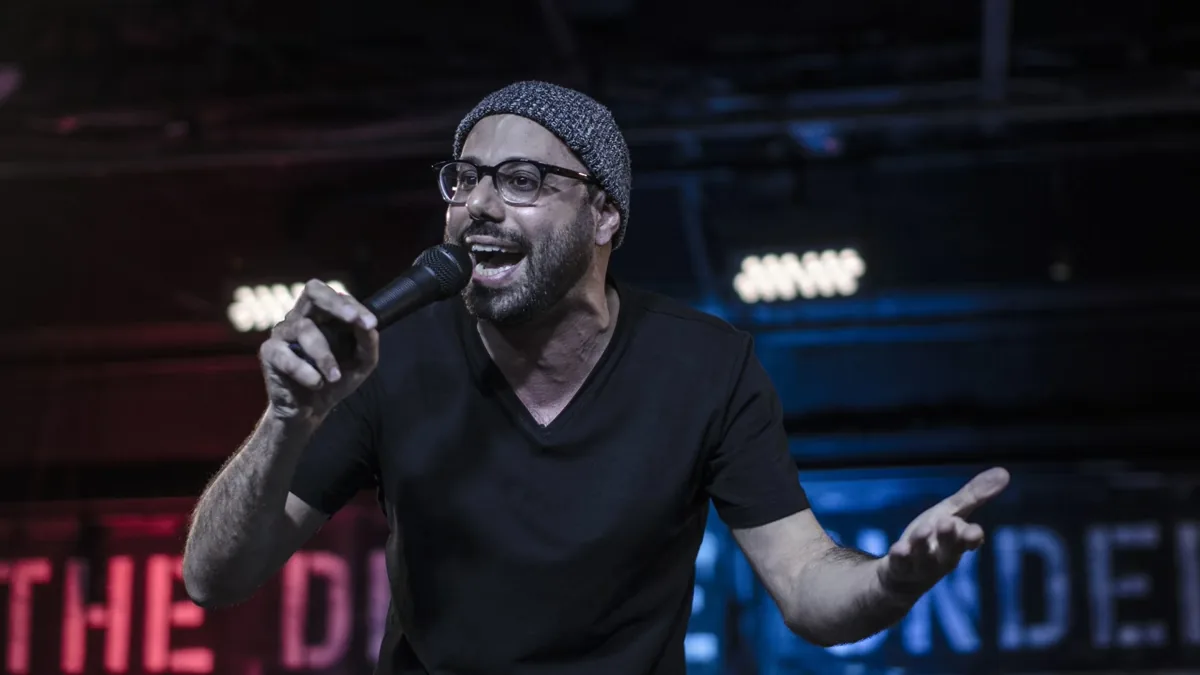
Looking at the raw transcripts from our Nov. 16, 2023 conversation with Dave Merheje is to see an artist fully cognizant of his foundation. There’s a particular grit that defines a Windsor comedian. It’s a border city identity forged in factory work union politics and the cultural bleed from Detroit. It’s an underdog’s sensibility. And Merheje, even with a Juno Award on his shelf and a key role in a critically acclaimed Hulu series under his belt, remains fundamentally a product of that environment.
His connection to the city isn’t a gimmick or a convenient biographical footnote. It’s the engine of his entire comedic project. When asked about his hometown’s influence, he’s immediate and direct. He points to the city’s robust Lebanese community as the bedrock of his perspective. “A lot of the source of my material is my family, in which they all still live in Windsor,” Merheje says. “So I think that, of course, the city and the city's culture had an influence on my act and me as a person.”
This isn’t just about surface-level observations. It’s about a specific diasporic experience that colours everything. The way families communicate the expectations the love and the absurdity of it all becomes universal through the hyper-specific lens of his Windsor upbringing. He’s not just telling jokes about his family; he’s translating a cultural code for a wider audience, and the Rosetta Stone was found in Southwestern Ontario.
But he’s quick to clarify that this wasn’t always the case. The confidence to mine his personal life for material was a slow burn. “It wasn't a source for me that much at the beginning of stand-up or even, you know, like, seven or eight years in,” he admits. “Maybe the last, like, seven or eight years, I wanna say, it's like I've, you know, have talked about it a lot more and expressed the love that I have for them through the material.” This is a critical point in any artist’s evolution. It’s the shift from chasing a perceived industry standard to embracing the one voice that is authentically yours.
That journey is long. Merheje spent 24 or 25 years in Windsor, a period that included four years at St. Clair College and a stint in a factory. That’s a life lived before the pursuit of comedy became a full-time reality. It grounds him. It’s why he insists his Windsor roots are non-negotiable. “Oh, 100%,” he says about carrying them with him. “I don't think I don't see why I wouldn't, in a sense.” It’s a simple statement but it speaks volumes about his artistic integrity.
His initial spark wasn’t even for stand-up specifically but for performance itself. A kid fooling around with his cousin Danny and sister Mary, just wanting to be on a stage. The pivot to comedy came through a classic form of education: the comedy album and the VHS tape. He rattles off the canon of late 20th-century stand-up royalty with a fan’s reverence. “My uncle would show us, you know, tapes of Richard Pryor, Andrew Dice Clay, George Carlin, Eddie Murphy's *Delirious*,” he recalls. That’s a murderer’s row of comedic philosophies. You have Pryor’s raw confessional vulnerability Carlin’s intellectual deconstruction Dice’s controversial swagger and Murphy’s stadium-rock charisma. It’s a potent cocktail of influences.
When Merheje talks about Windsor, the details become granular and sensory. He paints a map of his youth that will be instantly recognizable to anyone from the region. It’s a tour through a city that lives vividly in his memory. He speaks of family gatherings in the neighbourhoods around Niagara and Erie Street and the simple joy of visiting grandparents on both sides of his family.
Playing road hockey in high school with my friends at Lansbury Park when the when it was in ice, you know, just walking, you know, Ottawa Street, just like all of, like, Forest Glade going to the cinema there. Just like there's so many memories.
The cultural tapestry of the city is a recurring theme. He mentions the Carousel of the Nations with its Polish Greek and Italian festivals a celebration of the city's multicultural fabric. These events weren’t just background noise; they were formative experiences that shaped his worldview and by extension his comedy. The city itself becomes a character in his story.
And his memories are not just broad strokes. They are specific moments frozen in time. “Playing road hockey in high school with my friends at Lanspeary Park when it was on ice, you know, just walking Ottawa Street, just like all of Forest Glade, going to the cinema there,” he lists. He even recalls a long-gone arcade by the water near where the Chrysler Theatre now stands. These are the textures that make his work feel lived-in and real.
He even brings in the sense of smell a powerful trigger for memory. He talks about trips to the Lebanese bakery with his parents and the overwhelming aroma of freshly made pita bread coming down a conveyor belt. It’s these small deeply personal details that elevate his storytelling from mere recollection to evocative art.
That dedication to his craft and his story eventually earned him national recognition. His Juno Award for the 2019 album Good Friends, Bad Grammar was a monumental achievement not just for him but for Canadian comedy. The award for Comedy Album of the Year had been defunct for over 30 years before being revived in 2018. Winning it so soon after its return placed Merheje in a new class of Canadian comics.
He speaks of the win with genuine humility and excitement. “The stand-up category was gone for a very long time and it just had recently come back,” he explains. “So just kinda being nominated, just generally, I was very excited and grateful for.” It was validation from an industry that had historically overlooked the art form at its highest level.
The win put him on a national stage but it was his role as Ahmed on the groundbreaking Hulu series Ramy that gave him an international platform. The show, which offered a nuanced and authentic look at a first-generation Muslim-American family, was a cultural touchstone. For Merheje who had always wanted to act it was a perfect synthesis of his skills and his background.
Playing Ahmed allowed him to explore the themes of family identity and cultural conflict that were already central to his stand-up but within a different artistic framework. The show’s success amplified his voice and brought his unique perspective to a global audience. It was a clear case of the right actor finding the right project at the exact right time.
Revisiting this conversation, what’s most striking is the throughline of authenticity. From his earliest days in Windsor to his acclaimed work on television Merheje has remained tethered to his truth. He understands that the most compelling stories are not manufactured; they are excavated from one’s own life. His success is a testament to the power of that understanding.
He is a Windsor artist through and through. The city’s rhythms its cultures and its character are embedded in his comedic DNA. And as his career continues to expand he carries that piece of home with him onto every stage and every set. It’s his secret weapon. It’s his undeniable source.
519 Magazine Archive: We are thrilled to officially unearth the 519 Magazine Digital Vault. This isn't just a re-post; it's a high-fidelity restoration of a pivotal era in music journalism. By pairing original print dates with modern retrospectives, we’re bridging the gap between historical rock-and-roll grit and the lightning-fast performance of today’s web. These stories—once locked in physical print and lost URLs—are now back, fully searchable, and optimized for a new generation of fans.
We are thrilled to officially unearth the 519 Magazine Digital Vault. This isn't just a re-post; it's a high-fidelity restoration of a pivotal era in music journalism. By pairing original print dates with modern retrospectives, we're bridging the gap between historical rock-and-roll grit and the lightning-fast performance of today's web. These stories—once locked in physical print and lost URLs—are now back, fully searchable, and optimized for a new generation of fans.