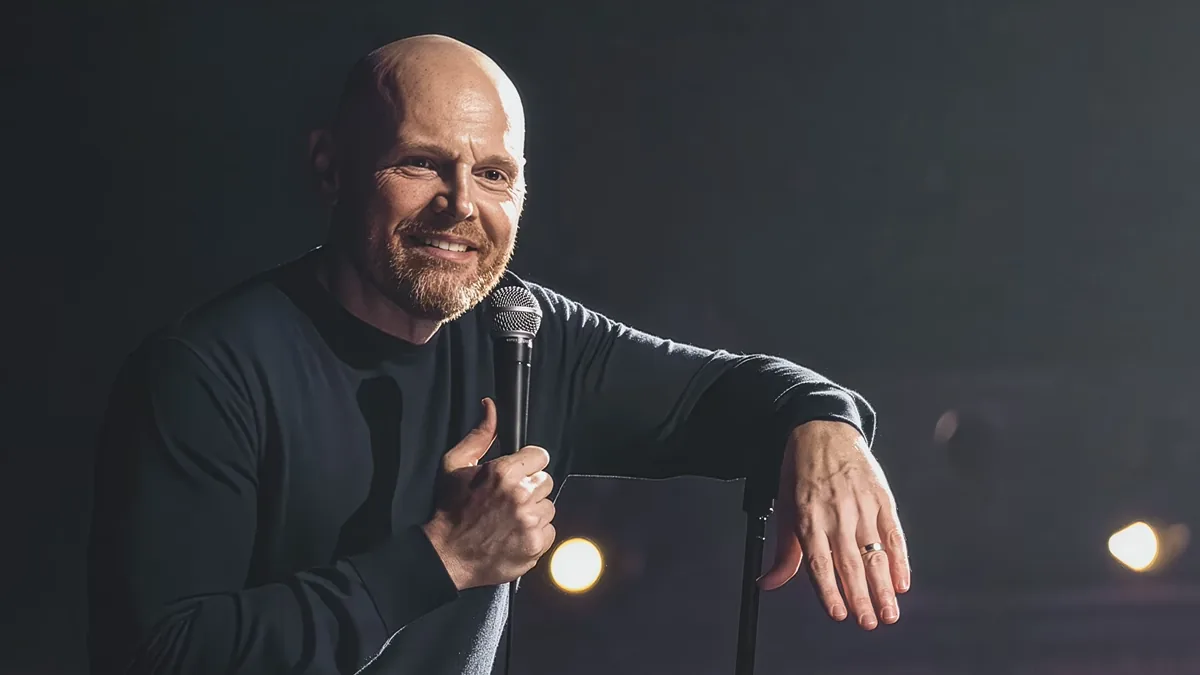

Revisiting this conversation from Feb. 27, 2020 feels like opening a time capsule from a world on the brink. Bill Burr was gearing up for a show in Windsor at Caesars Windsor, a 5,000-seat theatre he was sure to sell out – but the show never happened because of COVID-19. The industry was humming along and the comedian was at the absolute centre of his own sprawling universe: a network of stand-up specials, podcasts, acting gigs, and production deals. But looking at the raw transcripts from this era, you get the sense that for Burr, everything always comes back to the stage.
It’s the engine that drives the whole machine. While many of his contemporaries use stand-up as a springboard to escape the grind of the road, Burr runs back toward it. He sees it as the purest form of his craft, unburdened by the bloat of Hollywood. It’s immediate and it’s honest. And it’s still the only thing that really matters to him.
“That's all I ever wanted to do in this business,” Burr says, his voice cutting through with that familiar Boston cadence. “Everything else that I'm doing is just stuff that stand-up led me to, but I still think there's nothing cooler or more fun than being a stand-up comedian.” The contrast is stark. Film and television are a slog of hair, makeup, wardrobe, and endless takes. Stand-up is brutally efficient. “Do an hour and it takes an hour.”
But the Burr on stage in 2020 was not the same powder keg from a decade prior. A shift had occurred, one that he directly credits to a healthier mental state. He dismantles the tired trope of the miserable artist needing pain to create. It’s a myth. For him, clarity brought a sharper edge, not a duller one.
“I've actually found the healthier you are mentally, the funnier you are and the more fun you have doing it,” he explains. “Because once you examine yourself a little bit, you see your shortcomings, you start to develop more empathy on stage and you can have much funnier interactions when people heckle you rather than just trying to cut their heads off.”
This isn’t just psycho-babble; it’s a tactical evolution. He recounts a gig in Vancouver where a heckler was on the verge of getting tossed by security. The man pleaded directly to him. The old Burr would have gone for the kill, a verbal vivisection for the crowd’s delight. The new Burr chose a different path.
“He just goes, ‘Bill, Bill, please don't kick me out,’” Burr recalls. “And I was just like, ‘Buddy, I'm not kicking you out.’ I go, ‘Your actions have led to this moment.’ And it got like a big laugh.” He managed to talk the guy down, de-escalate the situation, and keep the show moving. It was a moment of crowd work that was more therapeutic than confrontational, a sign of a comedian completely in command of his craft and himself.
That command comes from a relentless process of discovery. He doesn’t write jokes word-for-word in a notebook. He finds them in the dark, in front of a live audience. His approach is simple and terrifying. “My approach to stand-up is just go up there and start talking. That's basically it,” he states. He’s listening to the crowd, feeling the rhythm of the room, and chasing the vibe.
I said, ‘Well, John, you know I've just been making fun of it. I've been trashing Star Wars on my podcast forever.’ And he goes, ‘Yeah. I know. He goes, I think your fans would find it funny if you were in it.’
It’s a philosophy he partly credits to the late great Patrice O’Neal, a comedian’s comedian revered for his uncompromising authenticity. “As the late great Patrice O'Neal said, if I have the essence of what I'm trying to say, I don't really have to say it the same way every night.” This makes every Bill Burr show a unique, living thing, not a polished recitation.
Of course, his success hasn't gone unnoticed. He was named Stand-Up Comedian of the Year by Montreal's iconic Just For Laughs festival a few years prior, but he dismisses the honour with his trademark self-deprecation. “That's only because a bunch of other guys turned it down,” he jokes. “The thing about giving somebody an award is they have to have the time in their schedule to show up and accept it. So, I was in the area, so they gave it to me.”
Yet some moments are too big to shrug off. Selling out Madison Square Garden is a pinnacle for any performer, especially a kid from the East Coast. But Burr’s most cherished memory of that night didn’t happen during his set. It happened before the doors even opened.
“Me and a bunch of my friends who played guitar and drums, we rented a bunch of instruments and we jammed and played all the songs we loved growing up in the empty arena,” he says, the awe still present in his voice. “It was amazing… The people at the venue really appreciated that we were having such a kick out of being there, so they actually put us up on the Jumbotron.” It’s a beautifully pure rock-and-roll moment for a man who wields a microphone like a Fender Stratocaster.
His career has been a series of smart pivots and gut instincts. He was an early adopter of podcasting, launching the Monday Morning Podcast when the medium was still a niche frontier. He didn't have a grand strategy. It was fellow comic Robert Kelly who pushed him into it. “He's just like, ‘This is a new way to connect with your fans.’ I had no idea what it was,” Burr admits. It started on MySpace with five-minute phone recordings and grew organically into the unfiltered institution it is today.
That unfiltered, contrarian viewpoint is his signature. He famously defended the guy who died building a steam rocket to prove the Earth was flat, not because he believed the theory, but because he respected the audacity. “There's a lot of people sitting in cubicles, playing it safe, making fun of a guy like that,” he argues. “He had a malfunction. NASA had a malfunction. His rocket crashed, but it didn't cost me a dime. So I'm alright with that guy.”
This same defiance eventually applied to his own career. Early on, an advisor convinced him his name was “too choppy,” leading to a few years where he was credited as Billy Burr. He ultimately rejected the advice. “I just accepted my name,” he says bluntly. “I was just like, ‘Fuck it. If I'm gonna go down, I'm gonna go down with what my real name is.’” It was a declaration of identity. Being a comedian for him is about being who you are. Anything else is a lie.
His acting career is a testament to that authenticity. While he downplays his role as Patrick Kuby on Breaking Bad, calling it memorable only because the pickings are slim, it’s a critical misreading of his own impact. He parachuted into one of television’s greatest dramas, and his agitated, fast-talking energy provided a necessary comic relief without ever feeling out of place. He wasn’t just a guest star; he was a perfect piece of the puzzle.
And then there’s The Mandalorian. It’s the ultimate Bill Burr story. For years, he mercilessly mocked Star Wars and its devoted fanbase on his podcast. It was a contrarian bit born from a comedian's instinct to poke at anything people hold sacred. So when director Jon Favreau offered him a role in the new Disney+ series, it felt like a prank.
“I said, ‘Well, Jon, you know I've just been making fun of it. I've been trashing Star Wars on my podcast forever,’” Burr recalls telling him. Favreau’s response was perfect. “He goes, ‘Yeah, I know.’ He goes, ‘I think your fans would find it funny if you were in it.’” Burr’s wife urged him to take it, and Migs Mayfeld, a cynical ex-Imperial sharpshooter, was born. He became a fan favourite, a testament to Favreau’s sharp casting and Burr’s surprising depth.
Looking back from today, the conversation captures Burr at a fascinating crossroads. He was a veteran comedian who had already built a formidable career, but he was also on the verge of becoming a household name through shows like The Mandalorian. He saw himself as a supporting player, a specialist dropping into other people’s worlds.
“I'm just psyched that my career seems to be working out where I get to paratroop into all of these really cool shows and just be a small part,” he says. A small part of Chappelle’s Show, a small part of Breaking Bad, a small part of The Mandalorian. But Bill Burr has never been a small part of anything. He’s an anchor, an agitator, and one of the most vital voices in modern comedy. And it all starts and ends with him alone on a stage with a microphone.
519 Magazine Archive: We are thrilled to officially unearth the 519 Magazine Digital Vault. This isn't just a re-post; it's a high-fidelity restoration of a pivotal era in music journalism. By pairing original print dates with modern retrospectives, we’re bridging the gap between historical rock-and-roll grit and the lightning-fast performance of today’s web. These stories—once locked in physical print and lost URLs—are now back, fully searchable, and optimized for a new generation of fans.
We are thrilled to officially unearth the 519 Magazine Digital Vault. This isn't just a re-post; it's a high-fidelity restoration of a pivotal era in music journalism. By pairing original print dates with modern retrospectives, we're bridging the gap between historical rock-and-roll grit and the lightning-fast performance of today's web. These stories—once locked in physical print and lost URLs—are now back, fully searchable, and optimized for a new generation of fans.