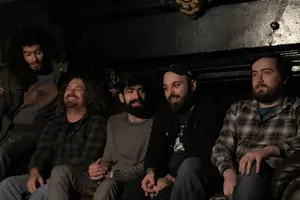


The weight of the *Up to Here* 35th-anniversary box set feels like a slab of Canadian granite. It is heavy, cumbersome and entirely necessary. Holding it, you realize that 40 years have slipped past since The Tragically Hip first started rattling the windows of Kingston pubs. They are the closest thing this country has to a national religion, but the new documentary series, *No Dress Rehearsal*, directed by Mike Downie, strips away the stained glass to show the cracked floorboards beneath.
I sat through the screening at the Toronto International Film Festival, watching the surviving members navigate the glare of the red carpet. Gord Sinclair, the band’s bassist and often its most grounded orator, looked at the spectacle with a mix of pride and genuine surprise. The Hip never quite bought into their own mythos, which is exactly why the myth grew so large.
Sinclair reflects on that TIFF premiere with a characteristic lack of pretension. “We were all there for the screening and I have to say, hats off to Gord's older brother, Mike Downie, who directed it,” Sinclair says. “I think he did an amazing job creating a doc series that people who knew the band intimately can get something out of it, and people that never even heard of us before take something from the story and maybe get into what we did and feel like they didn't miss out on something.”
There is a specific kind of anxiety that comes with watching your life projected on a massive screen in a room full of critics and superfans. The Hip always operated as a five-headed beast, a collective that prioritized the unit over the individual. Seeing that history laid bare for four hours is a lot to ask of anyone, let alone a group that spent decades dodging the typical rock-star tropes.
“We're pretty humble and when we heard that they were going to show all four episodes in a theater at TIFF, we thought, ‘Good Lord, the place is gonna be empty by the end,’” Sinclair says. “It turns out, people were on the edge of their seats and they stayed for the entire thing. It had a real resonance with the audience and it's due in no small part to Mike. He did a great job.”
The choice of Mike Downie as director was not just a matter of convenience or family ties. It was about access to the marrow of the band. Mike was there before the gold records and the cross-country tours. He saw the shift from Amherstview to Kingston, the transition from high school kids with cheap instruments to the architects of a national soundtrack.
“It hasn't been an easy process at all since the very start when we agreed to it,” Sinclair says. “We've known Mike for as long as we knew Gord when the family moved from Amherstview to Kingston to go to high school. Mike was in my grade, Gord with Rob, and Mike knew where all the skeletons were buried. He's lived it as Gord's brother. We've worked with him before, and to his credit, he approached us right off the start and said he didn't want to make a puff piece. He wanted to talk about the stuff that made the band what the band was.”
And what the band was, frankly, was a pressure cooker. You cannot keep five distinct creative egos in a van for 40 years without things getting ugly. The documentary does not shy away from the friction. It highlights the reality that The Hip was a democracy, and democracies are messy, loud and occasionally violent.
“A lot of those circumstances involve a lot of time, but a lot of heavy emotions,” Sinclair says. “It's about love, it's about loss, it's about friendship. It's about trying to maintain a creative partnership where five individuals are laying it all on the line. And, you know, sometimes you can't get your way. We had lots of scraps over the years. We never talked about it publicly before because that was just for us. That was part of the process whether it was how a lyric was supposed to go or which songs to put on the record.”
This is the "Information Gain" that most fans missed during the band’s active years. We saw the tight-knit brothers on stage at the Air Canada Centre, but we didn't see the boardroom battles over tracklists. Mike Downie’s lens captures the humanity of those disagreements, showing that the friction was actually the fuel.
“Those decisions weren't always easy, but we managed them,” Sinclair says. “I think that's what helped, Mike's sensitivity to that, but also to his brother and his brother's legacy and his family. He brought that into the documentary in a very masterful way that tells an interesting story. It's not a concert film. It's the story of 40 years together, and in any friendship, you're gonna have some highs, and lots of lows, and you're gonna lose people along the way.”
The core of the band was built on a foundation that predates the music. Sinclair and guitarist Rob Baker were literally toddlers when they met. That kind of history creates a shorthand that no session musician could ever replicate. It also creates a level of accountability that can be brutal.
“I see him (Rob Baker) all the time and talk to him every other day,” Sinclair says. “We've been hanging out with each other since I was three years old, and that's a big part of what the story was. Gord and Paul had the same relationship, and collectively the five of us have developed that trust and love for each other that saw us through a 40-year career of driving around North America, Europe, and Australia.”
In the music industry, bands usually implode over three things: money, credit or proximity. The Hip managed to survive all three by making a pact early on to split everything equally. It was a socialist experiment that actually worked in a capitalist industry.
“The stuff that kills a lot of bands is the proximity to each other and financial stuff and credit,” Sinclair says. “We resolved all those issues because we valued our relationship with each other first and foremost and didn't want to let anything else, not even a guy's stinky feet, bust the band up. We’re open when we talk to each other as friends should. From my perspective over 40 years, you realize how fortunate we were to have all the opportunities that we had and the number of people that we had the chance to work with.”
But the long road is littered with those who didn't make it to the end. The documentary features a striking image of the band’s 10 parents. It is a reminder that while the band was growing up, their support systems were fading.
“In retrospect, you look at who we've lost over those years and how instrumental a lot of people were to get us from playing a crappy little club in Kingston, Ontario to that final show,” Sinclair says. “Nothing more profound than seeing the picture of our 10 parents in the documentary, and now we're down to three. And that's part of life, right? We couldn't have done any of that without those 10 people.”
The most significant internal shift happened early on, and it was a bitter pill. In the beginning, Sinclair and Paul Langlois were major lyrical contributors. But as the band evolved, it became clear that Gord Downie was operating on a different frequency. The decision to make Downie the primary lyricist was a tactical move that felt like a personal rejection.
“That was a really difficult juncture in our career,” Sinclair says. “When Gord brought it to the group, it was a pretty fraught meeting, because it's impossible as an artist and as a writer to take your ego out of it. You're being told you need not bother any longer, that someone else is going to do it for you. We talked it out like we did with everything. It was important to Gord for the authenticity of the performance, both on record and live. I totally got that, so I respected the decision and moved on.”
It was the right call. It allowed the band to stop being a group of guys writing songs and start being a singular, atmospheric force. By the time they hit the mid-90s, they weren't just playing chords; they were building environments.
“As chance would have it was among the best decisions ever made, because now, as a writer, I don't have to worry about finishing a lyric or even starting a lyric,” Sinclair says. “I can concentrate on doing what I felt I did best for the group. It allowed us to develop our cooperative songwriting approach whereby the time we got to Day for Night or Trouble at the Hen House, we weren't even finishing musical ideas.”
This was the era of "The Hip" as a collective. The music became more abstract, more daring. They stopped trying to write "New Orleans is Sinking" clones and started chasing something more elusive.
“We just knew that we could go into one of our songwriting sessions and throw out a riff or a chord progression, and someone else in the band is going to pick up that thread, whether it's John rhythmically or Gord with the melody, and push that in another direction,” Sinclair says. “That represents what the group was as a collective. It's really what made The Hip.”
If *Fully Completely* made them stars, *Day for Night* made them legends. It was a dark, murky record that defied the bright, grunge-adjacent trends of 1994. It was the moment they decided they didn't care about the American charts.
“Day for Night was our real creative watershed where this is who we're going to be,” Sinclair says. “We're not going to chase radio singles, because that's a mug’s game. We're going to try to become the best band that we can and that's what we worked towards, and the first step towards that was Gord becoming our principal lyricist.”
Downie’s lyrics were a collage of Canadian history, hockey cards and overheard barroom chatter. He was a sponge for the mundane, turning a story about Bill Barilko into a national anthem. Sinclair watched this process from the inside, often seeing his own conversations reflected back at him through a microphone.
“It wasn't like he was writing, ‘Yummy, Yummy, I Got Love in My Tummy,’” Sinclair says. “He was a fantastic lyricist, a great storyteller, and one of the best our country has ever seen. He was a voracious reader, but he was a fantastic listener as well. He had a great ear for a turn of phrase and someone would say something unusual and it would go right into his book. It could be years, but it would reemerge in a lyric or a song title. He was our journalist on the road and it's amazing the number of times I’ve gone through the lyrics and I remember the circumstances of conversations I was involved in. It takes me back to how we actually wrote and recorded material together.”
The stuff that kills a lot of bands is the proximity to each other and financial stuff and credit. We resolved all those issues because we valued our relationship with each other first and foremost and didn't want to let anything else, not even a guy's stinky feet, bust the band up. We’re open when we talk to each other as friends should.
The band’s discipline was legendary. They would record dozens of tracks and then ruthlessly cut them down to fit the 40-minute constraints of an LP. In the streaming age, where albums bloat to 20 tracks to juice the algorithms, The Hip’s brevity seems like a lost art.
“Very early in our career, we did a gig with The Chili Peppers before they hit and watched them play,” Sinclair says. “This is down in Texas and I'd never really heard of the group. I was like, wow, this is fresh, this is new and it's cool. And they've got funk, but they put their own spin on it. And so being the bass player and certainly John, our drummer, we were drawn to it immediately.”
That funk influence popped up in tracks like "Ouch," but it didn't always fit the narrative of the record they were making. The Hip were masters of the "kill your darlings" philosophy.
“So, we wrote a bunch of songs like that, but we realized quickly that, well, you can't have two funk songs when we're kind of a rock and roll band,” Sinclair says. “It was much the same way that Get Back Again got left off of Up To Here because we wrote a better acoustic track that everyone had contributed to. It goes back to a time when, you're making LPs and you’ve got 40 minutes of music, tops. So, in a lot of ways, the CD age kind of killed that because all of suddenly you have 75 minutes of music instead of 40.”
The irony, of course, is that these rejected songs are now the crown jewels of these deluxe reissues. We are finally hearing the songs that were "too funk" or "too acoustic" for the 1989 version of the band.
“Having to edit yourself in advance and pick and choose between the songs that you've recorded for a project, invariably something potentially even great gets left off,” Sinclair says. “We're kind of the beneficiaries of that now because we wouldn't be putting this stuff out if it was crappy.”
The selection process was brutal. If a song didn't serve the collective energy of the album, it was buried in the vault. Sinclair points to "Ouch" as a prime example of a song that lost the battle to a more established hit.
“And then in the case of Ouch, I thought Twist My Arm resonated live with the audience, and it fit with the other tunes better than a song like Ouch, which was full on Funkadelia,” Sinclair says. “Same thing with 38 Years Old. I just thought it was a better song.”
Unlike many bands who recycle old ideas for the next session, The Hip were always looking for the next mountain. They didn't look back until they were forced to.
“We were never ones to say, 'We'll pick it up for the next record and throw it on,'” Sinclair says. “We were full steam ahead. So we've got this catalog and geez, you blow the dust off the tapes and listen to it 35 years later. Like, Paul’s song, Wait So Long. I hadn't listened to that in a long time and I can pick up the guitar and play it back for you right now. It's a great song, just never saw the light of day. It's just the nature of the medium that we're working in.”
The *Up to Here* sessions in Memphis were a turning point. They were kids from Ontario dropped into the humid, soulful atmosphere of Ardent Studios with producer Don Smith. It was a baptism by fire that produced some of their most enduring work.
“We went down to make our first album in Memphis,” Sinclair says. “Like most bands, we were super prepared for it. We rehearsed, we knew all our parts, and the songs were together. We had an acoustic number all prepared for that record called Get Back Again, one of my songs. It's a great song and always resonated with the crowd. But when we got down to Memphis, it was such a creative environment and Don Smith was always pushing cool ideas we should develop.”
It was during these sessions that "38 Years Old" was born—a song that would become a staple of Canadian identity, despite being written in the middle of the night in Tennessee.
“While we were there, we wrote 38 Years Old,” Sinclair says. “It started off as a guitar riff one evening, and by about 4 or 5 a.m., the song was entirely written. It was one of those moments creatively where all the dominoes fell exactly into place and Gord had this great story that we wrote one night and recorded the next day. We have so many stories like that. That was the cool thing about being in a creative unit where you had all this material. We used to approach making records like doing a live set. It was A side, B side, five-song sets.”
Decades later, the songs they discarded are finding an audience. "Get Back Again" recently hit number one on the charts, a feat that seems impossible for a 35-year-old "reject."
“So that's the way we sequestered and we came up with this acoustic number which knocked another acoustic number off the record,” Sinclair says. “We didn't really think about it too much. And then ironically, it just went number one in Canada a month or so ago. A song that's 30 years old that never saw the light of day. We're fortunate to be in this group that the songwriting was so much fun.”
Sinclair even revisited the track with members of The Trews and Miss Emily, proving that a good song doesn't have an expiry date.
“We kind of did that just for fun,” Sinclair says. “The guys in the Trews are dear friends of mine and they sort of came to the band around the time of Phantom Power. We were just goofing around in the studio and they suggested we do that version. They knew the song better than I did. I actually had to sit down and relearn it. That's the great thing about songwriting, it never goes away. Whether it's recorded or not, it's always there and it's something you can always come back to.”
If The Hip are the kings of Canadian rock, Rush are the emperors who built the palace. Sinclair speaks of Geddy Lee, Alex Lifeson and Neil Peart with a reverence that borders on the sacred. They provided the blueprint for how to be Canadian, successful and uncompromising.
“My love and respect and appreciation, gratitude, it's endless for those guys,” Sinclair says. “They in no small way built the road that we were just a decade behind them, following on the same path. It was probably around 91, 92 when we got the invite to support them. They did an annual charity fundraiser for the local United Way at Maple Leaf Gardens. We got the call completely out of the blue; would we come and support them on that show? I get goosebumps still just thinking about that opportunity.”
For a kid from Kingston, playing Maple Leaf Gardens was the summit. Doing it with Rush was something else entirely.
“The 16-year-old me would be like, it's unbelievable because the first show I saw, I can tell you what they opened up with, Bastille Day, I remember it like it was yesterday and here we are playing Maple Leaf Gardens with them,” Sinclair says. “All our moms and dads were there because at the time we figured it was never going to get any bigger than this. Playing the Gardens with Rush was going to be awesome. Moms and dads are all there. Equally significant was that they were playing this sold-out venue and yet every nickel that they were generating was going back into their community. Their philanthropy and their integrity, we took that page right out of their book that night.”
Rush taught The Hip that you didn't have to move to Los Angeles to be a world-class band. You could stay in the North, keep your integrity and still fill arenas.
“They are in my opinion, by far the best band that has ever come out of Canada,” Sinclair says. “You know, we're just lucky to have shared the stage with them a bunch of times and call them friends now.”
The philosophy of the "album band" is something Sinclair holds dear. In an era of TikTok snippets, the idea of a cohesive 40-minute statement feels like a radical act.
“Rush made it cool to be Canadian,” Sinclair says. “We were never big radio guys; we didn't live and die by the top 10. We were album guys and I can't think of a group that exemplifies that philosophy better than Rush. I think of Rush in terms of records, not hit singles. They had lots of great hits or songs that still resonate with people that are more popular than others. But I think that kind of came after the fact that's what we always wanted to be.”
The Hip’s refusal to chase the American dragon is a major part of their legacy. They were signed to MCA in the U.S., but they never pivoted their sound to appease the suits in New York. They remained stubbornly, gloriously themselves.
“We wanted to find our own voice in the same way that the guys in Rush had, and we were really lucky,” Sinclair says. “We were signed into the States because of all the touring we did and because of our relationship with the Canadian audience, we always did well enough for the record company that we got another chance to make another record. They kept us hanging around, but were never so popular at a commercial level where they tried to turn us into something that we weren't. And I think Rush was the same sort of thing.”
They could have been a blues-rock band. They could have stayed in the "New Orleans is Sinking" lane forever. But they chose the harder path.
“We had a pretty decent hit with ‘New Orleans is Sinking’ off of Up To Here, and it would have been easy for us to sit around and write 12 bar blues songs for the rest of our career, but we didn't want to do that,” Sinclair says. “We were able to find our own voice and be true to ourselves.”
The process was always democratic, always circular. They would sit in a room and hammer out ideas until the song revealed itself.
“The approach that we took to songwriting, we were always trying to write together and develop song ideas together,” Sinclair says. “We were always together when writing in various shapes and forms. it evolved, changed over time and some material is better than others, obviously, but we always had way more songs than we needed because of the way that we wrote songs together.”
It was a grind, but it was their grind.
“We would literally go around in a circle and throw out an idea and take it about as far as it could go,” Sinclair says. “And then, in particular, if Gord got a hold of a melodic or lyrical path that would really influence how the song evolved, we were always pretty successful that way.”
The rediscovery of these old tapes is largely thanks to Johnny Fay, the band’s drummer and unofficial archivist. Without his diligence, these 35th-anniversary sets wouldn't exist.
“As a result we’ve got lots of cool material floating around and I’ve got to give full props to Johnny, our drummer for finding these tapes,” Sinclair says. “That’s a Herculean task, but whenever a project is up, like what we went through with Up To Here, he'll phone up and say, ‘You won't believe what I found.’ It's cool to be part of something like that.”
The band is in a strange place now. They are more unified than they’ve been in years, yet they are missing their heartbeat. The documentary forced them to confront the silence left by Gord Downie.
“We've never been a better functioning unit in terms of communication than we are now,” Sinclair says. “Obviously, we're down one guy, the very important guy, and I'm quite sure that we wouldn't be doing any of this backward-looking stuff because he was always onwards and upwards. We no longer have him, but to honor him and to honor the group's time together. Now we have this ability to go back in time and sift through that stuff. If it was all crap, we wouldn't be out.”
Looking back also highlights how much the industry has changed. The Hip were the beneficiaries of a system that no longer exists—a system where a label would actually invest in a band’s development.
“Our first albums were records, and studio time was crazy expensive,” Sinclair says. “You couldn't make a record in your basement on your laptop with your Pro Tools rig. And stuff like that. You had to have a guy who knew. You had to have a building and a studio and a specific place to do it, and you had to have someone to pay for all that stuff.”
That financial barrier meant that only the most dedicated—or the most lucky—got a shot.
“We never had that kind of budget,” Sinclair says. “We were signed by an individual who was the vice president of artist and repertoire at MCA who saw the potential in my little group and convinced a bunch of suits in New York to pony-up the bread to allow us to make these records. That doesn't exist anymore. It makes me lament that period, where an artist or a collective, like my group, had the opportunity to do that and find their voice and to develop their talent.”
The documentary’s most jarring moments come during the recording of *Man Machine Poem*. The band was fracturing. Sinclair and Langlois actually walked away for a period, their egos bruised by the creative process. It was a low point that was immediately eclipsed by the news of Downie’s terminal cancer.
“We spent a lot of time with each other, really close friends, but were also co-workers, and businessmen together,” Sinclair says. “It wasn't always easy. We had to make tough decisions and, in some cases, feelings got hurt. In the documentary, we had to revisit quite a bit of that. Rob Baker had a similar experience when we produced Trouble at the Hen House. Didn't enjoy the process and I understand why. Self-producing is not easy. It's not just as simple as five guys making a decision. You know, decisions have to be made and toes get stepped on. We always had a great facility to talk things out.”
The silence between them lasted for months. It was a cold war that only a tragedy could end.
“Several months went by when we weren't talking,” Sinclair says. “It was a tough one. But it's funny. Something happens that affects your buddy or your brother in a particular way and all that quickly falls by the wayside. All those little conflicts are driven by ego, and my ego was bruised when We Are the Same came back and all the background vocals are gone. Particularly when you're talking to the producer about background vocal ideas while they're recording them when you're not there.”
The diagnosis changed everything. The petty squabbles over backing vocals became irrelevant in the face of mortality.
“It was a tough pill to swallow but you know, geez, you look in the perspective of what happened afterward and that is absolutely meaningless to the day we found out what Gord's diagnosis was,” Sinclair says. “All of a sudden you circle the wagons. Loss is very life-affirming. It's very love-affirming, and there are more important things than making sure that you get your own way. We learned that over the years. Five guys trying to make unanimous decisions. Sometimes there's an unpopular decision that gets through there, but we learned how to keep it in perspective.”
The final tour was a wake, a celebration and a national exorcism all rolled into one. It was the ultimate proof of the bond between the band and the country.
“We wouldn't have done any of this without the support of the fans over the years that followed us, that's what it's all about,” Sinclair says. “And that last tour that we did, I've said it before, but that's what it was all about. Getting that back from the audience means so much.”
As the credits roll on *No Dress Rehearsal*, you’re left with the image of a band that was profoundly human. They fought, they loved and they created something that belongs to all of us now. Sinclair’s hope is that the next generation of Kingston kids gets the same chance to fail, to grow and to eventually find their own voice. But in this digital age, that feels like a tall order. For now, we have the box sets and the memories of a band that never needed a dress rehearsal because they were always living it for real.