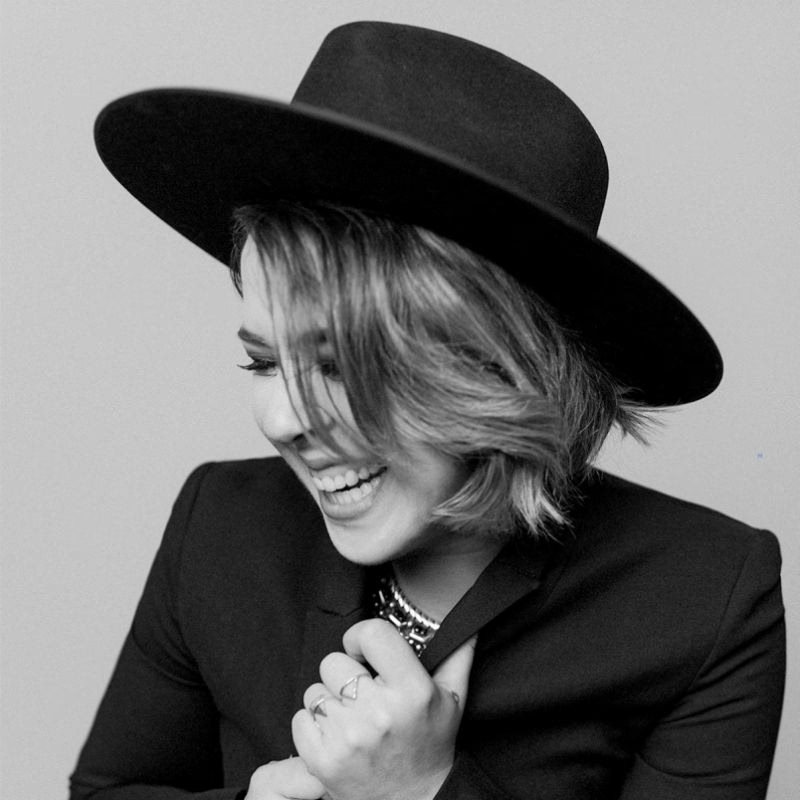
There is a specific kind of gravity that follows Serena Ryder. You feel it before she even opens her mouth to sing. It is the weight of a six-time Juno Award winner who has managed to navigate the treacherous waters of the Canadian music industry without losing her soul to the machine. And yet, this summer, the Multi-Platinum powerhouse is playing hard to get. She is not on a marathon tour. She is not grinding through 40 cities in 50 nights. Instead, she has carved out exactly three dates for the season.
One of those dates is the Kingsville Folk Music Festival on Aug. 9. Getting Ryder to headline is a massive coup for the festival, a signal that the small-town stage can still pull the heaviest hitters in the business. We caught up with her to talk about the mechanics of her creativity, her obsession with the backbeat and why she is currently obsessed with stripping everything back to the bone.
When you talk to Ryder about where her songs come from, she does not give you a PR-sanitized answer about "finding herself." She treats the process like a haunting. It is less about construction and more about being a conduit for something she cannot quite name.
"Well, I feel like that is the indescribable thing that I just feel really grateful for. I feel like every time I try and put my finger on it, it seems to go away. I just try and not figure out what it is. I feel like a big part of creativity is just being open to it and actually listening to what’s going on around you, instead of thinking about what you’re going to do, more about quieting your mind and being open to what’s happening," Ryder says.
It is a refreshing take in an era where every pop star claims to be a "disruptor." Ryder is okay with the silence. She is okay with the lack of control. But there is a technicality to her "openness" that borders on the spiritual.
"Because a lot of the most brilliant things that happen are things that happen without you trying to put your mark on them. I feel a lot of the songs that I write and a lot of them were the songs that exist without me. If I’m there—I sound like such a hippie, it’s just hilarious—but it’s like if I’m just present, it kind of comes out, which is awesome," she adds.
But do not let the hippie talk fool you. Beneath the ethereal vibe is a musician obsessed with the visceral, physical reality of sound. Specifically, the rhythm. If you listen to her discography, the transition from her early folk-leaning work to the stomp-and-clap anthems of her later records is not an accident. It is a deliberate pivot toward the heartbeat.
"Oh my gosh. My number one inspiration is rhythm, for sure. That was a really good segue on your part, because it’s like, okay, if there’s anything that could inspire me to write a song, it’s the beat. It’s the rhythm, because there’s no melody there. There’s no lyrics there, but there’s something that just moves your body, you know?" she says.
This shift became most apparent during the sessions for *Harmony*. That record was a turning point. It was the moment Ryder put down the acoustic guitar—the safety blanket of every singer-songwriter—and started building from the floor up.
"For me, that’s huge. I kind of discovered that on my second last record, which is called Harmony. That was the first time that I ever wrote without a guitar to begin with. I would just listen to the beats and the rhythm. I worked with a producer who was a really amazing drummer, and that was the most exciting thing for me because it was like you could base your song on how your body’s going to move, how people’s bodies are going to move, like the heartbeat, which is awesome," Ryder explains.
And let's be clear: her love for the kit is not just theoretical. She is not just a fan of the drummer; she wants to be the drummer. There is a kit sitting in her studio right now, probably covered in the dust of a thousand frantic practice sessions.
My number one inspiration is rhythm, for sure. ...If there’s anything that could inspire me to write a song, it’s the beat. It’s the rhythm, because there’s no melody there. There’s no lyrics there, but there’s something that just moves your body.
"All the time. I don’t think people would be very happy with it. But I do love bashing on the drums. I play for fun here and there, and it’s one of those instruments I feel like that takes a really long time to get really, really good at. But yeah, no, I love the drums. They’re my favourite instrument, actually. I have a drum kit set up in my studio," she admits.
When asked if we might eventually see her behind the kit on stage, she does not hesitate. "It’s very, very possible because I just love it so much," she says.
Lyrically, Ryder has always been a bit of an enigma. Her songs feel like they were ripped from a diary, yet they rarely follow a linear A-to-B narrative. She avoids the "this happened, then that happened" trap of amateur songwriting. Instead, she leans into the abstract.
"Oh, absolutely. I feel like it’s important for me to be speaking from the heart. I think it’s important for everyone to be speaking from the heart. I can’t really sing a song if I can’t relate to it. All of my lyrics are very much from the heart and very honest. I don’t necessarily write in actual timeline storylines, like this person, this thing happened. It’s really more based on metaphor and feelings in the moment. I’m a really big fan of poetry and using words to describe feelings and things that have happened to you in a larger, profound way instead of necessarily a story," she says.
But then there is "Electric Love." That track was a curveball. It pushed her further into the electronic space than her fans were used to. It had a sintetized, neon-soaked texture that felt like a departure.
"That was a song where I went into the studio and my producer just started playing this crazy drum beat and I was like, 'Hey, let’s do a sexy dance song,' because I’ve never done something like that before. It’s definitely, a little bit more electronic, and even just the melody and stuff like that. It’s this kind of cool, almost froggy, rocky, weird ‘80s kind of sound," she notes.
And yet, Ryder is a shapeshifter. She is not content to let a song sit in one genre. For the Kingsville show and her limited summer run, she has dismantled "Electric Love" and put it back together with a wrench.
"But it’s funny because I just reworked a different version of it because I have this new stripped down band that I’m going to be touring with, which is just me playing guitar, my guitarist, and my drummer. We came up with an acoustic-y, rocky version of the song, which completely changes it as well," she says.
This is where Ryder gets academic about her craft. She views genre not as a cage, but as a translation tool.
"It was really cool, because I always say that different styles of music are like different languages. You can say the exact same thing, and if you play it in a different style, then it’s almost like it’s a different language. Other people can hear it. There are certain people that are like, 'Oh, I’m a country fan,' or 'Oh, I’m a rock fan,' or 'Oh, I’m an R&B fan,' but it’s all melodies and lyrics, and if you just change the style or the sound of the song, it’s like different people can hear the song in a way that they can relate to," she explains.
And then there is the trivia. Fans have long obsessed over the digits in her track "Got Your Number." Is it a real number? Is it the Canadian version of Tommy Tutone’s "867-5309"?
"The 5346607, that literally just flew off of my lips. You know what? I’m sure it is somebody’s phone number, and I apologize to them. I’ve often wondered, I’m like, has anybody tried this number? Should I try this number?" she laughs.
As for what is next, Ryder is currently in the "incubation" phase. She is writing, observing and preparing to head back into the studio late this year.
"With the new album, I think we’re going to start working on it at the end of the tour, which will be end of November, beginning of December. But right now, it’s kind of just been a writing process," she says.
The inspiration for that record is being pulled from the very road she is currently traveling—even if that road only has three stops. "Absolutely! The people I meet, the things that I go through, everything is going on the record," she says. When we suggested that Kingsville might provide some of that spark, she was all in: "Make something crazy happen and it’ll go on the record. Let’s do it!"
But the real challenge for an artist with Ryder’s catalogue is the setlist. How do you condense a career into a 90-minute festival slot? She is notoriously prolific. For her last record, she wrote nearly 100 songs just to find the 14 that made the cut.
"I wish I could play them all, but you guys would be there for, like, a week. My last record, I wrote almost a hundred songs before I put the 14 songs that went on the record. But I try and think about if I’ve been there before, what I’ve played before, what people are like there, what they’re into, what I know about them, what I know about the place. Also, if I know there’s been certain songs that have been played on the radio, I want people to be able to feel like they know the songs that I’m playing," she says.
Ryder is acutely aware of the "artist's ego" trap—the tendency to ignore the hits in favour of obscure B-sides. She refuses to be that artist. She wants the crowd to sing.
"If I could figure out the songs that people loved and knew, I would just play those songs. I’ve thought about even having just little things where I send out messages and be like, 'Okay, what songs should I put on my set list, Kingsville?' Which maybe I should do like, 'Hey, which ones do you guys want to hear?' Because now in a time of social media, it’s like there’s no guessing for anything. But I definitely like to play as many songs as people feel like they can relate to and know. Because there’s nothing better than going to a concert and being able to sing the words and know the songs that the artist is playing," she says.
"Yeah, because it feels so good," she continues. "I know a lot of artists that are touring and stuff, they kind of get sick of their own stuff and just do a lot of covers or play things that people have never heard. I feel like that leaves people alienated in a way. I like to balance it out with the things that I want to play for myself and the things that are for everybody else as well, because that makes the evening really great for me. I’ll put in as many, I guess you could say quote-unquote hits as possible, ones people know, and then balance it out with a few little surprises, a few little nuggets there that people will be like, 'Oh, what’s this? I haven’t heard this like this before.' So yeah."