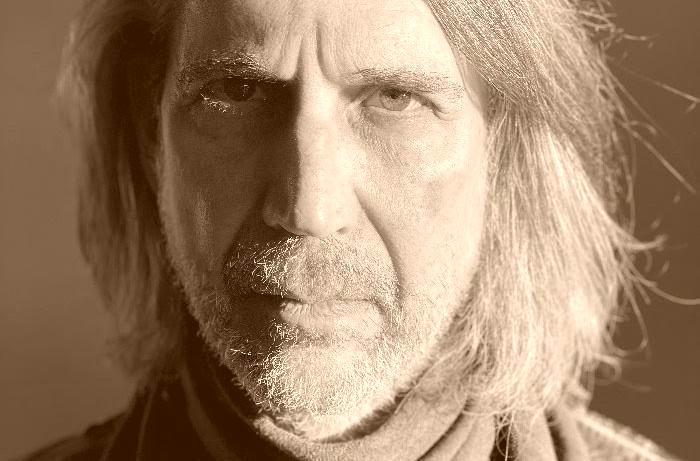

Paul Barker is not interested in your nostalgia. While a certain segment of the industrial fan base remains perpetually locked in the 1990s, Barker is busy vibrating the floorboards of the present. Holding a physical copy of his latest Lead Into Gold record, *The Eternal Present*, you feel the weight of a man who has spent three decades refining the art of the sonic assault. He is the architect behind the most punishing textures of Ministry, a producer who understands that volume is a tool and silence is a weapon.
Barker has always been the quiet engine of the genre. But his work under the Lead Into Gold banner feels more personal, a stripped-back exploration of what happens when you stop trying to please a stadium and start trying to satisfy a singular, demanding internal critic. This third album is a departure from the frantic energy of his youth, opting instead for a heavy, considered pace that feels like it was forged in a furnace.
The writing of *The Eternal Present* was born from a desire to escape the mental traps that catch veteran musicians. Barker realized he needed a jolt to the system. He took a suggestion from a peer and turned the creative process into a sprint.
"I did 99.9% of it myself," Barker says. "I decided to change my writing process because it was so belabored. A friend suggested a 30-song in 30-days challenge, where the goal was to drum up ideas. After 30 days, I ended up with 30 kernels of ideas to work on. The transformation from those initial one- to two-minute ideas into full songs was incredible. In many cases, only 10% of the original idea remained."
This wasn't about perfection; it was about momentum. Barker describes the assembly of these tracks with the pragmatism of a mason. There is no room for preciousness when you are working against the clock. He builds, he evaluates and then he destroys what does not serve the foundation.
"I come up with ideas, work on them, and then walk away from them," Barker explains. "I return to see if there's anything usable, and if not, I strip things out and start again. Deadlines are my friend; they're the only way things get done."
It is a brutal way to work. But it produces results that are intentionally narrow and stylized. The album does not try to be everything to everyone. It is slow. It is brooding. It is heavy. There are sprinkles of melody, sure, but they feel like light flickering at the end of a very long, very dark hallway.
The title itself, *The Eternal Present*, acts as a philosophical hook. It is a phrase that demands the listener stop looking back at the "glory days" of industrial and focus on the immediate, uncomfortable now. Barker finds a certain dark humour in the name, too.
"I love that title," Barker says. "It's a trod for anyone who cares to think about what they're doing. It challenges us to examine the beliefs we inherit from society and accept as reality. It's a bottomless pit of discussion, but that's the inherent purpose of the title. Plus, it has a goofy double entendre that I adore."
The lyrics follow this thread of dismantling inherited truths. Barker is singing about the friction of existence, urging people to look at the world from a different angle. It is a call to growth, even when growth is painful. He is not here to provide easy answers or anthems for the masses.
And while critics love to play the "spot the influence" game, Barker is keeping his cards close to his chest. He listens to everything, but he refuses to give the audience a roadmap. Part of the joy of Lead Into Gold is the mystery of the DNA.
You start working with someone, you barely know what you're doing. You're just doing it. ...It shaped my life 100%. I decided when I was a kid that I was going to be in the arts somehow, and that's what happened.
"I listen to a lot of different music," Barker says. "I won't explicitly reveal those influences because it's more fun for listeners to figure it out. There's a lot of music out there, and repetition can be boring. I have my favorites, of course, but as much as what I like influences me, what I don't want to do—what I've already done—is equally important."
This rejection of his own history is what keeps the project vital. Working alone allows for a level of purity that a band environment kills. There are no committee meetings in Lead Into Gold. There is no compromise to soften the blow.
"Lead Into Gold is my own thing. And when you work with other people, there's a certain amount of compromise that you have to make," Barker says. "But when I'm working on my own stuff, I only have to satisfy myself. And therefore, you have to have a deadline. Otherwise, it'll never be finished."
This uncompromising attitude carries over into the live setting. If you expect a high-energy rock show, you are in the wrong theatre. Barker wants to submerge the audience. He wants the sound to be a physical presence in the room, something that presses against your chest and makes it hard to breathe.
"I want to envelop the audience in a low frequency blanket," Barker says. He admits the music might not be "fun" in the traditional sense, but it is immersive. It is a dynamic experience that stays with you long after the ringing in your ears stops.
Naturally, the shadow of Ministry looms large. Barker spent years in the trenches with Al Jourgensen, creating the blueprint for industrial metal. Looking back at those early days, he sees a mixture of brilliance and total chaos. It was a time of pure experimentation where the rules were being written in real time.
"You start working with someone, you barely know what you're doing. You're just doing it, you know," Barker says.
They were fueled by a naive energy and a hunger for new technology. Samplers, synths and distorted guitars were the tools of a revolution. That period shaped him entirely, providing a foundation for everything that followed in his career and his personal life.
"We only have one life, so I can't compare it to anything else," Barker says. "It shaped my life 100%. I decided when I was a kid that I was going to be in the arts somehow, and that's what happened."
But Barker is not the type to sit around reminiscing about old tours and gold records. He is aware of his legacy, but he does not live in it. There is a sharp divide between Paul Barker the Industrial Icon and Paul Barker the man living in Portland.
"When I'm home in Portland, all that shit means nothing. The only time those historical elements come to bear is when I'm on tour and people talk to me," Barker says.
When he isn't making music, he is building the tools that other people use to make it. His company, Malekko Heavy Industry Corporation, has become a staple in the world of guitar effects and modular synths. It started almost by accident when he moved to Austin, Texas. He met Josh Hawley, a fellow synth enthusiast, and the two decided to build a pedal.
"We started doing that, and then it just snowballed from there," Barker says.
Malekko does not do clones. Barker has no interest in recreating the sounds of the sixties or seventies. He wants to push the envelope with digital signal processing (DSP) and innovative circuitry. He wants to create something new, not a museum piece.
"We rather make interesting products than clones of other people's products, you know, clones of sixties and seventies products," Barker says.
Balancing the business of pedals with the art of music is a constant struggle. After a day spent managing engineers and production schedules, the last thing Barker often wants to do is sit in a studio. He has to be disciplined. He has to treat music like a job to get it done.
"For me to work on music, I have to force myself to do it because it's too easy to not do it," Barker says.
But when he does force himself, the results are undeniable. His expertise has even landed him in the world of Hollywood, contributing to soundtracks for films like *Natural Born Killers* and *AI*. Scoring for film is a different beast entirely. There are no vocals to worry about, but you have to serve the director's vision without being distracting.
Barker explains that the process is often frantic. He might get a full script or just a single scene. Usually, he is brought in at the very end of a project that has been in development for years, and he is given a tiny window of time to deliver the goods. It is a high-pressure environment that suits his "deadlines are my friend" philosophy perfectly.
With *The Eternal Present* now out in the world, Barker continues to prove that he is one of the most relevant figures in the scene. He isn't chasing trends or trying to recapture his youth. He is simply existing in the now, making the music he wants to hear, and building the machines that make it possible. And if you don't like it, he probably doesn't care. He's already moving on to the next thing.