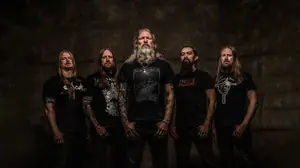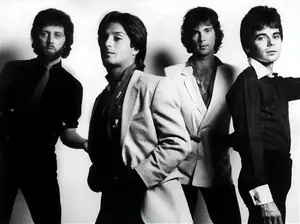


The Gothenburg sound isn't just a subgenre; it is a weight that every band from the Swedish west coast carries like a leaden rucksack. For At The Gates, the architects of that very sound, the pressure to either replicate *Slaughter of the Soul* for the rest of eternity or drift into total obscurity is a constant tension. But with their latest offering, *The Nightmare Of Being*, released through Century Media Records, they aren't just leaning into the past. They are actively trying to dismantle it.
Sitting down with founding member and vocalist Tomas Lindberg, you get the sense that the band is no longer interested in the three-minute serrated blast. There is a physical density to the new record, something you feel in the vibration of the low end when "The Fall Into Time" kicks in. It is demanding. It is occasionally exhausting. And that is exactly the point.
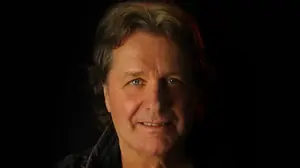
"Well, it’s one of the biggest efforts that we’ve ever done, I think. A lot of work came into this record. It’s a very cinematic, dark, progressive album that will probably challenge the listener a little bit," Lindberg says. He is lean, articulate and carries the weary energy of a man who spent his morning grading papers and his afternoon screaming into the abyss.
The track "The Fall Into Time" serves as the record's gravitational centre. It doesn't just play; it looms. It represents a shift toward a more expansive, almost orchestral darkness that moves away from the frantic D-beat energy of their youth. But the fans, surprisingly, aren't revolting. They are leaning in.
"We wanted to do the first two singles a little bit more like straightforward At The Gates songs. But of course, they’re more complex now than they would have been if we wrote them in the 90s," Lindberg explains, acknowledging the inevitable friction between nostalgia and growth.
"They still have some progressive elements, but as the third single, we thought that’s going to be for the diehard fans that really want to be intrigued by the band. And therefore, we thought they might be ready for something more epic, cinematic and progressive. The song is the centerpiece of the record, basically, it’s for us as old school guys, we see the vinyl version, and this is a first track on side B, of course."
There is a certain stubbornness to that vinyl-first mentality. In an era of algorithmic playlists, At The Gates is still thinking about the physical flip of a record. It is an analogue mindset in a digital meat grinder. But this shift toward the progressive isn't a sudden pivot or a desperate attempt to stay relevant. It is a slow-burn realization of ideas they had three decades ago but lacked the technical vocabulary to execute.
"It’s always been there - the progressive elements since the early 90s actually, but back then we didn’t really know how to incorporate it," Lindberg admits. "Now we have a deeper understanding of what the band is about, what is the core elements that we can’t change sort of thing. And therefore with that security, we can actually experiment more without losing the identity of the band. And I think that’s the maturity we have - to be at the point where we could take more experimental steps while still keeping true to ourselves a little bit."
The heavy lifting for this new sound falls largely on the shoulders of bassist Jonas Björler. While most death metal bassists are content to just mirror the guitar riffs, Björler has been busy writing full-scale orchestrations. It adds a layer of prestige to the grime.
"There’s a lot of work that goes into it, the orchestral parts are written by our bass player, Jonas Björler. He basically writes it by himself, and then transcribes it for the musicians - it’s very hard work. I can’t believe he can do it, but it’s fantastic. The rest of the arrangements and everything else, that’s something we come up with together," Lindberg says.
The creative process here is less about jam sessions and more about emotional architecture. They aren't just looking for a catchy hook; they are trying to evoke a specific kind of dread.
"We have this idea that At The Gates is a very emotionally driven band musically. So we talked a lot about that. Which emotions do we want to portray with the certain songs? Where do I want to take it? Then it’s just to color it with different instruments and different arrangements to bring that point home a little bit - to challenge the listeners, but also get those emotions out," Lindberg says.
One could argue that the band doesn't need to work this hard. They could easily tour the festival circuit playing the "hits" from 1995 and retire comfortably. But there is a palpable sense that for this group, stagnation is a death sentence.
"Yeah, I think so. At this stage in our career, we have released albums now since the early 90s. At our age, it’s a lot of work and it takes a lot of time from your personal life. We have normal day jobs as well," Lindberg notes. "So a project like this, it’s almost overwhelming, and therefore it has to be important for us - we have to train the listener to this as well. The thing with At The Gates is that we would stop immediately with the band if it didn’t feel important for us."
Visually, the band is also moving away from the standard "five guys in a warehouse" aesthetic. The video for "The Fall Into Time" is a stark, animated fever dream crafted by Costin Chioreanu. It matches the music’s density in a way that live-action footage rarely can.
It’s one of the biggest efforts that we’ve ever done, I think. A lot of work came into this record. It’s a very cinematic, dark, progressive album that will probably challenge the listener a little bit.
"I think we always loved doing more animated videos, they can portray the emotional side of the song better than just seeing us with guitars running around. If we have the chance, we probably would have all animated videos, but of course, people want to see the band a little bit," Lindberg says. "We really enjoy seeing another artist’s vision of what he or she hears in our music. That’s really intriguing. Costin Chioreanu did the animation for this one. This is his artistic vision when he hears our song and it’s great for us to see it. I think his work portrays the songs really well."
The pandemic, while a curse for the touring industry, acted as a strange sort of catalyst for the album's production. It forced a level of isolation that allowed the band to obsess over the minutiae of the arrangements.
"Yeah, we did the three videos together with Patric Ullaeus, the guy who did the Spectre Of Extinction and The Paradox. There’s another video coming out with him as well, but that’s all shot here in Gothenburg. It was easy because we’re based in Gothenburg and Costin is based in Romania. It’s of course easier to work like that," Lindberg says.
"But, the pandemic hasn’t really hindered us so far. In this process, we’ve been lucky with all the restrictions and stuff like that. I think even with the pandemic, it was one of the reasons the album is so big and has a lot of details, because we can go back to the songs. We had a lot more focus this time around because there were no distractions."
After 30 years, Lindberg’s perspective on the band has shifted from adolescent aggression to a more calculated, historical view. He views the different eras of At The Gates not as separate entities, but as a continuous evolution of the same emotional core.
"There’s different eras to this band a little bit. I think now, when we are older and more mature, we can see the whole spectrum of At The Gates and we can see why we did something that way in ‘94, for example, I get it because we have always been ruled by emotions, and even much more back in the early days, when we were in our teens, almost when we started," he reflects. "We can learn a little bit from our history and take out the good bits of it and build up on those and learn from our mistakes. It’s a very good time to be in the band. And as I said before, this maturity kind of gives us a better base to be more progressive and challenging."
One of the most impressive feats of Lindberg’s career isn't just the longevity of the band, but the longevity of his throat. Death metal vocals are a young man's game, often resulting in shredded vocal cords by the time a singer hits 40. Yet, Lindberg sounds more controlled and visceral than ever.
"Actually, since the comeback in 2008, I think it’s actually become easier because I had to really reacquaint myself with my technique, just like back in the 90s. I was just a kid screaming, whereas now I know how I do it and know why. I haven’t gone through vocal therapy or anything like that, but I got more familiar with the tool that is within my body. That’s the hard part, the instrument mentors inside me here. I learned a lot this past 13 years and now I think it’s just fun to go into the studio to create something and I know that I will be capable of performing live as well."
There is no magic pill or secret tea. It is about discipline and the unglamorous reality of aging in the public eye.
"How can I say it? It’s hard because it’s within you, as I said. Of course people go to classical singing lessons but I just somehow learned how to control it and not burn myself out. Find that perfect pitch where the voice is comfortable and so on. And also take care of myself better. Of course, with my age, you can’t go on an all night binge drinking, if you have a show the next day, that doesn’t work. You have to drink a lot of water, you have to take care of yourself, and you have to sleep, to keep yourself and your whole body in-check."
Then there is the other side of Lindberg. The side that exists in a Gothenburg classroom. To many fans, the idea of a death metal pioneer teaching social studies to teenagers is a jarring juxtaposition. For Lindberg, it is a necessary grounding mechanism.
"It’s a logistical challenge sometimes, but I have an understanding boss at the school, I have an understanding wife, and I have understanding bandmates, which is good. But I think when we did the reunion, we pretty early on decided that At The Gates should never be the main source of income," he says.
This is a critical point of integrity. By removing the financial pressure to "hit," the band is free to make the challenging, uncommercial music they actually want to hear.
"We always wanted to have our day jobs on the side, because when we believe that if the band becomes the main source of putting food on the table, you know what, if you want more food, what do you want to do, then you start changing your songs to appeal to more people. You get more, so that therefore is a conscious decision for us to have our feet on the ground to be rooted in reality, to work with normal people as well. Not just people that will pat your back and say great show every night. It’s a good way to keep ourselves on our toes. Especially the teaching thing. I’ve come to terms with that a lot."
Lindberg has managed to merge these two identities into a single, cohesive person. He no longer feels the need to perform a "metal" persona when he's at home or in the classroom.
"Back in the early days, I had to step into the role of being Thomas from At The Gates, Thomas the teacher, or Thomas the husband at home. But I found a way to make it psychologically and mentally work. so now there is one person, and that’s so much easier - there’s so much less stress. A kid from my class could come to one of the shows and still recognize me, I wouldn’t have to act differently because I’m in the metal scene or the other way around. That’s much easier, actually. With comfort, it comes with age as well."
His students, mostly from economically challenged areas of Gothenburg, aren't exactly lining up for autographs. To them, he is just the guy explaining the nuances of the Swedish political system.
"There’s some parents that are metal heads, but I teach in what you would call the socially economically challenged neighborhoods of Gothenburg. So basically, the kids listen mostly to hip hop. They think it’s cool that I do it, but I don’t think they have a system to organize, which kind of music this is, it’s just noise for them."
Yet, the skills required to command a classroom of 15-year-olds aren't that different from the skills required to command a crowd at Wacken Open Air.
"Some of the ideas are the same like, connecting, getting a relationship with the crowd or the classroom. So there’s a lot of that - there are two kind of arenas where I feel comfortable being in the center, if I know what I’m doing. I’m the worst person to throw a surprise party for example, because I hate being socially in the middle, then I just want to be on the side. But the classroom and stage, I can perform there because I know what I’m doing. I think that’s the connection. Of course, there’s a deeper connection probably with the students in one way because, you talk to each one of them, whereas the crowd you talk to them all at the same time. It’s like crowd control, but in different ways."
The impact of his work, both in the classroom and on the stage, is something Lindberg treats with a characteristic Swedish humility. He knows his music has saved people, even if he finds the idea overwhelming.
"Yeah, it’s really a rewarding profession, being a teacher, and it’s very rewarding also being a metal frontman, so to speak. I’ve been very lucky so far, with all that, it has given me a lot. I’m very happy to be in both my professions," he says.
"I’ve been told that from people. It’s hard for us, because we are pretty humble people, as I said, feet on the ground kind of thing, but when someone tells you something like that, you feel very overwhelmed and you’re happy that you’d made something good that could mean something to somebody. But of course, I can go back, there’s bands that mean a lot to me, and it got me through dark times when I was a teenager; stuff like that. I get the idea of it, but it’s hard to understand that someone can think that way about us."
Ultimately, *The Nightmare Of Being* is a philosophical inquiry, a far cry from the "chopping horror" themes of his peers. It is an album that demands curiosity, much like his teaching.
"Well, of course, that’s more like a philosophical album, the concept, so that would be for the philosophy teacher, probably. But I think in general, what the students give me and what teaching gives me is just inspiration to be curious, and to be open minded, because as a teacher, you can’t just basically go in and tell them how it is, because then you will never reach them," Lindberg explains. "You have to make them kind of realize themselves how it is, and therefore, I approached them to awaken their curiosity. And, of course, then they challenged me a little bit as well, and there’s discussions and that’s what it gives to me, and it kind of keeps me on my toes. No specific subject matter goes into the lyric probably, because they’re 15/16 years old, so I can’t go talk about chopping horror with them, since that will scare them."
At The Gates has survived the explosion of the Gothenburg scene, a long hiatus and the fickle nature of the metal press. They remain relevant because they refuse to be a museum piece. *The Nightmare Of Being* is proof that there is still plenty of room for darkness to grow, provided you have the courage to let it change. Check out AtTheGates.se for more music, merch and upcoming tour dates.