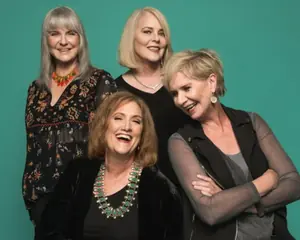


There is a specific, sharp vibration that hits the back of your throat when three voices lock into a perfect triad. Standing in the wings of a drafty Ontario theatre, you can feel the floorboards hum before the microphones even pick up the signal. This is the seasonal reality of the Good Lovelies. Kerri Ough, Sue Passmore and Caroline Brooks have spent over a decade turning the Canadian winter into a professional ecosystem.
They are currently rolling out their 13th annual Christmas tour. It is a grueling, tinsel-strewn circuit that covers the 519 area with the kind of logistical precision usually reserved for political campaigns. This year carries more weight than the usual holiday fluff. It marks the 10th anniversary of their breakout seasonal record, *Under The Mistletoe*, and they are supporting a fresh collection titled *Evergreen*.
The tour stops in Grand Bend, Stratford, Guelph and London. These are not just pins on a map; they are the heart of the folk-pop touring engine in this province. I caught up with Caroline Brooks to talk about the industry of the holidays and why this trio cannot seem to shake the snow off their boots.
When asked about their return to the 519 region, Brooks is quick to acknowledge the regional loyalty that keeps the lights on. "We love that area," she says. "We’ve had such a nice experience over the years touring through Guelph, London, south of there, north of there, it’s been really lovely and we have such a nice following at Christmas time that it’s really special for us to be able to add a few shows in the area this year. So yeah, we’re really looking forward to it."
The London stop on Dec. 12 carries a different kind of atmospheric pressure. It is a homecoming of sorts, specifically for Ough, and the crowd usually reflects that intimacy. It is a "stronghold" in an industry where audience retention is notoriously fickle.
"Yeah, she’s an alum of Western, so we definitely get a lot of her buds from the university coming out," Brooks explains. "And we all have families from the area too. So London has been a stronghold actually. We’ve been doing a Christmas show in London every year since our second year as a band. So this will be, I think, our 12th year doing our Christmas show in London and it’s one of only three places where we have done a Christmas show every year."
But let’s talk about the branding trap. For a serious musician, being labeled a "Christmas act" can feel like a death sentence to your artistic credibility. It is the musical equivalent of being a character actor who only gets cast as Santa’s elves. Brooks did not always embrace the red and green aesthetic.
And that honesty is refreshing. There is a snobbery in the indie-folk world that suggests seasonal music is beneath the "real" art. Brooks admits she carried that weight for a long time before realizing that joy is a valid commodity.
"Yeah, it’s sort of a thing," Brooks says. "I will admit when our band started, I had this, ‘Bah, humbug,’ thing about being a Christmas band, quote-unquote. We do live in two worlds during the year. We have our regular show and then we have our Christmas show and a lot of people who get to know the Good Lovelies come to us through the Christmas show, the Christmas album, and now albums. But when we started, I used to have this chip on my shoulder about being a Christmas band, because in my mind it was like there was something about it that didn’t quite feel super artsy or super creative. But what’s happened over the years is I’ve let so much of that go, because our Christmas show and our Christmas records are so special to people and the amount of joy that comes from that show, from the audience to us and vice versa is so special. It’s become a huge part of people’s yearly traditions. And we’re watching kids grow up in our audience and experiencing that thing. It’s so magical."
The technical reality of being a touring parent in Dec. is a logistical nightmare. You are selling "cozy" to thousands of strangers while your own domestic life is managed via FaceTime from a tour bus. Brooks manages to find a thread of consistency between the stage and the living room.
"I think any one of us would give you a different answer," Brooks says when asked about her personal connection to the season. "For me there’s a special family magic that comes at Christmas time. I have two little kids now and we are really in it. This is the magic time. The kids are so excited and there’s just this feeling, I can’t even quite describe it. It’s this cozy warmth about this time of year and family and traditions and now that has extended to our Christmas tour."
I will admit when our band started, I had this, 'Bah, humbug,' thing about being a Christmas band... But what’s happened over the years is I’ve let so much of that go, because our Christmas show and our Christmas records are so special to people and the amount of joy that comes from that show, from the audience to us and vice versa is so special. It’s become a huge part of people’s yearly traditions. And we’re watching kids grow up in our audience and experiencing that thing. It’s so magical.
She continues, framing the season as an extension of her professional identity. "So for me, I can’t separate Christmas from music, and my best friends, and touring with all these great people, and just lovely interactions with people. So it’s all tied together for me now and it’s made Christmas all that much more special and it’s a lot longer now. Sometimes our Christmas tour starts at the end of November, so we have extended-Christmas. It’s our lives."
The Brooks household—or rather, the Love household—is a study in Toronto domesticity. Brooks married into a name that is almost too on-the-nose for a folk singer. She kept her maiden name for the sake of the brand, a move that shows a level of industry savvy that most fans might miss.
"I love that you called it the Brooks household," she laughs. "Their last name is actually Love, which is so special. Yeah, I married a Love, but when we were married, I couldn’t take his last name, because I could not be Caroline Love of the Good Lovelies for the rest of my life. It was too much."
When the tour ends on Dec. 22, the shift from performer to matriarch is instantaneous. There is no decompression period. It is straight into the tourtières and the family chaos of a cramped Toronto home.
"But there’s a few traditions we have, we get a tree and we set it up and do all that stuff," Brooks says. "We host Christmas Eve, which has become really special. We have this small-ish house in Toronto and we invite all of my husband’s family to come and it’s really squished in here, but it’s really fun, we serve tourtières and then we do the run around. We see my family in Whitby, Ontario and that is so lovely. Big family dinners and we try to really not make Christmas about buying more stuff. It’s really about spending time together as much as we can. Although we have little kids, so they love stuff too. It’s a pretty special time for us, especially after I come off the road, because it’s a very busy month. And so Christmas I’m back in the zone, running the house again. And it’s a really nice feeling for all of us."
The new record, *Evergreen*, is a calculated move to honor their history while refreshing the setlist. It was tracked in Toronto during the spring, a common industry practice that often leads to a disconnect between the performer and the material. But here, they brought back Adam King, the producer who helped define their sound ten years ago.
"Yes, we do," Brooks says regarding the new release. "So this year is the 10th anniversary of our first Christmas album. That album was called Under the Mistletoe. So last Friday we released Evergreen. It’s a collection of new originals, and some songs that we’ve been doing in our Christmas show for the last decade. It’s kind of a way for us to pay homage to the first Christmas record, which is, as I said earlier, a real way that people connect with us in the first place."
The recording process for *Evergreen* was a civilized affair compared to the trauma of their first holiday outing. There is a grit to the Good Lovelies' history that belies their polished harmonies. Their first seasonal record was born in a Toronto heatwave, a city paralyzed by a garbage strike and a complete lack of climate control.
"It didn’t this time, the first time it did though," Brooks says of the springtime recording sessions. "The benefit is we were rehearsing all those songs in the Spring, so our rehearsals this year aren't as intense. Yes and no. I mean we’re in an air conditioned studio. But the first time we made our Christmas record, which was, as I said, 12 years ago, we recorded that during a heat wave in the city of Toronto. And we were in a studio that had no air conditioning."
The imagery is brutal. "There was also a garbage strike. So hot and so gross. And I have this vivid memory of Sue being outside, because we wanted to create a horse hoof sound. We were out sweating on the sidewalk, hacking at a coconut, so that we could use it for a percussion sound. Oh, my God. So yeah, that was a little weird. But now Christmas is such a part of our lives that it’s kind of nice. It was like, ‘Oh, I love these songs. This is great.’ Singing O Holy Night in May."
The title *Evergreen* was pulled from a lyric in their original track, "The Garland." It is a bit of clever marketing, but it also speaks to the shelf-life of holiday music. In an era where streaming numbers drop off a cliff two weeks after a release, a Christmas record is the only product with guaranteed annual ROI.
"So Evergreen is part of a lyric from one of our originals called The Garland," Brooks explains. "And the lyric goes, ‘there’s an evergreen wrapped up in a garland. There’s a Christmas tree at the center of a family.’ We were looking at all these titles for the record, looking through lyrics and evergreen felt right to us, because you can picture it as Christmas. A lot of people have an evergreen in their living room, this time of year. But also the idea of what evergreen means, always new, always relevant and we loved that idea that this Christmas album we’ll return to it every year. It’s not like your regular album recording where a couple of years later it’s your old record. The Christmas albums really can return year to year and people do listen to them year, after year, after year and that’s kind of what was really captured in that title as well."
One of the more daring—or perhaps conventional—choices on the record is a cover of The Beach Boys’ "Little Saint Nick." It is a technical gauntlet. Brian Wilson’s arrangements are notoriously difficult to replicate, especially when you are flipping the gender of the vocal stack.
"That’s a tough one for me because the Beach Boys are male harmony voices singing," Brooks says. "That’s the center of our band, The Good Lovelies is really about harmony singing. So Kerri brought that song to the table and she’s like, ‘I really want to do this song.’ I think she used to listen to the Mini-pops sing it when she was a kid. So when we approached it we didn’t want to stray too far from the original but it’s got a very similar harmony structure and we had the guys sing on it too, so there's a lot of big gang vocals in there. It’s so fun to sing live. It’s a bit of an exercise for sure, but when we were putting it together, like I said, we didn’t want to stray too far from the original, but it definitely has a Good Lovelies stamp on it."
Looking past the tinsel, the band is at a crossroads. Their last non-holiday record, *Shapeshifters*, pushed them into a more polished, pop-centric territory. It was a necessary evolution, but it leaves fans wondering if they are abandoning their banjo-plucking roots for good.
"Shapeshifters is definitely leaning a little harder into the pop category," Brooks notes. "We’re just at the point where we’re writing the next record and we don’t really know where it’s going to lead specifically sonically. We’ll listen to pop music and we all enjoy it. So I wouldn’t be surprised if we continue down that road, but who knows, we might end up making like a banjo record. At this point the world is ours. We haven’t decided specifically what we’re going to do yet."
The origin story of the Good Lovelies is the kind of accidental success that rarely happens in the modern, curated music industry. They were three soloists who decided to harmonize for a one-off show. It was not a business plan; it was a fluke.
"I think the universe got us together in a really special way," Brooks says. "That show was meant to be done as soloists and then it was near Christmas, so we sang three or four songs in harmony. And I can remember the first time we practiced, the hair on my arms standing on end and I just knew immediately there was something really special about it. And so we did that show."
And then the momentum took over. "Then a friend who was at that show said, ‘Hey, I want you to come and open for my CD release party, but I want you to do it as a trio.’ And we were like, ‘Okay.’ So this name Good Lovelies, which was a random name we had slapped on that first show was then the name of our band. And six months later we were recording an EP. And then that summer we played our first festival together. A year later we all quit our jobs and we went on the road. And it kept snowballing. To use a Christmas metaphor. A Winter metaphor. Yeah, we just kept playing and all these things were coming to us, these opportunities and we just kept taking them. And it’s easy to quit your job when your two best buddies are in it with you and you’re making music. It was really special. And now here we are 13 years later and it’s our full time job and the Christmas thing is part of it. So cool."
Thirteen years in, the Good Lovelies have moved beyond the novelty of the harmony trio. They are a staple of the Canadian cultural diet. Whether they are sweating over coconuts in a heatwave or selling out theatres in London, they have managed to turn a seasonal gig into a career that actually lasts. And in this business, that is the only "evergreen" that matters.