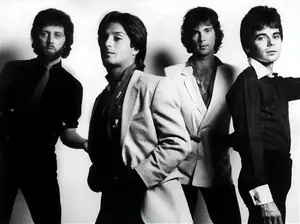


Sitting in a dimly lit room with the physical pressing of *Moving Walls* spinning on the platter, you realize quickly that Matthew Good is no longer interested in being your typical Canadian rock export. The distortion that defined the late 90s has been replaced by something far more cinematic. It is a record of deep undertones, orchestral patterns and a haunting intimacy that feels like a cold wind blowing off Lake Ontario.
Good is back, but he is not the same man who fronted a band and dominated the MuchMusic countdowns. This new collection of songs is multifaceted, trading in the aggression of his youth for a sophisticated, brooding vibration. It is a pivot that feels earned.
But this is not just a stylistic choice. It is a rejection of the status quo. Good is nearly 50 and he has zero interest in pretending he is still 25. He is looking at the landscape of modern rock and he is seeing a lot of Peter Pan syndromes that he simply cannot relate to anymore.
“I think that as you get older, you look at things differently,” Good says. “Nothing personal at all, but I’ll watch someone like Dave Grohl still doing the same fucking thing and I’ll just think, I’m fucking almost 50, I’m beyond that. I don’t want to do that. It’s just not where I’m at in my life at all.”
It is a sharp take, maybe even a bit brutal. But it is honest. There is a specific kind of dignity in allowing your art to age alongside your bones. Good is leaning into the grey areas of his psyche, and the result is some of the most textured work of his three-decade career.
And while some fans might pine for the high-octane anthems of the past, *Moving Walls* demands a different kind of attention. It is a slow burn. It requires you to sit with it, to feel the weight of the arrangements and the space between the notes.
One track in particular, Selling You My Heart, hits with the force of a blunt object. It is not a love song, at least not in any traditional sense. It is a song about the debris left behind after the party is over and the lights are too bright.
“I used the metaphor of being drunk and then you wake up the next morning and you’re next to some stranger and you stand up and it’s a reflection of your life in a bottle in a way, you know what I mean?” Good explains.
He leans into the imagery of that morning-after clarity. It is the kind of writing that feels uncomfortably close to the skin. It is about the exhaustion of the soul.
“Like you look at yourself in the mirror and you see everything that’s in that bottle and you sigh or exhale in a way. It doesn’t really draw parallels as far as me being a writer and talking about art with regards to it being about me and doing certain things, or even selling a part of myself or giving a part of myself away to what I do. It’s way more personal than that,” Good says.
I think that as you get older, you look at things differently. Nothing personal at all, but I’ll watch someone like Dave Grohl still doing the same fucking thing and I’ll just think, I’m fucking almost 50, I’m beyond that. I don’t want to do that. It’s just not where I’m at in my life at all.
That distinction is important. He is not talking about the "selling out" tropes that music critics love to obsess over. He is talking about the literal cost of existence. He is talking about the way a life can be measured in the residue of a glass.
But the record is also shaped by a hard reality that Good has been navigating for over a decade. His life and his creative process changed forever 13 years ago when he was diagnosed with type-2 bipolarity. It was a moment of total collapse that eventually led to a new kind of clarity.
He does not treat the diagnosis as a tragedy or a dark secret. He treats it as a biological fact. It is a refreshing lack of drama in an industry that usually loves to romanticize the "tortured artist" trope.
“I was in a psych ward and three months later I was on talking about it,” Good says. “I don’t think it’s something that’s embarrassing. People have diabetes. I have neurotransmitters that misfire at the nucleic level in my brain. I was born that way.”
The comparison to diabetes is a powerful one. It strips away the stigma and replaces it with clinical reality. You do not blame a person for their insulin levels, so why blame them for their brain chemistry?
“Bipolarity is a neurochemical disorder,” Good explains. “It’s not something that you pick or choose and it’s not something that happens because of trauma or anything else like that. You’re born that way.”
This perspective informs the music. There is a sense of controlled chaos in the new tracks, a feeling of someone who has learned to steer through the storm rather than just being tossed around by it. The orchestral swells feel like the rising and falling of a mood.
If there is a critique to be made, it is that the album can occasionally feel too dense. At times, the "vibrations" he speaks of are so low and so slow that you might lose the thread of the melody. It is a record that demands a quiet room and a good pair of headphones.
But for those willing to do the labour, the rewards are there. This is a mature artist who has stopped caring about the charts and started caring about the truth. And the truth is often messy and quiet.
Good is taking this new sound on the road for a 31-date headline tour. It is a gruelling schedule for a man who just admitted he is feeling his age, but the road is where these songs will likely find their final form. The band is tight and the arrangements are being adapted for the stage.
The tour makes several stops in Southwestern Ontario, a region that has always been a stronghold for Good’s fanbase. He plays London on March 13, Kitchener on March 14 and Sarnia on March 15.
These are the rooms where the intimacy of *Moving Walls* will either shine or be swallowed by the crowd. But Good seems confident. He has been through enough psych wards and recording studios to know how to hold a room.
He follows those dates with a show in Hamilton on March 21. There is also a quick jump across the border for a gig in Detroit on April 15, bringing the new Canadian sound to a US audience that has always had a complicated relationship with Good’s brand of intellectual rock.
And that is the thing about Matthew Good. He is not interested in making it easy for you. He is not interested in being the guy from the 90s who plays the hits and goes home.
He is an artist who is evolving in real-time. He is a man who is comfortable with his misfiring neurotransmitters and his aging perspective. He is, quite simply, beyond the "same fucking thing."
Watching him perform these songs from the front row will be a test of endurance and emotion. But if *Moving Walls* proves anything, it is that there is still plenty of life left in the bottle. You just have to be willing to look at the reflection.