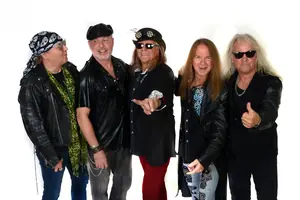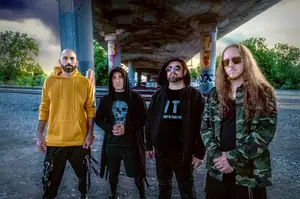

Standing in the back of a dimly lit room in Philadelphia, you can almost smell the spent oxygen and stale beer that defines the city’s rock circuit. It is a gritty, unpretentious scene. Rat Rod fits right into this grimy aesthetic, but they carry a sonic weight that suggests they belong on a massive festival stage in Adelaide or Leeds rather than a corner bar. They are the antithesis of the polished, over-produced pop dominating the airwaves.
The band operates in a space where the distortion is thick and the rhythm is punishing. They draw from the well of hard rock history, specifically the high-voltage electricity of AC/DC and the street-level grit of Rose Tattoo. And they do it without looking like a nostalgia act. There is a contemporary sharpness to their delivery that keeps the music from feeling like a museum piece.
Their third studio effort, *Four on the Floor*, arrived as a declaration of intent. It follows their 2017 debut, *Do You Remember Rock and Roll*, and shows a band that has figured out exactly who they are. They do not bother with complex time signatures or avant-garde experimentation. They play 4/4 hard rock. It is simple, effective and loud.
The record opens with "Cars, Guitars, and Rock-n-Roll," a track that functions as a mission statement for lead vocalist Mark McCarthy. It sets the pace for a ten-song run that feels like a high-speed chase. From the kinetic energy of "All or Nothing" to the cinematic violence of "Call Down the Thunder," the album never lets up on the throttle.
I caught up with McCarthy to discuss the mechanics of the new record. He is a straight shooter, much like the music he frontlines. We talked about the title, which serves as a double entendre for both the band’s technical approach and their obsession with automotive culture.
McCarthy explains, "The bands we collectively admire, including AC/DC, The Angels, and Rose Tattoo, typically use a drumbeat referred to as 'four on the floor'. Given our name, Rat Rod, there’s also an homage to our affinity with car culture as 'four on the floor' hints at a four-speed floor shift vehicle."
This connection to the machine is vital. Rat Rod’s music feels mechanical in the best way possible—synchronized, powerful and heavy. The creative process behind the album was equally methodical. It was not a series of jam sessions fueled by aimless wandering. It was a calculated construction.
McCarthy says, "The recording process always begins the same way. I start by taking riff ideas that either Brice, Mike or I have and making basic demos of the song ideas that I, and often time Brice and I put together."
But the magic happens when the full unit enters the room. This is where the skeletal demos get some meat on their bones. The band values the collective input, ensuring that the final product carries the DNA of every member.
McCarthy says, "When we collectively are ready, we will begin playing the songs together, further refining each of our individual parts. This is where the songs become Rat Rod songs."
The actual tracking of the album was a feat of endurance. The band decamped to Studio E in Westminster, Maryland. They did not go there to linger. They went there to work. The goal was to capture the raw energy of their live performance, something often lost in the sterile environment of a modern studio.
McCarthy says, "We travelled to his studio, Studio E in Westminster Maryland where we set up shop. We went down with 16 songs to record with the intention of capturing basic drum tracks as the focus. As it turned out we got all 16 basic tracks completed with not only good drum takes but most of the bass and guitars that you hear on the album completed in about 12 hours!"
That kind of speed is unheard of in an era where bands spend weeks tweaking a snare sound. It requires a level of tightness that only comes from relentless rehearsal. You cannot fake that kind of chemistry in the booth.
McCarthy says, "I attribute that to all of the preparation that we all put into this."
But the work did not end in Maryland. The band returned to their home turf to polish the rough edges. They moved the operation to Rhawn Street Studios in Philly, working with Lance Walter to finalize the mix. It was a process of refinement, ensuring the "liveliness" they captured remained intact.
The bands we collectively admire, including AC/DC, The Angels, and Rose Tattoo, typically use a drumbeat referred to as 'four on the floor'. Given our name, Rat Rod, there's also an homage to our affinity with car culture as 'four on the floor' hints at a four-speed floor shift vehicle.
McCarthy says, "Once back in Jersey we spent the next few months recording all the overdubs and fixing any mistakes we may have made in Maryland. Once everything was recorded, we mixed the record at Rhawn Street Studios in Philly with Lance Walter."
The result is a significant step up in production quality. *Four on the Floor* has a depth that their earlier recordings lacked. The low end is more pronounced, and the drums have a room-filling resonance that demands a high-volume playback.
McCarthy says, "This record sounds substantially more superior than our earlier work! The dynamics of all the instruments are much broader, and there’s a distinct liveliness to Harry’s drumming. We experimented a bit more with vocal harmony and LJ was given the opportunity to be more innovative on his bass guitar."
One of the standout moments is "Cars, Guitars, and Rock-n-Roll." It is a biographical slice of McCarthy’s life. If you want to know the man, you listen to the lyrics. It is an honest portrayal of a guy who lives for the stage and the garage.
McCarthy says, "When introducing myself to strangers, I often say that I’m all about cars and guitars. The 'rock n roll' addition completes the picture. Given this title, Mike does what he excels at, translating thoughts to paper and concocting the right lyrical concoction."
Then there is "All or Nothing," the obvious choice for a lead single. It is built on a massive hook that feels designed for crowd participation. When you hear it, you can see the fists in the air. The band knew they had a winner with this one early on.
McCarthy says, "'All or Nothing' always gets a great response when we play it live. It’s got a great hook, people dig it. When we sat down with our label and talked about possible singles, 'All or Nothing' was always top of mind and we worked down from there, so it just made sense."
The music video for the track reinforces their no-nonsense identity. Filmed at The Union Firehouse in Mount Holly, New Jersey, it captures the band in their natural habitat. There are no green screens or high-concept narratives here. Just a band playing loud in a room.
McCarthy says, "The video was really just us doing what we do best. We wanted something that didn’t go too deep and have super 'heady' meaning because let’s face it we are a fun rock n roll band not political activists or anything. So we wanted something that showed us in our natural environment so to speak."
And they added some casino footage to drive the point home. It is a literal interpretation of the song’s title. If you are going to play the game, you go all in. There is no middle ground in this genre.
McCarthy says, "The casino footage really signifies going 'all in' which is what the song basically says. All or nothing and not settling for anything less. There’s really nothing any deeper than that."
The album also features a bit of cinematic flair. McCarthy is a fan of the film *Tombstone*, and that fandom bled into the songwriting. "Call Down the Thunder" serves as a sequel to their previous track "Peacemaker (Ballad of Tombstone)."
McCarthy says, "The former is taken straight from the scene where Wyatt Earp bitch slaps Johnny Tyler and throws him out of the Oriental saloon. Call Down the Thunder is based on later in the movie when Wyatt takes revenge on the Cowboys. Just in case you haven’t seen the movie I’ll stop at that."
The track "Hella Ride" has a different origin story. It dates back to the pre-pandemic era, born from a casual rehearsal session. It is the kind of song that proves the best ideas often come when you aren't overthinking them.
McCarthy says, "We recorded the first jam of the music way back in early 2019 at a rehearsal one day. I did what I normally do when inspiration hits, I grabbed my phone and recorded it."
But the album isn't just a relentless assault. "Motherload" offers a change of pace with a slow blues beat. It was written during the height of the COVID-19 lockdowns, a time of forced reflection for everyone in the industry.
McCarthy says, "During COVID, one day in April, I was at my desk doing work when this riff came into my head."
Signing with Vanity Music Group’s Shock Records imprint gave the band the push they needed to reach a wider audience. For an independent band, the right partnership can be the difference between staying local and going global.
McCarthy says, "In a word, exposure. Shock and Vanity are great organizations to work with. They are very supportive and have gotten us attention that would have really been tough for us otherwise to obtain."
At the centre of it all is that "four on the floor" rhythm. It is the heartbeat of the band. It provides a relentless forward momentum that defines their sound. It is simple, yes, but it is also undeniably effective at moving a room.
McCarthy says, "It’s a drive, a pulse that pushes the song along, and we want that same energy in our music."
Now, the band is looking toward international markets. *Four on the Floor* has already hit shelves in Europe and Japan. For a group of guys from Philly, the prospect of their music resonating in Tokyo or Berlin is a massive motivator.
McCarthy says, "Will we be excited to learn how much those markets choose to embrace what we do? Of course, and we will be encouraged by that to continue to make our best music."
They are comfortable with the comparisons to the legends of the genre. Being mentioned in the same breath as AC/DC is never a bad thing. But they are also keen to establish their own legacy. Rat Rod is not a cover band; they are an evolution.
McCarthy says, "We are much more than those two groups or any of the other groups we have been compared to."
Ultimately, Rat Rod is a reminder that hard rock does not need to be complicated to be good. It just needs to be honest. *Four on the Floor* is a high-octane ride that rewards the listener for turning the volume up as far as it will go. The engine is running, and they aren't slowing down.