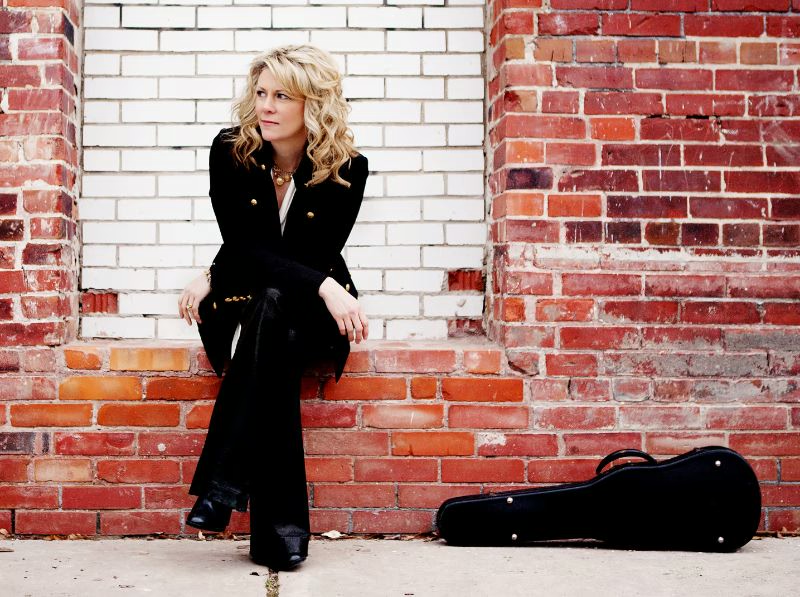
Sitting in the kitchen of Natalie MacMaster’s Lakefield home, you don’t get the sense you are in the presence of a global folk deity. There are no gold records buffed to a high sheen on the walls and no pretentious velvet ropes. Instead, there is the lived-in warmth of a house that handles the chaotic, beautiful friction of nine people under one roof. MacMaster is the undisputed queen of the Cape Breton fiddle, a woman whose bow work has the precision of a surgeon and the soul of a kitchen party.
But she is also a mother, a wife and a logistical wizard. Since marrying fellow fiddle heavyweight Donnell Leahy in 2002, she has navigated the industry with a unique kind of grace. They have seven children. Let that sink in. In an era where most artists struggle to balance a tour schedule with a houseplant, MacMaster is running a small civilization while maintaining her status as a technical powerhouse.
She is bringing that power to the stage soon. She hits Stratford’s Avon Theatre on Jan. 25 and makes her way to Brantford’s Sanderson Centre on April 8. Her latest project, *Sketches*, is a departure from the high-octane arrangements we usually expect. It is a stripped-back affair that leans into the raw, emotive capacity of the fiddle without the safety net of vocals.
We sat down with her to talk about the mechanics of her life and the philosophy behind her music. When asked about the formula for balancing the demands of being a parent, a spouse and a world-class musician, she is refreshingly blunt.
"Well, I’m not really sure. We just kind of do it. I think like anything in life you come to it in little increments. So even for the example of having seven children, we just didn’t have seven children, we had one. You know, you slowly ease into it. Now, this is a big story, it’s like, Oh my gosh, you’ve got seven kids, you home school, you tour, you both have careers, how do you last? Well, you can understand this is the path that life has led us down and we have said yes to follow by many little actions and slowly over days, weeks, months, years, we can make a statement and it sounds like a grand statement, but I really think that anybody given the same set of circumstances that we grew up in and were given, that anybody would do the same thing. It’s not as hard as it sounds. I just do it. I feel like a Nike ad campaign now," MacMaster says.
There is a pragmatism there that you only find in rural communities. It is the "just get on with it" attitude that defines the Canadian East Coast. And it extends to her vision for her family. Most people view seven children as a daunting statistical anomaly, but for MacMaster, it was a quiet, long-held expectation.
"I guess so. I tell Donnell now, and I remember when I was in high school telling my friends I was going to have six kids someday, three girls and three boys. So, I don’t know. Then in my twenties, I mean, for me, I’m always open to all of that. So, we didn’t set out for any amount of kids. We were open to what life is going to give us," she says.
And life has given them a touring troupe. The MacMaster-Leahy household is essentially a traveling conservatory. When the bus leaves the driveway, it isn’t just the road crew and the talent; it is the whole family tree. This isn’t a vacation for the kids; it is their education and their lifestyle.
"Most times, yes. Any big tours we do that are fairly extensive, like two, three or four weeks, we will take everybody. Usually the shows that we do together, we do it with everyone. It’s like it’s a family, more of a family show and that’s what it’s becoming anyway. And then, for gigs that we do separately, we might just take one of the kids, do something special, or something different," she explains.
Watching her and Donnell together is like watching two high-performance engines synced to the same frequency. They are the power couple of the Celtic world, but their bond seems rooted in something far more ancient than modern celebrity. It is about the endurance of the partnership, a concept that feels increasingly rare in the disposable culture of the 21st century.
"Donnell and I look at each other and we say, you know what, it’s pretty good. I think the biggest key for us is that we just come from an era with our parents example where you’re just there forever. You’re going to be there no matter what. We’re flexible with one another. We allow each other to be themselves. We don’t try and force change or anything like that and we’re glued. It just is. It’s how we live and that’s how our parents lived their lives together and that example was given to us. It was an unspoken thing and you don’t discover it until you’re in your parents’ shoes and you don’t even think of it until someone asks the question," she says.
Oh my goodness. I love it. Every time I think of it, I get teary eyed and it comes up on me like that. I just think of it right now and my eyes are welling. Yeah, I love it. Do I miss it? I can’t say I miss it and I don’t know why that is. To be so moved by the place and, but not having feelings of longing for it. ...I’m 100% confident on where we’ve been planted to raise our family anyway.
But do not mistake that stability for a lack of fire. There is a competitive, mischievous edge to their dynamic. If you put them in the middle of a high-stakes musical duel, the roles would be clearly defined. Natalie isn't the one playing by the book.
"Oh, I’d be the devil. Yeah, that’s a great question. Donnell would be Johnny. Donnell is very obedient. I’m a rule breaker. Donnell is just with little things, I always get a kick out of when we’re walking through airports and it says, don’t drive your stroller on this walkway and I’ll just quickly do it, you know? Donnell’s like, Oh, you can’t do that," she laughs.
That rebellious streak is exactly what makes her playing so vital. She doesn't just play the fiddle; she interrogates it. There is a conversational quality to her music, a way of bending notes that feels like a dialogue. And as she gets older, that dialogue is becoming more profound. She is noticing the shift in her own "voice" as she looks back at her earlier work.
"Yeah. I mean it’s funny, somebody just recently gave me a copy of a thing that was done in 1994, so it was 25 years ago and at some festival somewhere. We were listening to it yesterday and I was analyzing my music then. I mean I feel like I’m the same, but there’s something more seasoned, I think, about me now and to just answer your question, I definitely feel as the years go on and times go on and you keep at your craft, you do mature with it in ways that you can’t predict. And it’s a subtlety, but it is there and it is definite and obvious, but it’s subtle and it’s beautiful. And I do like the transformation, the slow transformation," she says.
This concept of "seasoning" isn't just an abstract idea. It is a physical reality in the world of traditional music. She recalls a moment with her uncle, the late Buddy MacMaster, that perfectly illustrates the difference between technical proficiency and the weight of a life lived.
"And I remember one time my uncle Buddy MacMaster, who was, who passed away two years ago, he was 89 when he died, but we passed a fiddle around one time at our house. Buddy was sitting there and there was a bunch of people like myself and Donnell, and some of Donnell’s siblings who played fiddle and a few friends, they were all fiddlers. So there were 12 of us and we passed this one fiddle around and everybody had to play a little piece of a tune on the fiddle. And when it got to Buddy’s hands and he would’ve been probably 80 or we’ll say in his 70’s, he was probably in his late 70’s at the time. When it got into his hands, it just sounded like a different instrument. There was a calm seasoning about it. A season found, a maturity of depth. A calm that was not existent in any of these other fiddlers, myself and Donnell included, like there were good fiddlers there and here’s this old guy and so yeah, I’m looking forward to living through that change," she reflects.
It is rare to hear an artist of her calibre admit they are still struggling with the basics. But that is the secret to her longevity. She hasn't reached a plateau because she refuses to believe one exists. Even after nearly four decades, the instrument remains a mystery she is trying to solve.
"It’s freaky, but I’m so just excitedly discovering new things. I can’t quench the thirst. Yeah, it’s awesome. And I don’t know why. You’d think after all these years, I’d be sick of it. I think it’s just the change of the, the thrill of the game is still there. The game being, what’s going to come, what’s around the corner? What can we try for and achieve, that’s the game. How do we do this? How do we do that? And then, the actual music of it is the game, and then there’s the actual music that is an absolute delight, like to write music. I love writing music. I never get to do it very often. That’s probably why I like it so much. I’m always consumed with parenting, which is number one. So, you get that in little bits and I just love it. Love trying to be a better player. I’m still working on my intonation. Its 37 years. It’s still an adventure. It’s still exciting," she says.
Her perspective on difficulty has shifted too. What used to be a mountain is now a molehill, but she respects the climb her own children are making. She understands that musical growth is relative to the stage of life you occupy.
"That is a different answer for different stages in my life. I was telling the kids the other day, they obviously all play fiddle and one of my daughters said, mom, I want to learn this tune called Olympic Reel. And she’s eight and I said, “Julia, I was like 25 when I had to learn that tune.” And I said, “It took me a month.” It took me a whole month. And now, when I play the tune, I realize this tune isn’t that hard. But at the time, it was a new challenge for me. And so, that was where I was at then. Now okay, I can remember when I was in my teenagers learning Tullochgoram, which is a traditional Scottish piece and it took me probably a month. Now, to learn it, it would take me a day probably. It just depends on where you’re at in life," she says.
That sense of perspective is the driving force behind *Sketches*. The album is a deliberate rejection of the "more is more" philosophy of modern production. By stripping away the piano and the big arrangements, she has left the fiddle exposed. It is a brave move for an artist who has spent her career in the spotlight.
"Because, I felt like I wanted to give the listener a sense this record was a sketch of the music, basically. It is not a full band. It is not a big production. It’s an outline of the music. And the reason why I don’t want to do a lot of music is I recorded the whole record with guitar. Just a guitar player. The first time I’ve never had piano on a recording and I did it with just guitar and then, I over dubbed the bass. It’s very simple. I mean the arrangements are still very intricate, but just a couple of people playing melody. That’s why it’s called Sketches. I’ll let you fill in the rest. And, on the cover is a picture of a hand, a bird settling in someone’s hand and it’s meant to represent a rare beautiful moment," she explains.
The artwork itself was a point of contention. In a house full of seven children, the obvious choice was to use their creativity. But MacMaster wanted something that spoke to the specific aesthetic of the music—something minimalist and evocative.
"I can’t draw. Actually, originally Donnell and I were saying, Oh my gosh, we could have the kids artwork, you know? But then we thought, Oh, it might look like it’s a kid’s record. We thought, no, we won’t do that. I had a girl draw something. I didn’t tell her what, but we talked about conceptually, what we wanted it to say. I want to say it was different than normal. She was thinking rare bird, settling on the hand and I see real beauty in the simplicity of it. Anyway, that’s getting really deep about it, but you asked, so there you go," she says.
Despite her life in Ontario, the ghost of Cape Breton is always present. You can hear it in the grit of her playing and see it in the way she talks about home. She is a woman caught between two worlds—the farming village where she is raising her family and the rugged coastline that forged her identity.
"Oh my goodness. I love it. Every time I think of it, I get teary eyed and it comes up on me like that. I just think of it right now and my eyes are welling. Yeah, I love it. Do I miss it? I can’t say I miss it and I don’t know why that is. Like, to be so moved by the place and, but not having feelings of longing for it. I don’t have missing type feelings. I have feelings of favoring and loving and gratefulness and we go there a lot. I mean we’re there three or four times a year anyway. I see my parents probably six times a year, because they come up or they meet me at a gig somewhere or something. I remember when I was in my twenties, I remember the first year we were married, I was home in Cape Breton more than I was the previous five years," she says.
She has spent decades in transit, a professional nomad who has managed to plant deep roots. The distance doesn't diminish the connection; it just changes the nature of it.
"Maybe that prepared me. I’ve just been used to jet setting and gone, gone, go, go, go going, and going. I’ve been leaving Cape Breton for decades and I guess I’m used to always feeling like, well I’m just gone for a bit, but that’s my home, you know what I mean? I still feel like that. I feel I’m just gone for a bit. I know, it’s strange, but anyway, it’s good. I don’t analyze it too much, because I don’t want to change. I mean, I don’t live there now. We’re raising our kids in a little farming village in Ontario and I wouldn’t change that. I just love it. I don’t know why I have such a sentimental attachment for home, but yet I’m 100% confident on where we’ve been planted to raise our family anyway," she concludes.