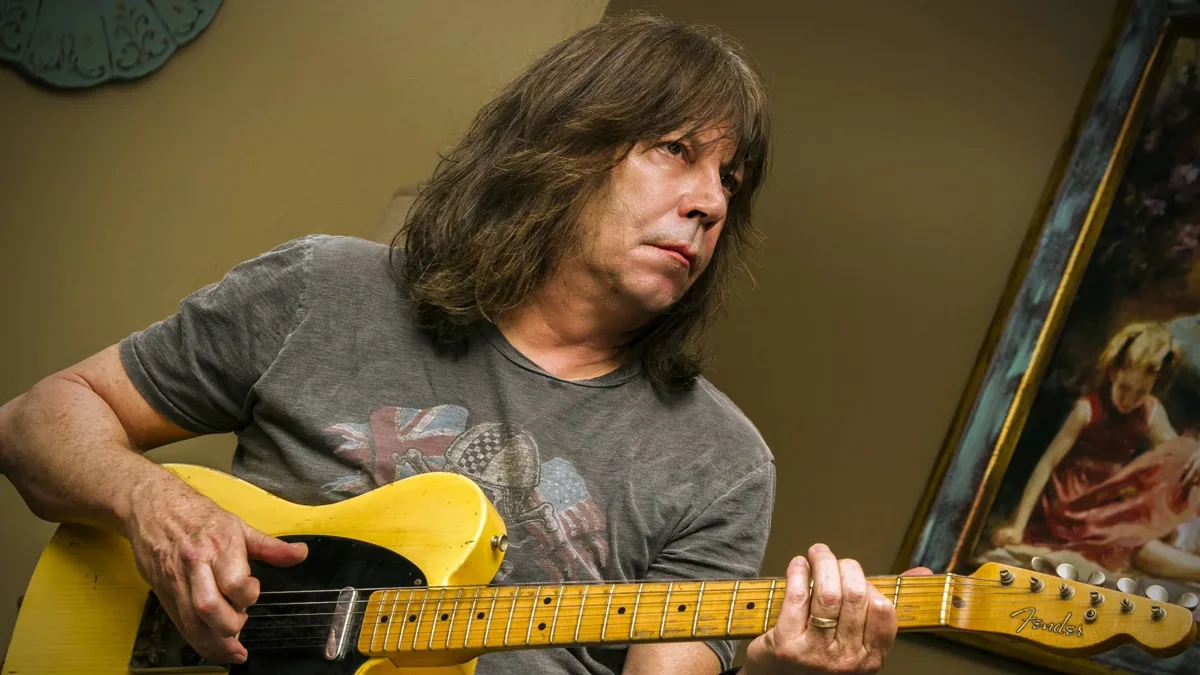
Looking at the raw transcripts from this 2018 conversation with Pat Travers is to look at the anatomy of a true rock and roll survivor. Here was a guy on the line for what he thought was a George Thorogood pre-show interview only to find out he was booked to talk about a blues festival in Windsor. But the initial confusion quickly gave way to the candid and unflinching memory of a man who has seen the inside of the rock machinery for decades. It’s a machine he’s outlasted largely on his own terms.
The central pillar of that legacy was looming at the time of our call: the 40th anniversary of Live! Go for What You Know. But any notion of a grand artistic statement is immediately shot down by Travers. This was not a masterpiece by design. It was a product of exhaustion and financial necessity, a stopgap record to squeeze some advance money out of the label so he could finally get off the road after four brutal months of touring.
“I was looking forward to having a few months with no touring obligation,” Travers says, recalling the pressure cooker of the late 1970s. The plan was simple: record the last few shows, hand in the tapes, collect the cash, and take a break to write the next studio album. The label wanted it mixed and released immediately, a demand Travers met with near indifference. He was done with the material and had zero interest in reliving it note for note in a studio.
He booked time at Bayshore Studios in Coconut Grove with producer Tom Allom, fresh off landmark work with Judas Priest and Black Sabbath. And his instructions were clear. No fixing it in the mix. “A lot of people with live albums would really fart around with them in the studio,” he explains. “Bands would come in and redo this and that. But I didn't wanna do that. I wanted to get this project done, move on.”
His one concession was a single harmony vocal from guitarist Pat Thrall that didn't get picked up by a microphone. That’s it. “I think the fact that I just left it alone and it has this great rawness to it and didn't make really any attempt to sand down any of the rough edges and just left it that way,” he reflects. “It jumps out of the grooves, you know. It just seems to come at you out of the speakers the way a lot of recordings don't.”
There's a massive lesson there. In an era where live albums were becoming increasingly polished and overdubbed to perfection, Travers’s fatigue-driven laziness produced one of the most honest and electric documents of the era. It’s a happy accident of the highest order. Most of the album was pulled from a single blistering show in Gainesville, Florida, not because it was magically superior but because it was easier. It was all on one reel of tape.
And then there was the song that changed everything. “Boom Boom (Out Go the Lights),” the track that became an FM radio monster, was an outlier taken from a show in Orlando. Its inclusion was almost an afterthought, yet it became the engine that derailed his plans for a vacation. The song’s origin story is pure Canadiana, a memory lodged in his brain from when he was just 13 years old.
They played this song and I heard it once when I was 13. And then fast forward to, what, about seven years later, eight years later, and I'm in London, England working on my very first album. And and I'm short one song... So I remembered this song, boom boom, I'll go to lights.
Travers was in his hometown of Ottawa, hanging around his uncle’s music store on Bank Street, which was supplying gear for the annual fair. He saw a bluesman from Hamilton named Richard Newell, who performed as King Biscuit Boy. “I really, the only song I remember is Boom Boom I'll Go the Lights. They played this song and I heard it once when I was 13,” he recalls. Years later in London, short one song for his debut album, the memory surfaced. He tracked down the record and cut his own version.
The live arrangement, however, morphed into something else entirely, a call-and-response monster born from spontaneous audience interaction. That organic energy is precisely what the live album captured, and it’s what sent him right back out on the road. “I was just, you know, having fun doing nothing and working on new material and being a, you know, a 24 or five year old rock star with super long hair and stuff,” he says. “And then it's like, we gotta get out on the road. Boom Boom (Out Go the Lights) is a huge FM radio hit.”
The irony is that the forced touring schedule inadvertently led to his finest studio work. The follow-up album Crash and Burn was recorded in fits and starts over eight months between tour dates. This piecemeal approach allowed him and producer Dennis MacKay to focus intensely on two or three songs at a time, ensuring every performance was top-tier. It was a process born of necessity that yielded what Travers considers “a real piece of aural art.”
His career is peppered with these moments of being in the right place at the right time. He talks about his first major US tour in early 1978, opening for Rush. It was a trial by fire. “They only gave us thirty minutes, you know, to play every night,” he says. “And the first fifteen minutes of that, most of the people were finding their seats.” But in that final window, they would unleash a torrent of energy that won over Rush’s notoriously discerning crowds night after night.
This wasn't just a gig; it was a front-row seat to rock history. He remembers Geddy Lee playing him rough mixes of the songs that would become Moving Pictures. “I remember going, 'Man, you guys are gonna get, you're actually gonna get some airplay on this,'” he told Lee. “It was really obviously, even in the rough mix stage, that, you know, this was very cool stuff.” He wasn’t wrong.
His connections run deep. He was one of the first people Gene Simmons welcomed to New York City back in 1977. More critically, he’s the man who introduced Doc McGhee to KISS. Years later, he did a handful of dates on the Lick It Up tour and offers a sharp, unvarnished take on that controversial era. Without the theatrics, he argues, the magic was gone. “In the absence of that, they were just kind of an okay rock band,” he states bluntly. “It was Doc McGhee, who I introduced him to, who said, 'You gotta have the makeup and the smoke bombs.' He said, 'If you don't have that, then you don't have KISS. That's what KISS is.'”
That same candour applies to his memorable cameo on Extreme’s “Get the Funk Out.” Nuno Bettencourt, a massive fan, was persistent after a chance meeting in Los Angeles. Travers flew out ready to lay down vocals and guitar tracks only to be met with a very specific request. “He said, 'I just want you to sing this line, and if you could sing it almost exactly like the demo,'” Travers laughs. “So I didn't even really get to improvise there.”
Beneath the anecdotes is a philosophy about his instrument. He’s a melody man, a disciple of B.B. King and Albert King, who values economy and phrasing over pyrotechnics. “Any person can sit on the end of their bed for eight hours a day and learn how to play like... Joe Satriani,” he muses. “But I just don't know, you know, what that all adds up to. You know, it's kinda just like a display of skill as opposed to trying to make a piece of music that has emotion.”
In 2018, he was still chasing that emotion with a lean and powerful trio featuring drummer Tommy Craig and bassist David Pastorius, the ridiculously skilled nephew of jazz fusion legend Jaco Pastorius. He spoke of a new model for his music: recording a few songs at a time, shooting video, and promoting them independently one by one. It was the sound of a veteran artist taking full control, refusing to be boxed in by an industry he’s long since figured out.
And that’s the takeaway. Pat Travers never stopped being a working musician. Whether it’s a festival in Windsor, a rock cruise in the Baltic Sea, or a studio in Florida, he remains in motion. His career wasn’t built on a grand plan but on instinct, grit, and a few very fortunate accidents. And it’s all the more authentic for it.
519 Magazine Archive: We are thrilled to officially unearth the 519 Magazine Digital Vault. This isn't just a re-post; it's a high-fidelity restoration of a pivotal era in music journalism. By pairing original print dates with modern retrospectives, we’re bridging the gap between historical rock-and-roll grit and the lightning-fast performance of today’s web. These stories—once locked in physical print and lost URLs—are now back, fully searchable, and optimized for a new generation of fans.
Get Tickets

We are thrilled to officially unearth the 519 Magazine Digital Vault. This isn't just a re-post; it's a high-fidelity restoration of a pivotal era in music journalism. By pairing original print dates with modern retrospectives, we're bridging the gap between historical rock-and-roll grit and the lightning-fast performance of today's web. These stories—once locked in physical print and lost URLs—are now back, fully searchable, and optimized for a new generation of fans.