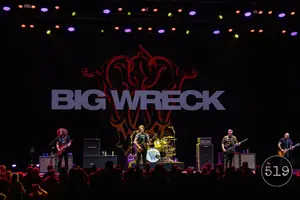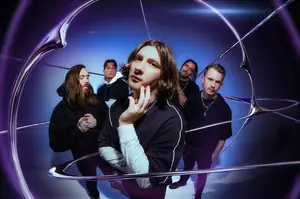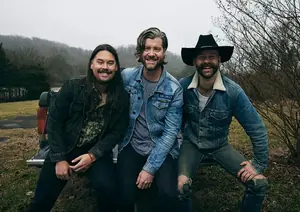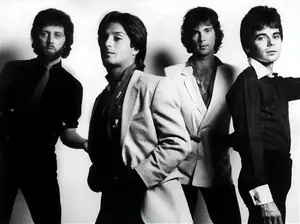


Standing in the back of the Imperial Theatre in Sarnia, you can smell the history—a mix of old velvet, floor wax and the faint, electric ozone of a lighting rig warming up. It is a tight, intimate room, the kind of place where a band like Marianas Trench can’t hide behind arena-sized pyro. They have to actually play. I am leaning against the soundboard, watching the roadies tweak a pedalboard, thinking about how rare it is to find a genuine human tether to the people on stage. Usually, the "rock star" interview is a choreographed dance of PR-approved platitudes. But Matt Webb, the long-standing guitarist for the Vancouver pop-rock juggernaut, accidentally stepped into my orbit through a bizarrely domestic connection.
A few years back, I was grinding away at a newspaper in Regina alongside Gary King. Gary is a solid guy, a veteran of the ink-and-paper era, who also happens to be the father of Jessica King. For a stretch of time, Jessica—a Playboy model with her own gravitational pull—was dating Webb. The relationship has since dissolved into the ether of "former flames," but the bridge remained. When I sat down with Webb ahead of the band’s sold-out Sept. 5 show, I decided to burn the professional distance immediately.
"I wanted to start by saying we have a slight connection," I say, testing the water.
Webb looks up, curious. "Oh do we?"
"We do. You dated Jessica King for a bit," I counter.
"Yeah..." he says, his voice trailing off as he prepares for whatever gossip might follow.
"I’m really good friends with her dad Gary," I clarify.
The tension breaks instantly. Webb’s face lights up with genuine recognition, a far cry from the rehearsed grin of a junket. "Oh you’re kidding me."
"I used to work with Gary in Regina," I add.
"Oh you’re kidding me. I love Gary, he’s a great guy. I still see him sometimes when we’re in Regina," Webb says.
And just like that, the wall is down. We aren’t just a journalist and a subject anymore; we’re two guys who know the same people in a small industry. It is the perfect leverage to pivot into the meat of his current trajectory: a solo career that exists in the massive shadow of the Trench. Webb recently dropped a track called "Again and Again," a piece of power-pop that feels lighter and less burdened by the operatic weight of his main gig.
"It’s great to hear new solo stuff from you. Again and Again is a cool song," I tell him.
"I was sitting around with a little spare time and I thought I would throw out a song. Nothing serious but yeah it was a lot of fun," Webb says.
But here is the thing about side projects in the Canadian music scene—they are rarely just "fun." They are a pressure valve. When you are in a band known for sprawling, symphonic concept albums, sometimes you just want to write a four-chord hook that doesn't require a libretto. I ask him how he decides which ideas get sacrificed to the band and which ones he keeps for himself.
"Well I don’t know," Webb admits. "When I was writing it I was writing with some other friends completely separate of that Mariana’s stuff and had every intention of it being a solo song. I don’t know why I just had it and we did it in December and I wasn’t in the studio and I wasn’t on tour and I was just by myself hanging out with some other friends."
It is a classic creative's dilemma. Do you hold back the "A-game" for the commercial beast that pays the bills? Webb is remarkably candid about the hierarchy within Marianas Trench. He knows his role, and he knows the brilliance of his frontman, Josh Ramsay. There is no ego here, just a pragmatic understanding of the machinery.
"Well you know with Mariana, Josh is obviously the brains behind that one," Webb says. "He’s the primary songwriter obviously so he always wants to save his A-game for the Trench. You’re always trying to do your best, but there’s just certain stuff that you come up with that doesn’t necessarily fit into that particular style and maybe you save it for some other project. We’re creative people and it’s always fun to just make music whether it’s suites Marianas Trench or not."
Josh is obviously the brains behind that one. He’s the primary songwriter so he always wants to save his A-game for the Trench. ...there’s just certain stuff that you come up with that doesn’t necessarily fit into that particular style and maybe you save it for some other project. We’re creative people and it’s always fun to just make music whether it suits Marianas Trench or not.
The visual side of Webb’s solo work is equally telling. In the video for "Bad Girl," he was the focal point, the leading man. But for "Again and Again," he took a backseat, opting for a meta-narrative where he is essentially an extra in his own story. It is a self-deprecating move that fits his personality—the guy who would rather be at the bar with Gary King than under a spotlight.
"Oh thanks, that was a fun shoot," Webb says when I mention the cameo. "I’m such a miserable actor. I don’t like to plaster my face all over the place. People have seen enough of me, they can find me in other places if they need to. I just like the idea of doing a video. It was great, because I just got to sit around and eat food all day and watch the actors at work."
This lack of vanity is refreshing. In an era of hyper-curated Instagram aesthetics, Webb is happy to be the guy eating craft services while someone else does the heavy lifting. But the timing of the release is interesting. Ramsay also has a solo single floating around. In most bands, this would be the start of a "creative differences" press release. In the Trench, it seems to be encouraged.
"Is there a friendly rivalry between you guys?" I ask.
Webb laughs, a quick, sharp sound. "You know what, there’s no rivalry at all. I think it’s like everybody’s wishing maximum success for everybody else - it’s meant to be shared. I can’t compete with that guy, are you kidding me? He’s such an accomplished and successful songwriter and myself on the other hand, am not so much, so I really can’t compete."
It is a bold admission of the band’s internal dynamic. Most guitarists would claim they are the secret sauce. Webb just points to the chef. But there is a danger to this fragmentation. If everyone is busy building their own brand, does the main house start to crumble? Webb argues the opposite. He sees these solo ventures as a way to keep the engine idling while the main bus is in the shop.
"Oh absolutely not," he says, dismissing the idea of a band-wide threat. "In fact I find that this stuff really helps the band because we’re in between album cycles right now with Mariana Trench and we’re in the studio working on new stuff, but sometimes our stuff isn’t ready to come out yet and people haven’t heard anything from any of us in a while. Its nice when Josh puts out a song or Mike puts out something or I put out a song. It’s just like keeping the name out there, keeping that brand alive. We’re literally spending 40 hours a week in the studio right now working on a new record – things couldn’t be any better."
That 40-hour work week is the unglamorous reality of the Canadian music industry. It is a blue-collar grind. They are currently deep in the guts of their next record, and the anticipation is starting to boil over.
"So you just said you were in the studio, when can we expect the album out?" I ask.
"That’s a good question," Webb says. "I am really hoping for a release before the end of the year. I think we’ll be done. I would say we are 60/70 percent of the way there. It’s getting close and the songs are really awesome, really strong and feel like it’s some of the best material that we’ve ever done. I’m really excited to release it."
The Trench has built their reputation on the "concept album"—the kind of ambitious, theatrical storytelling that most bands abandoned in the 1970s. From the cinematic sweep of *Masterpiece Theatre* to the 1980s synth-drenched *Astoria*, they don't just release songs; they build worlds. I try to pry the theme of the new record out of him.
"Yeah there is," Webb confirms regarding a concept. "It’s always nice to have a concept piece, for the writing and the recording and then a live show with photos and outfits. We’re keeping it all close to the chest right now because we want it to be a surprise for everybody."
This commitment to the "bit" is what separates them from their peers. They understand that pop music is as much about the costume as it is the chorus. But Webb admits this wasn't always the plan. The band didn't start with a manifesto; they stumbled into the theatre.
"Yeah I think it just kind of evolved that way," Webb says. "Certainly we didn’t set off from the very beginning like that, but as we started focusing on concepts it made everything more fun and more cohesive. If you have an overall concept you can pull from it for everything – from the production of the show, the lighting, the style of photos that you take and the outfits that you’re wearing; the mood of the songs that you’re recording; the instruments that you were playing everything like that. I never really thought about that until we started doing that. So instead of just having a rock record, you’re dressed as vampires or something like that and it’s all sort of cohesive in a way."
The mention of "vampires" isn't just a throwaway line; it’s a nod to the band’s willingness to look ridiculous for the sake of the art. It is a high-wire act. If you miss, you look like a high school drama club. If you hit, you’re Queen. Webb’s own writing process is far more grounded, a mechanical construction that balances Ramsay’s more ethereal approach.
"Me personally? What I usually do is sit down at home and create a demo," Webb explains. "I have some drum ideas and some bass ideas and I build guitar ideas and a musical track around it. And then the last thing to come is generally that the melody and the lyrics for me and that’s the way that I write. Josh is kind of the other way around. He starts with a melody in his head and then builds a song around that. And obviously he’s pretty good at it so maybe he’s doing something right and I’m doing something wrong, but I don’t think there’s rules. Some people like to start with the title and then they build around that, while others start with the whole lyrical concept. I’m a musician first and a writer later, so I start with the music and it develops from there."
There is a certain technical honesty in that. Webb is the architect; Ramsay is the interior designer. They have been doing this since they were teenagers, an age where most people are still figuring out how to do laundry, let alone navigate the Juno Awards. The band has transitioned from the post-grunge angst of the early 2000s—opening for Three Days Grace—into a polished, genre-bending entity.
"Yeah it’s definitely grown with all of us as we’ve grown older, you know certainly in terms of songwriting style," Webb says. "There’s different experiences to reflect on as we’re older now and when we first started we were very much like a rock band and opening for Three Days Grace and Theory of a Deadman. Now we’re sort of a pop rock band and we’re still doing what we’ve always done, but it’s just evolved along the way. And you know as we gain more experience, hopefully that’s all reflected in the music that we make, and the shows that we play."
Despite the shifts in the industry—the death of the CD, the rise of TikTok—the core of the band remains remarkably stable. They are the rare Canadian export that hasn't imploded under the weight of its own ambition.
"So you must still enjoy doing what you’re doing then?" I ask.
"Absolutely yeah. We have so much fun," Webb says. "We have a lot of fun in the studio together and then when the studio stuff is done, we have a lot more fun on the road together. It’s like a family of four plus our crew. We’ve been together for a very long time and have a lot of fun, but I think we’ll continue to do it as long as we can. I don’t think it gets any better than this, to be honest with you."
Part of that fun involves their legendary red carpet appearances. They have shown up in everything from inflatable suits to horse-drawn carriages. It is a middle finger to the self-serious nature of the awards circuit, and Webb promises the stunts aren't over.
"We like to wait till the last minute for those things and then quickly brainstorm something incredibly inconvenient and uncomfortable," Webb says. "Sometimes we’re restricted by permits and by the bylaws and you know rules and stuff, but we certainly try to do wacky things and I can’t imagine us stopping that for any reason. The problem is it’s tough to top yourself every year. You know what I mean, like we’ve had some pretty legendary red carpets instances over the years but they keep upping it every year it gets more and more challenging."
But beneath the "wacky" exterior lies a darker history. Josh Ramsay’s past struggles with heroin addiction are well-documented, a narrative that often threatens to overshadow the music. Webb, who knew him long before the fame, had a front-row seat to the chaos.
"It’s tough to say," Webb says when I ask about seeing the worst of it. "I met Josh when I was in grade school and he’s a little bit older and he was just a wacky guy. I didn’t really see him as worst or anything – he was basically in school for a while and then he just disappeared, and I guess at the time I was like 'Where the hell did that guy go', but he was actually no longer in school because of some issues he had. I didn’t know any of that at the time, I was just pretty fresh so I didn’t really know what was going on and we didn’t become super close until after that time in his life."
I ask Webb if he ever felt the pull of that lifestyle, the stereotypical "rock star" pitfalls that claimed so many of their contemporaries.
"I’m sure it’s possible it could have been anybody, but I just never went down that path," he says. "I don’t know why and I thank my lucky stars that it didn’t. That was something didn’t really appeal to me. I just wasn’t interested."
The bond between Webb and Ramsay is clearly more than just a business arrangement. It is a brotherhood forged in the trenches of the Vancouver indie scene and tempered by 15 years of shared history.
"Oh yeah absolutely, we speak our own language I suppose," Webb says. "It’s probably like we’re twins or something like that. We all know everything that there is possible to know about one another in our band that’s for sure. That’s what happens when you spend 15 years together. I mean I spend more time with the band guys in a band with anybody else."
As we wrap up, the conversation turns back to the immediate future: the sold-out show at the Imperial. Sarnia is a tough town, a border city with a blue-collar edge, but it loves its rock stars. Webb prefers these smaller, sweatier rooms to the cavernous arenas.
"The small shows are awesome because you can engage with the audience so much more," Webb says. "You know you can make eye contact with every single person in the room which you can’t do at a bigger venue or an outdoor venue. I love the energy of the small shows. The big shows are so much fun because you get to incorporate a larger than life production, and you feel like a big rock star up there. But then when you get back into clubs you realize you’re missing a lot of that audience interaction and a lot of that energy that comes from those shows."
Watching Webb prepare to take the stage, it is clear that he is exactly where he needs to be. Whether he’s dating a Playboy model or talking shop with Gary King’s former coworkers, he remains the grounded anchor of a band that is constantly threatening to float away into its own conceptual stratosphere. Sarnia is in for a hell of a night.
Get Tickets