
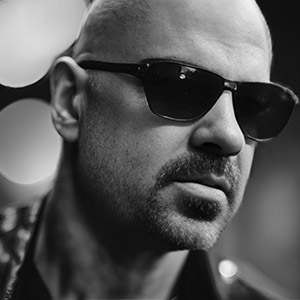
Sitting in the back of a dim studio, the smell of ozone and expensive guitar cables heavy in the air, you get the sense that Jason Hook is finally breathing. For years, he was the precision-engineered engine room of Five Finger Death Punch, a multi-platinum machine that demanded a specific kind of servitude to the riff. But that was then.
Now, Hook is leaning back, nursing a coffee and talking about *Dark Side of the Brain*. Released July 19 via Fearless Records, the debut album from his new outfit, Flat Black, is less of a career pivot and more of a hostile takeover of his own creative identity. It is a record that feels heavy, not just in its tuning, but in its intent.
Hook is not interested in the usual PR fluff. He is direct. He is wired. The enthusiasm he has for this new chapter is almost jarring compared to the stoic professional he portrayed for a decade on global stages.
"I'm so excited to have shared these songs with the public," Hook declares. "Dark Side of the Brain is personal, every lyric came from a real place."
And you can hear it. The record avoids the bloated, cookie-cutter metal tropes that have plagued the genre lately. Instead, it offers something leaner. The name of the band itself suggests a lack of pretension—a matte finish on a high-performance vehicle.
The origin story of the moniker is pure Vegas, fitting for a man who spent years in the neon glow of the desert. It was not a boardroom decision or a focus-grouped branding exercise. It was an observation.
Hook recounts the moment: "I was driving past the Las Vegas private airport and saw a private jet that was painted flat black. It looked so amazing. I started to think about that as a name. It's a colour, not unlike Deep Purple. Everyone liked it, so that ended up being the name."
It is a sharp choice. In an industry obsessed with neon and digital gloss, Flat Black implies a certain industrial weight. It is the absence of light, a solid foundation that does not need to scream for attention because its presence is undeniable.
But a name is just paint if the engine is shot. Hook knew that to make this work, he needed a unit that could actually play, not just look the part in a music video. He went on a scouting mission that prioritized talent over social media following.
"Well first and foremost, I wanted to find top-notch musicians," he explains. "The drummer had to come first. Without a good drummer, you don't have that solid foundation. I wanted to find people that could also sing well... we do all our backgrounds, the three of us."
This focus on vocal harmony is where Flat Black separates itself from the pack. While most modern metal bands rely on a single vocalist backed by a wall of pre-recorded tracks, Hook wanted a live, breathing choir of three. It adds a texture that feels more classic rock than Pro Tools.
The search was not just about finding the right hands for the instruments. It was about finding the right heads. In a touring band, you spend 22 hours a day waiting to play for two. If those 22 hours are miserable, the music suffers.
"Lastly, it's all about the hang," he adds with a laugh. "I wanted to feel a connection to these people on a personal level. That part is vital."
Well first and foremost, I wanted to find top-notch musicians... Lastly, it's all about the hang. I wanted to feel a connection to these people on a personal level. That part is vital.
The timeline for this assembly was strange, dictated by a global shutdown that most artists found crippling. For Hook, however, the silence of the world provided a rare opportunity to build his fortress without the usual industry noise.
"I think the pandemic worked to my benefit," he reflects. "Don't get me wrong, it was a horrific time for the world. But in a way, there was no activity. People were sitting around doing nothing... which made it easy to link up with people and get their attention."
It was during this forced hiatus that the DNA of Flat Black was coded. While other bands were trying to figure out how to livestream from their living rooms, Hook was obsessing over the human element of his new recordings.
He has a legitimate grievance with the current state of rock production. Everything is too perfect, too gridded, too devoid of the "mistakes" that make a record feel alive. He wanted to push back against the digital tide.
"I really wanted to focus on highlighting the people and their performances," he states. "I feel like computer music has taken over. Also, I wanted to be picky about the songs. I tried to pick the best 14 from the 30-35 that were written."
That level of curation is rare. Most bands write 10 songs and put 10 songs on the album. Hook’s willingness to kill his darlings—cutting more than half of the written material—shows a level of discipline that only comes from years of high-level industry experience.
The result is a record that feels curated rather than just compiled. The lyrics, in particular, carry a weight that suggests Hook is processing the fallout of his previous professional life. He is not naming names, but he is not hiding either.
"All the lyrics came from a real place," he reveals. "If you look at my recent history, some of it might make sense."
It is a tantalizing breadcrumb for fans who followed the drama of his departure from 5FDP. But even without the gossip, the authenticity of the performance on *Dark Side of the Brain* stands on its own. It sounds like a man who has something to prove, mostly to himself.
His time with his former band was not just about the fame; it was a masterclass in the technical side of the industry. He was not just a hired gun; he was a student of the studio environment.
"I learned a lot about making records, which is my passion," he reflects. "I studied with Kevin Churko and was intimately involved in all those records. I even built a home studio to loosely match the Hideout so I could practice at home."
That education is the reason he decided to sit in the producer’s chair for this debut. It is a risky move—self-production often leads to a lack of perspective—but for Hook, it was the only way to ensure the vision remained pure.
"No one is going to care more about your record than you!" he exclaims. "I'm very picky... I had a vision. Sometimes producers can apply too much of their vision. These recordings are personal. I knew exactly how I wanted to present Flat Black."
The production is indeed slick, perhaps a bit too polished for those who prefer the raw grime of the underground, but it fits the stadium-ready ambitions of the songs. It sounds expensive. It sounds like it belongs on a main stage.
Despite being the clear architect of the project, Hook is quick to dispel the notion that this is a solo project with session players. He wants the friction and the "magic" that comes from a group dynamic.
"It's a band, everyone has a voice," he asserts. "My role is to pick through the suggestion box and try to identify which ideas have magic."
That magic is now being tested in the real world. Flat Black has been out on the road, securing a coveted opening slot for Godsmack. It is a trial by fire, playing to massive crowds who are often there for the hits they know, not the new band they don't.
"I'm grateful to Sully from Godsmack for giving us the chance to get out on the road and play for such an amazing group of fans," he says.
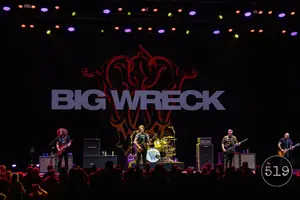
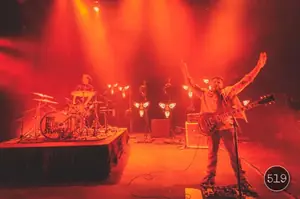
The live show is where Hook’s vision truly manifests. He is not content with four guys standing in front of a banner. He wants a spectacle. He wants the visual to match the sonic density of the music.
"Long term goals are really to make good records and build some kind of visually exciting live show," he states.
It is a straightforward ambition, but in a fractured music industry, it is also a difficult one to achieve. Yet, watching him talk about the future, you get the sense that he has already done the hard part. He has escaped the shadow of his past and built something that belongs entirely to him.
There is a certain peace that comes with that kind of autonomy. He is no longer a cog in a massive machine; he is the one holding the wrench.
"I'm in control of my life... I'm in the driver's seat," Hook concludes. "It's not an ego thing... I just prefer to have creative control over what I'm doing. Life is short."
For the listener, *Dark Side of the Brain* is a solid, heavy-hitting entry into the modern rock canon. It is professional, powerful, and undeniably Hook. Whether it can reach the heights of his previous work remains to be seen, but for now, the engine is running, the tank is full, and Jason Hook is finally the one choosing the destination.
Get Tickets