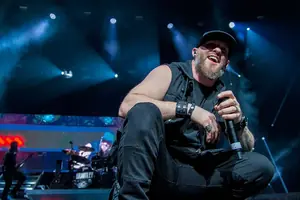

Standing near the soundboard at a stop on the Get Rollin’ Tour, you can feel the floorboards vibrating before Josh Ross even hits the stage. It is a specific kind of kinetic friction that happens when a country artist decides to stop playing nice and starts playing loud. Ross is currently the opening gambit in a high-stakes summer circuit, and he is doing it with a chip on his shoulder that suggests he knows exactly how hard he had to fight to get here.
The set kicks off with "Ain’t Doin’ Jack," a track that serves as a loud, distorted mission statement. It did not start this way. Originally, the song was a slow-burn ballad, the kind of mid-tempo pining that fills the middle of a country record. But Ross and his team saw the writing on the wall when the invitation came to join Nickelback and Brantley Gilbert. You do not bring a knife to a gunfight, and you certainly do not bring a soft ballad to a stadium full of people waiting for "Rockstar."
The transformation into a high-octane country-rock anthem was a calculated pivot. It reflects a brand of live energy that is less about the campfire and more about the pyrotechnics. This isn't just a stylistic choice; it is a tactical necessity when you are sharing a bill with some of the heaviest hitters in the post-grunge and country-rock crossover space.
"My role is to engage the crowd and set the stage for Brantley, and then he does the same for Nickelback," Ross says during our sit-down. He understands the hierarchy of the touring machine. He is the spark that starts the fire. "I've even got a more rock-oriented release that just came out that you may have heard called Ain’t Doin’ Jack, that was tailored for this tour. It's about engaging the audience, getting them hyped."
The synergy on this tour is an oddity on paper that works perfectly in practice. You have the polished, world-beating rock of Nickelback, the blue-collar grit of Brantley Gilbert and the rising tide of Ross’s modern country. It is a cross-section of the North American listener who does not care about genre labels as much as they care about a hook they can scream back at the stage.
Ross is soaking up every second of this exposure. He is a sponge in a baseball cap, watching how the veterans handle a crowd of 20,000. "It's been so awesome. Both bands have been great, and Brantley offers fantastic guidance. Then there’s Nickelback and Chad—getting to learn from someone known worldwide is an unparalleled experience," he says.
The highlight for many—and clearly for Ross himself—is the nightly collaborative rendition of "Copperhead Road." It is a moment of genre-blending that bridges the gap between the three acts. It also serves as a full-circle moment for a kid from Burlington who grew up on the staples of the genre.
"Chad suggested the song, and it’s one of my all-time favourites, having gotten me into country music when I was young. It's just been a lot of fun," Ross says. His enthusiasm isn't the canned PR variety; it’s the genuine excitement of a fan who somehow found himself on the other side of the barricade.
Watching Ross navigate this ascent, it is clear that his path has been defined by a willingness to embrace the left turns. He broke out with "First Taste Of Gone," a song that leaned heavily into the heart-rending balladry he’s known for. Since then, he has shared the stage with Jordan Davis and Tyler Hubbard, proving he can hang with the Nashville elite while maintaining his Canadian identity.
But the polish of his current success hides the raw nerves that got him here. Ross found his voice when he stopped trying to write what he thought people wanted to hear and started writing what he was actually feeling. It was a shift from performance to confession.
I think for me, a lot of my growth as an artist didn't begin until I started writing about real, raw emotions. It emerged from real life situations, asking if you should stay in a relationship that might be toxic, or if you should leave.
"I think for me, a lot of my growth as an artist didn't begin until I started writing about real, raw emotions," Ross says, reflecting on the success of his hit "Red Flags." That track didn't come from a boardroom; it came from the messy reality of a relationship on the brink. "It emerged from real life situations, asking if you should stay in a relationship that might be toxic, or if you should leave."
That honesty is paying off in the metrics that matter. With over 32.1 million global streams and a shelf full of award nominations, the industry is finally catching up to what Ross has known for years. He has played the 109th Grey Cup and dominated the airwaves, but the internal struggle remains the primary driver of his art.
Take his song "Trouble," which found a second life on the TV series Welcome to Flatch. It is a haunting piece of work that sounds like a late-night realization set to music. "Trouble was inspired by a voice message I left for someone," Ross says. "It highlighted what I was going through in life. The song came out quickly and seemed to write itself, mirroring the true events of my life."
This is the core of the Ross appeal. He is not interested in the manufactured gloss of "bro-country." He is looking for the release that only comes from putting a pen to paper when things are falling apart. It is a therapeutic exercise that happens to have a catchy melody.
"Songwriting has been therapeutic for me. It feels like a huge release when I can articulate my feelings into music," he says. This authenticity is the bridge between him and the fans who see their own mistakes reflected in his lyrics.
As we look toward the Boots and Hearts Kick Off Party on Aug. 10, the stakes feel higher. This is a homecoming of sorts. Ross has been to the festival before, playing the side stages and the showcases, but returning as a bona fide star is a different animal entirely.
"This is my first official real show here, which is super cool. I love Boots and Hearts. I'm excited to show people all the different sides of my music—from the party anthems to the more profound ballads," Ross says. He is ready to prove that he is more than just a radio single.
His trajectory was never a straight line. He moved to Nashville before he had any momentum in Canada, a move that most would consider professional suicide. But Ross knew he needed to be in the room with the best to become the best.
"I moved to Nashville before I had anything going on in Canada. My dream was to be a better songwriter, which was one of my biggest things, and that had to be Nashville for me," he says. He views the city through the lens of an athlete, which makes sense given his history.
"It's like playing football and the greatest people are in the NFL. And for me, Nashville represented the greatest songwriters and artists, spanning various genres, not just country," he adds. The comparison is apt for a man who spent his university years on the gridiron.
"I finished playing football at Western in 2017 and had started getting into songwriting and performing just locally. After a reality check at the Boots and Hearts Emerging Art Showcase, by the end of 2017, I was already making trips to Nashville. And then came 2019, and I made the move," Ross says.
The move was immediately met with a series of biblical-level disasters. He arrived just in time for the city to be leveled by a tornado, followed immediately by the global shutdown of the pandemic. For most, this would be a sign to pack up and head back to Ontario.
"Nashville got hit with a tornado right before COVID. I had just moved my stuff that very day. And then came the pandemic," he says. But instead of folding, he leaned into the isolation. "COVID was a great thing for me in a way. I felt like I entered the music scene quite late, so I had a lot of catching up to do. So, I used COVID to my advantage."
That period of forced reflection allowed him to sharpen his sound. He didn't just want to be a Canadian artist in Nashville; he wanted to be an artist that transcended the border. He often gets asked about the cultural divide, but he sees more similarities than differences.
"People always ask about the biggest difference. For me, I was drawn to some of the American sounds and artists. But in essence, it isn’t that different. The food, the culture may vary, but the core remains unchanged," Ross says.
His songs are built on that universal core. He writes about the things that keep people up at night—the regrets, the drinks and the long drives. "A lot of the stuff that I've gone through, I’d say three quarters of my listeners, if not more, have experienced as well. Me being honest about what goes on in my life seems to resonate with many others," he explains.
It is a long way from the kid in Burlington writing poems in the dark. Ross has always been a storyteller; he just finally found the right volume. "I wrote a song called Cheap Red Wine with a buddy, Will Finch. And going even further back, I remember having a little book under my bed as a kid where I'd write short stories or almost like poems," he says.
When the first chords of "Ain’t Doin’ Jack" ring out this summer, it isn't just a song. It is the sound of a man who took the hard way around and finally found his centre. Josh Ross is no longer just the opener; he is the main event in waiting.
Get Tickets