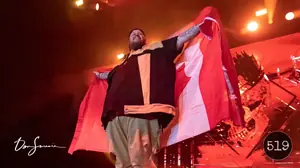

The humidity at Burl’s Creek was a physical weight on Aug. 11. It was the kind of heat that sticks to your skin and refuses to let go, but the 50,000 people packed into the fields for Boots and Hearts did not seem to mind the sweat. They were there for a collision of worlds.
For years, this festival was a sanctuary for pure country. But the gates have swung wide for something heavier. The Friday night bill looked like a fever dream for anyone who grew up on a diet of MuchMusic and CMT: Nickelback, JJ Wilde, Big Wreck and Hardy.
And then there was Cory Marks. Standing near the side of the stage before his set, Marks looked like the living embodiment of this identity crisis. He is the guy who figured out how to make a banjo and a double-kick pedal coexist without it sounding like a gimmick.
Marks did not just appear out of nowhere. His rise was fast, driven by the massive success of "Outlaws and Outsiders". That track did something rare; it climbed the rock charts while keeping its boots firmly in the dirt. Billboard could not figure out where to put him, which is usually a sign that an artist is doing something right.
He is often grouped with guys like Hardy or Brantley Gilbert. It is an easy comparison, but it misses the technical foundation of what Marks is doing. He is not a country singer trying to be edgy. He is a rock kid who happens to have a rural soul.
I sat down with him behind the scenes, away from the roar of the soundcheck. Marks is grounded, but there is a restless energy to him. He talks about music with the precision of a mechanic.
"Before I started writing and singing, I was a drummer," Marks says. This is the key to his whole operation. You can hear it in the pocket of his songs. He does not just follow the beat; he attacks it.
His early years were spent worshiping at the altar of Canadian prog-rock and British heavy metal. He was obsessed with Rush and Deep Purple. But he was also listening to the storytelling of Merle Haggard and the guitar gymnastics of Brad Paisley.
This duality is not a marketing ploy. It is his DNA. When the conversation shifts to his influences, his face changes. There is a genuine reverence there, especially when the name Neil Peart comes up. The loss of the Rush percussionist clearly still stings.
“I know that reaching that level of skill is pretty much unachievable, but I was very highly influenced by Neil and I cried like a little baby when I heard about him passing,” Marks says. “He’ll always be my hero when it comes to drums. There are so many out there like Ian Paice from Deep Purple that set the marker high.”
It is rare to hear a "country" artist cite Ian Paice. But that is the point. Marks is trying to bring that level of musicianship back to a genre that sometimes settles for four chords and a truck metaphor.
I know that reaching that level of skill is pretty much unachievable, but I was very highly influenced by Neil and I cried like a little baby when I heard about him passing. He'll always be my hero when it comes to drums.
The scale of the Friday night show was not lost on him. Sharing a stage with Nickelback is a specific kind of Canadian validation. Say what you want about Chad Kroeger, but the man knows how to command a crowd of 50,000.
Marks watched the spectacle with the eyes of a student. He has spent the last few years on the road with some of the biggest names in the business, and he is a sponge for stagecraft.
“Being on the same stage, that massive main stage, on a sold out Friday night of Boots and Hearts with Nickelback is... a milestone,” Marks says. He says it with a grin that suggests he knows he belongs there, even if he still finds the scale of it slightly surreal.
His time on the road with Five Finger Death Punch and Brantley Gilbert served as an unofficial graduate program in arena rock. You do not tour with Ivan Moody without learning how to project to the back row.
“I’ve borrowed elements from watching Ivan Moody, particularly in songs like ‘Burn It Up’ and ‘Keep Doing What I Do’,” Marks says. You can see it in his posture. He has learned how to take up space on a stage that is 100 feet wide.
The technical side of his sound is handled by Kevin Churko. Churko is a titan in the industry, the man behind the board for Ozzy Osbourne and Disturbed. Having a guy like that produce a country-leaning record is a bold move.
Their partnership resulted in the EP *I Rise*. It is a heavy, resilient record that feels like a middle finger to anyone who told Marks he had to pick a side. The story of how they met is already becoming a piece of industry lore.
“I was opening up for Toby Keith in Moose Jaw — that’s where Kevin’s originally from — he and his family flew in and saw the show. No pressure at all,” Marks says with a laugh.
“He jokes around saying, ‘I never signed you for your songwriting or your voice. I saw a drum solo that you did at some bar back when you were younger doing a one-handed roll thing,’ and he says, ‘that’s the reason why I signed you’,” Marks says.
It is a funny anecdote, but it proves the point. Churko saw the raw, technical talent before he saw the hat. He saw a performer who could handle the complexity of a rock production.
The title track of the EP, "I Rise", has become a sort of anthem for Marks. It reflects a career that has been about grinding through the noise and the skeptics who think "country-metal" is a contradiction in terms.
“It’s a reminder that we must persist, embrace the grind, and stay unerringly committed to our vision,” Marks says. His voice is steady when he says this. He is not interested in the easy path or the radio-friendly compromise.
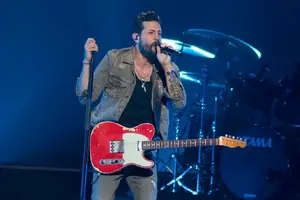
The set at Boots and Hearts was a proof of concept. When he played "Devil's Grin" and "Blame It On The Double", the crowd did not look confused. They looked energized. The mosh pits were small, but they were there, right next to the people in cowboy boots.
But there is a risk here. The fusion genre is a tightrope. If you go too heavy, you lose the country crowd. If you go too twangy, the rock fans walk away. Marks manages to stay on the rope, mostly because his songwriting is solid enough to support the weight of the production.
His vocal performance has improved significantly since his debut. There is more grit in his lower register now, a byproduct of those long tours and the influence of guys like Moody. He is finding a way to growl without losing the melody.
Watching him from the sound booth, you could see the gears turning. He is a perfectionist. Even when the crowd is screaming, he is likely thinking about the timing of that one-handed roll or the mix of the guitars.
The industry loves to put artists in boxes. It makes them easier to sell. But Cory Marks is a difficult product to shelf, and that is exactly why he is succeeding. He is the bridge between the beer-drinking country fan and the headbanging rock kid.
As the sun went down over Burl’s Creek and the lights of the main stage took over, the distinction between the genres felt irrelevant. It was just loud, well-executed music.
Marks is not just a participant in this new wave of genre-blurring. He is one of the people drawing the new map. He is proving that you can have the heart of a country singer and the hands of a metal drummer.
And if he keeps playing like this, the milestones are only going to get bigger. The Friday night crowd at Boots and Hearts was just the beginning of the next phase.
Get Tickets