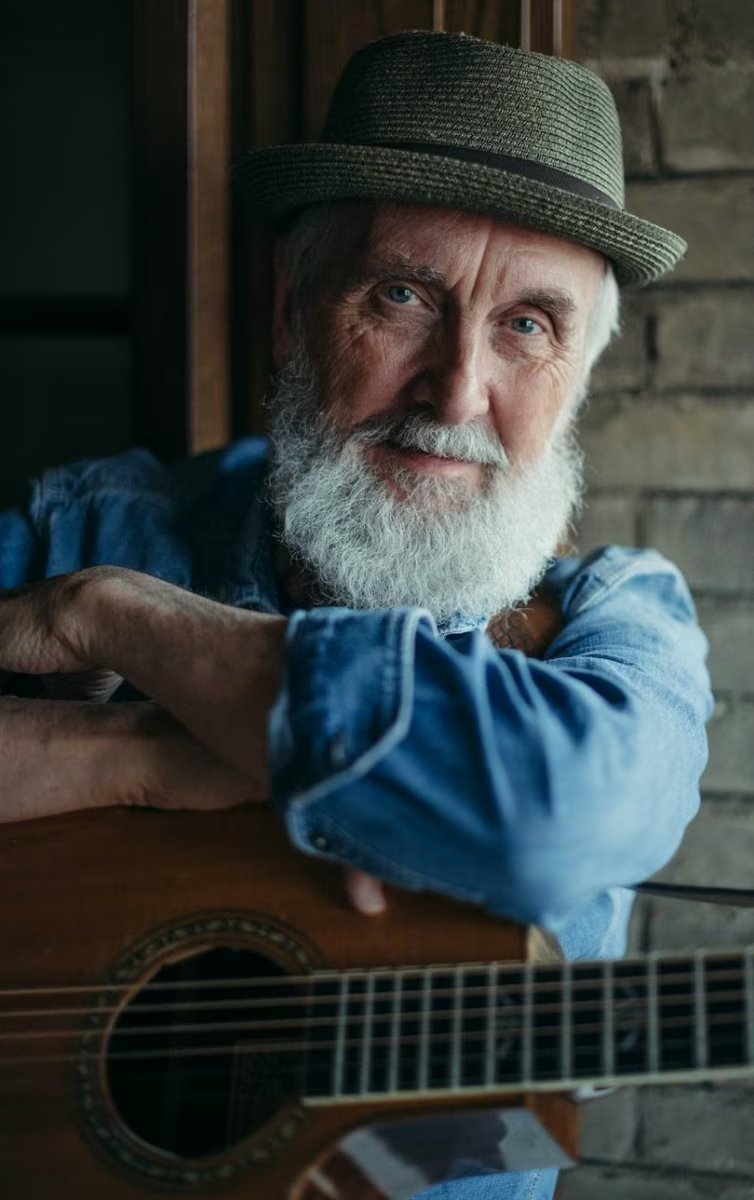

Fred Penner is the survivor no one saw coming. In an industry that eats its young and forgets its elders, Penner has maintained a stranglehold on the Canadian family circuit for four decades. He is currently preparing to hit the road for stops in Hamilton and London this March, marking the 40th anniversary of a song about a persistent feline that simply refuses to stay buried.
The track, "The Cat Came Back," is more than a song. It is a cultural fixture. Penner called into the 519 newsroom from his Manitoba home to discuss the longevity of the track and the strange gravity of his career. I asked him about the sheer length of time this cat has been on the prowl.
"Well, you know what they say, the nine lives of the infamous cat. Yes, it is a long time," Penner says.
But the song is not a Penner original. It is a piece of folk history that dates back to the late 1800s, originally penned by Harry S. Miller in 1893. It was a different era of songwriting, one built on repetition and dark humor. Penner found it in the way most great folkies find their material: by digging through the crates of history during the 1970s.
"I discovered it in an old folk song book that I was flipping through in the '70s. And a cousin of mine and my brother, we were just sitting jamming one night, and flipping through this book, and suddenly turned the page and there was The Cat Came Back. Oh that's a nice progression. I like that E minor, D, C, B7 turn. And it's easy to jam to. It's fun to play," Penner notes.
The technical simplicity of that E minor to B7 turnaround is exactly why the song works. It is a loop that invites participation. It does not demand high-level musicology to understand, yet it provides enough of a rhythmic hook to keep an audience of toddlers—and their exhausted parents—engaged.
And then there are the lyrics. The original versions of the song are surprisingly grim, involving various attempts to dispose of the animal. Penner leaned into the absurdity of the narrative, treating the cat less like a nuisance and more like a cartoon protagonist.
"And the verses are like a bunch of cartoon scenarios, because it's these crazy, impossible things were happening to this cat. But in spite of that, he managed to survive. So it was an interesting story. And it had that bit of magic to it, a storytelling sense that makes the song even more fun to sing," he says.
Penner has never been one to let a song stagnate. He treats his repertoire like a living document, adding and subtracting elements based on where he is in the world or what the season demands. It is a modular approach to performance that has kept the material fresh for him, even after thousands of iterations.
"So I've adapted multiple verses over the years to that song. I've got a Santa Claus verse that I threw in, and I did a version where the cat is actually getting into traveling the world and goes to Australia and the Far East. And so it's taken on many ramifications over the years. But it's always a really a delightful song to sing and share with the audience," Penner explains.
When I mention that the cat’s international travels add a nice layer to the lore, he simply agrees. "Yes, exactly," he says.
But there is always the obvious question for a man who has spent 40 years singing about a pet. Does he actually like them? The answer is surprisingly pragmatic for a man whose brand is built on warmth.
"I do. I'm a cat person more than a dog person. We've had numerous cats and dogs over the years, but I'm still on the road a lot, so I don't have pets now," he admits.
This honesty is a hallmark of the Penner brand. He does not perform a character; he provides a presence. That presence has now spanned multiple generations. We are reaching a point in Canadian history where the people who watched *Fred Penner’s Place* on CBC are now bringing their own children—and in some cases, grandchildren—to see the man in the cedar forest.
"Yes, for the most part. The audiences that I had certainly in the '80s, when this whole journey began, those parents, those grandparents, the postwar generation, the boomers, were very excited about having quality entertainment for their children. So they brought the kids in, and those children from the '80s are now the parents of the next generation and then into grandparent world," Penner says.
The math checks out. The boomers wanted "quality," a word that often meant anything that wasn't purely commercial or loud. Penner provided a folk-inflected alternative that felt grounded.
"So the whole journey has turned into this beautiful life circle. And it's quite amazing to watch how it has grown and developed over this amount of time. And multiple generations are coming to my shows now, and it is a little awesome that this is actually happening, because in the beginning I know I had no idea where or how long this would continue. And here, in 40, 45 plus years of being a professional entertainer, I'm still apparently kicking the cat, no pun intended," he says.
There is a weight to this kind of career that goes beyond record sales or Nielsen ratings. Music for children often carries a heavy emotional load because it is tied to the formative years of development. Penner recalls a specific moment at the University of Manitoba in 1979 that reframed his entire perspective on what he was doing.
"Oh, numerous along the way. One of the earliest ones was after The Cat Came Back album had been created, the vinyl, back in the late '70s, '79, around 1979. And one of the first performances I did in support of that album was at the University of Manitoba, at one of their rooms. And at the end of the show, there was a lady who was waiting to talk to me. So I signed a batch of autographs, and then I went and had a chat with her," he recalls.
The story she told him was a brutal reminder of the stakes involved in family entertainment. Her four-year-old son was in the nearby Victoria Hospital, facing a terminal diagnosis. The family used Penner’s record as a tether to normalcy during his final days.
Initially in the '70s, I did a lot of acting, theater class, just a wide range from comedic performance to serious drama... I was a folk singer in the '60s and '70s, playing the coffee houses... All of those skills I bring to the stage now. I still know how to engage a full audience from a few hundred to several thousand people. ...The kinds of songs that I write are universal concepts. So parents, grandparents, children, everybody can relate to them.
"And she wanted to tell me a little story, as often happens, where their family, she and her husband, had three kids, and their youngest was four-years-old, and he was in the Victoria Hospital, which was just around the corner from where we were playing. And they had brought my Cat Came Back album into their child's hospital room. And they'd had a little record player that they would play the album on. And through that song and the music, they would sing along and listen to it and laugh and have fun. And that album, she said, was such a wonderful bonding thing for the family during such a tragic time of their lives. And the child did pass away. But she just wanted me to know how truly valuable that was to them," Penner says.
It is a heavy anecdote to process. "And I thought, 'Oh, my goodness. That's a pretty amazing story to start the deal there,'" he adds.
This level of impact eventually led to the highest honours the country can bestow: the Order of Canada and the Order of Manitoba. For Penner, these are not just medals to hang on a wall. They represent a specific Canadian identity rooted in humanity rather than just industry.
"Well, I am a Canadian, and I am honoured to be that. When you see what's going on in the rest of the world, Canada really is standing at the forefront of being one of the most powerful countries from a humanity point of view. I think Winnipeg, or Canada, has a pretty solid perspective. And being recognized by my home province of Manitoba, and by the country of Canada for the work that I had done over these decades is a little overwhelming," he says.
He is quick to dismiss the idea that he was ever chasing status. In his view, the work is the reward, and the accolades are merely a byproduct of showing up and being present.
"It's not something, again, that I had ever aspired to. I know very few performers who actually look for the accolades. The accolades come as a result of the work. And that's where I'm based is I love to do the work. I love my journey of going on stage and creating a dialogue, a musical dialogue, and sharing thoughts and feelings with an audience. And that continues. I am honoured to have been in this occupation and the number of places that I played and the people I've connected with are continuing. And there still seems to be a relevance of the work that I'm doing. And I'm just answering the call as long as I can," Penner says.
Before he was the man in the log, Penner was a theatre kid and a coffee house folkie. He was doing *Death of a Salesman* and covering Joni Mitchell. His career could have easily veered into serious drama or adult contemporary folk, but a chance meeting with his future wife changed the trajectory.
"That's where it evolved. Initially in the '70s, I did a lot of acting, theatre class, just a wide range from comedic performance to serious drama, like Death of a Salesman. And I just explored many different directions. I was a folk singer in the '60s and '70s, playing the coffee houses, doing the Gordon Lightfoot and Joni Mitchell songs in bars and nightspots," he says.
The shift to children’s entertainment was organic. It wasn't a calculated business move; it was a response to the creative environment he was in.
"And then towards the end of the '70s, my future wife, we met. And she was a dance choreographer, and she was coming to Winnipeg. And she started her dance career there. And we developed a children's dance theatre company that ultimately led to an offer to do the first record back in that date. So it could have taken many directions. It could have gone into just serious acting. But then as I developed my career of music, being a musical performer, I did lots of Gilbert and Sullivan and Rodgers and Hammerstein, that kind of stuff, and I just built my skill as a stage personality. And all of those skills I bring to the stage now. I still know how to engage a full audience from a few hundred to several thousand people," he says.
Penner rejects the idea that being a "children's performer" is a limitation. To him, a good song is a good song, regardless of the target demographic's age.
"I've learned many abilities in the world of performing over the time. And all of those came together. And I do write. And often reviewers or interviewers ask about, 'Did you ever want to be an adult performer? Is this holding you back at all?' things like that. And it never has, because the kinds of songs that I write are universal concepts. So parents, grandparents, children, everybody can relate to them. And they just have that topic. And some of them go quite deep into emotional directions. And I just find it very gratifying to be able to do that. And I mean, I've written literally hundreds and hundreds of songs over the years for different projects I've done," he says.
He belongs to a specific "Big Three" of Canadian children's music alongside Raffi and the trio of Sharon, Lois and Bram. They all emerged from the same folk tradition, filling a vacuum that existed before children's media became a corporate behemoth.
"True. We all did that, because in the '60s and '70s, there was no really such thing as a children's entertainer. There were people who did the old, old folk songs, like Ella Jenkins and Pete Seeger and a handful. But there were no specifically children’s oriented performers then until Raffi, and Sharon, Lois and Bram, and I came along. And we were listening to the demand that was coming again from the postwar generation," Penner says.
He speaks highly of his peers, noting that their success was built on actual musical ability rather than just bright colours and loud noises.
"But we all came from the same roots, and it ultimately led to the value of what we were doing. This folk performance was bringing just good songs to an audience. And that's what the performing for families is all about. It's having integrity with your style, with your ability to make music, because Bram is a very, very fine guitar player. And Raffi, he is a very good guitarist and songwriter. And also, we just developed our careers as a demand called upon," he says.
While Penner appeared on *The Elephant Show*, his own television legacy was already in motion. *Fred Penner’s Place* was born out of a specific need at the CBC to fill the void left by a legend.
"No, the Fred Penner's Place came up long before the Elephant Show did. It was a phone call that came from the head of children's television in Toronto in the mid '80s, after I'd been touring for five years, playing festivals and coast to coast runs. And they had been looking for a replacement for The Friendly Giant in 1985," Penner says.
Replacing Robert Homme was no small feat. The show had to be different enough to stand on its own but grounded enough to capture the same audience.
"And they saw the work that I was doing and they liked my energy and approach. So they said, 'Would you like to do a TV series?' And I was a bit aghast because I had not even considered that. But then they said, 'Yeah, we think you'd be a good replacement.' So I developed the core of Fred Penner's Place, and then other writers and people came in to put in their perspective, and ultimately the series evolved, and away we went," he says.
In the age of TikTok and hyper-saturated digital content, Penner’s work remains an anomaly. It is slow, deliberate, and acoustic. I asked him why he thinks a song like "The Cat Came Back" has survived the tech revolution.
"I think because of the essence of the songs, I mean, and hopefully my energy in bringing them to the front, because it's not condescending, there's engagement with the audience. It's all about participation is what I do in my life," he says.
He also credits the simplicity of the hook. "But it just kept, I think, because it has that history going back to those early days when those kids first started listening to it. It gained popularity. And the phrase The Cat Came Back is just a beautiful, simple four word phrase that people remember," he notes.
The album itself is a mix of tradition and original contributions from his circle of friends. "Yeah, there were songs that I brought to that album, songs that I had grown up with myself and a few original tunes as well. But it was all about doing something that had a connection between me and the audience. And they responded and they liked it and then kept demanding it," he says.
While "The Cat" is the flagship, it isn't the only heavy hitter in his setlist. "So two songs on the album, The Cat Came Back and Sandwiches, it was written by a friend of mine, Bob King. Those two songs are the number one and number two requests, still, in my repertoire. So I just do what I, again, what I do to the best of my ability. And if people respond to it, then that really is on them," Penner says.
Penner’s musicality isn't limited to the acoustic guitar and folk melodies. He has a hidden side that occasionally surfaces during radio appearances, like the time he jammed an AC/DC track on a Vancouver rock station.
"Oh, it was hilarious. Because it was a rock station that I was on, and just to try and generate some excitement on the program, they said, 'Can you jam to one of these AC/DC songs? And I said, 'Sure. Play it.' I mean most rock songs are pretty easy to play with, because they're only three maybe four chords. They're not tough things. So once I know the chord progression, easy, easy to jam," he says.
His ears are always open to different genres, from the classics to modern jazz. He is a student of the craft.
"Always, from country to jazz to blues to rock. No, I cover a lot of territory in my musical experience," he says. When asked what is currently on his playlist, he mentions a mix of old school rockers and new talent.
"Oh, God. I'm listening to some of the Hall and Oates stuff. Daryl Hall has the program on YouTube, and he brings in a lot of his old pal rockers, and I play along with that. And I've got a wack of old jazz stuff that I listen to, and the country classics, and more and more contemporary albums by some great female singers coming up. Variety is the spice of life," he says.
One of the most striking things about a Penner performance is the clarity of his delivery. In an era where vocalists often mumble through autotune, Penner’s enunciation is surgically precise. He views language as a tool for development.
"Language certainly is. Yeah. My wife is a vocal coach, and language is such an important part of her work, and the enunciation, and using the right words. And I think it would be doing a disservice to the audience, certainly to my audience, to not enunciate, to not use full sentences and words, because that's how a young person learns the language, learns how to pronunciate and then speak properly. So, yeah, so language has always been very important from my point of view. I tend to write lyrics before I do the music, so the lyrics have to be clear," he explains.
At 77, Penner is still "answering the call," even as his body reminds him of the decades spent on the road. He is looking for a balance between the stage and the quiet of Vancouver Island.
"It is slowing down, other than this year is very intense. But I'm just doing the work that is answering the call, the demand, as I said. But at the same time, my wife and I are finding time to relax. We're going to go to Hawaii in April. And then things are very slow in May, and then a few festivals over the summer, and then another," he says.
He is realistic about the physical toll of the job. "Well, our place, where we are, in Vancouver Island, is very much a place of relaxation and calm. And so it's finding a balance, certainly, in my life. And so I don't cause too much stress to my aging body. I mean, I do have lots of aches and pains, so I'm just trying to take care of myself as much as possible," he says.
As he prepares for the upcoming dates in Hamilton and London, he reflects on the consistency of his career. He doesn't have one specific memory that towers above the rest; he treats every show with the same level of professional focus.
"Oh, I've played there many, many times. There's just so many festivals in the area. I've been to Hamilton Place a number of times. I have fond memories of just about every place I've ever played, because you're only as good as your last gig. So I try and be consistent with where I'm playing, nothing specific jumps out at this moment," Penner says.
Consistency is exactly what has kept him relevant. Whether he is crawling through a hollow log or playing a rock riff on a radio show, Fred Penner remains a singular force in Canadian music. And like that cat, he just keeps coming back.