
Walking through the backstage corridors at Caesars Windsor, you do not just hear the hum of the air conditioning. You hear the history of a band that refused to become a trivia question. Most of the class of 1993 is either playing county fairs or chasing a sound that died with the VCR. But Collective Soul is different. They are currently celebrating their 25th anniversary in 2019, and they are doing it with the kind of grit that suggests they are just getting warmed up for the next few decades.
The group from Stockbridge, Georgia did not just arrive on the scene; they exploded. Their debut, *Hints, Allegations and Things Left Unsaid*, was a multi-platinum monster that redefined what radio rock could sound like in the shadow of Seattle. "Shine" and "Breathe" were not just hits. They were the sort of massive, inescapable anthems that defined a specific era of North American guitar music. And yet, the trajectory has never really flattened.
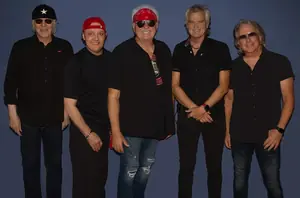
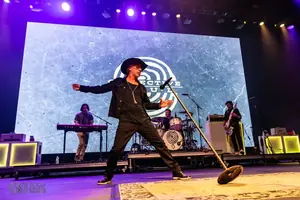
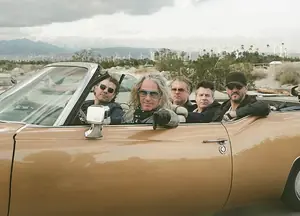
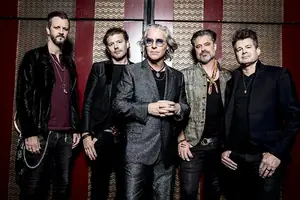
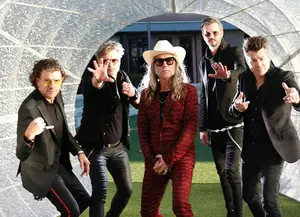
The current lineup is a well-oiled machine. E Roland is on vocals and guitar, Dean Roland handles rhythm guitar, Jesse Triplett is on lead, Will Turpin holds down the bass and Johnny Rabb is the engine on drums. They are hitting Canadian soil with a stop at Caesars Windsor on June 27 and a slot at the Roxodus Music Festival in Edenvale, Ontario on July 11. It is a heavy schedule for a band that has already done it all.
I caught up with Johnny Rabb to talk about the mechanics of the tour, the weight of the new record and his obsession with the physics of drumsticks. He is an interesting cat—part technician, part philosopher.
We started with the obvious. Most bands hitting a quarter-century are essentially cover bands of their younger selves. They stop trying. But Collective Soul is pushing a new record and a massive tour. Rabb does not see retirement as an option.
"We definitely think it’s important to keep expressing what we’re living for, I mean Ed’s on fire with writing, and the whole band has never been in a better spot," Rabb says. "I believe if you’re not living you’re dying. We’re not just going to sit back and hang, so we enjoy it and we have a good time. We try to keep true to how they began and I’m 8 years in with the band. With the 25th anniversary, we felt it was very important to make new music and keep reaching out to our fans."
That "living or dying" mentality is what keeps the setlist from feeling like a museum exhibit. The band is not trying to be a new hybrid or jump on a trend. They are just growing into their own skin. It is a rare thing in an industry that prizes the new over the authentic.
"Yes, absolutely," Rabb says when asked about their development. "We just did 'See What You Started by Continuing' a few years ago, and now 'Blood' is coming out June 21st, and it’s a great collection of things that have happened within our lives—real stories, real kinds of losses, real triumphs and real things that have gone down. It’s a lot of meaning for me on this new record coming up, and we’re out on the road now supporting that record. We’re excited about the release of it. We do think it’s extremely important to keep cataloging and keep track of what we’ve done in life and there’s no end in sight for us."
The new record, *Blood*, feels heavy. Not just in terms of the guitar tone, but in the emotional weight of the songwriting. One track, "Observation of Thought," stands out. It is personal. It is raw. Ed Roland usually takes the lead on the pen, but Rabb has a deep, visceral connection to this specific piece of music.
"I absolutely have connections to that song, specifically," Rabb says. "Ed wrote that song. When he writes them, he brings his songs to the band for input. He writes it all, even though all of us have the ability to write, but Ed’s got a magic when he does it. Look at how many hits he’s penned. I also write songs, but I personally never had a hit. Please don’t get me wrong, what I’m saying is that everyone does their job in this band, Dean’s got his band Magnets & Ghosts, Jesse has records, I’ve got records out, Will of course with his solo, but Ed is the songwriter for the band."
But the connection to "Observation of Thought" goes beyond the credits. It is rooted in a moment of profound personal tragedy that happened while the band was grinding it out on the road.
We definitely think it’s important to keep expressing what we’re living for... I believe if you’re not living you’re dying. We’re not just going to sit back and hang, so we enjoy it and we have a good time.
"That being said, Observation of Thought has a very personal meaning for me," Rabb says. "I didn’t know it would, but my mom had passed away while on tour last October and that song is my personal observation. The band was absolutely amazing with their support for me and my family during that time and I don’t mind sharing my personal experience."
Rabb’s voice changes when he talks about this. It is the reality of the touring musician—the world stops for no one, even when your personal world is falling apart. The band did not just offer condolences; they offered a space to grieve through the music.
"Everyone in the band has had very personal losses last year as well, so to me, every time that song is played or I hear it, it’s a big deal to me," Rabb says. "We actually open with that during the set too. Because I found out about my mom just a few minutes before a meet and greet—and it was a devastating thing—that song reminds me that we just don’t know when things are going to happen, and we can all get through this. I’m not even dissecting the song and saying this is what the song means, but to me, the sound of the song and the lyrics have a certain special meaning for me. That song is a huge one for me. I do love it, for sure."
The idea of finding out your mother passed away minutes before you have to go out and smile for photos at a meet and greet is haunting. It is the kind of professional demand that would break most people. But Rabb used it as fuel.
We shifted gears to something more technical. Rabb is a gear nerd of the highest order. He does not just play drums; he designs the tools. Designing a drumstick sounds simple to the uninitiated, but it is a nightmare of physics and finance.
"It is a complex process and I will tell you that our first thing was trial and error and unfortunately a lot of money spent that I didn’t have," Rabb says. "I was young and to make a long story short, I had a partner at the time who was a lumber manufacturer who had endless resources and I didn’t realize how much money was being spent to make what they call a knife to make the stick. The whole process was like yeah, this one feels good, let’s draw this out. So we draw a stick. At first, some of our sticks were literally just trial and error, which isn’t how you shouldn’t really do that."
The "knife" he refers to is the custom blade used to turn the wood. It is precision engineering. If the curve is off by a millimetre, the balance is ruined.
"It’s about $2,000 per stick to make up a prototype, so the answer is yes, there’s a balance and weight," Rabb says. "I associate it with a golfer that might like a certain height of his club or even a hockey player to his hockey sticks—there are obviously heights and widths and curves. It’s the same thing with the drumstick; you have something that feels good to your hands. I could be different from my friends from Queensrÿche or to that of Tommy Lee from Mötley Crüe—they’re usually a pretty big stick. Steven Perkins may have a different stick from me and I know Gin Blossoms’ Scott has a different one. So there’s all these different diameters and lengths—it’s really nerdy, and it’s fun, very fun."
Rabb’s company was not just another manufacturer. They were disruptors in a very old-school industry. They looked at the stick and saw something that could be improved, even if the "big guys" were watching closely.
"We were one of the first companies to offer the same size stick, what would be the same diameter, so that’s a standard stick," Rabb says. "But, we were the first to offer a different taper at the end and then different tips on the same stick. This is literally back in 1999. So it goes back quite a ways. We did get copied very quickly by the other big guys. That’s fine. But we were the first to kind of do that."
Innovation in the drum world is usually subtle. But Rabb went for something radical with the Rhythm Saw. It looks like something out of a sci-fi flick, but it serves a very specific sonic purpose.
"Our standard length is a 1/4 inch longer than the other companies, so it added a different feel to it," Rabb says. "Then we patented a stick called the Rhythm Saw, it has these ridges in it and you could do like DJ type effects and different scraping sounds and stuff like that. That really was a challenge for me when I invented it. There was a lot of sticks being thrown against the wall because I was like, this is so stupid, it doesn’t work, but then I was forced to learn my own invention and it really does work. I strive to make my own sounds so that’s one signature stick that’s all me—the Rhythm Saw."
Watching Rabb play with those sticks is a lesson in textures. He is not just hitting things; he is drawing sound out of the kit. It is that attention to detail that makes Collective Soul more than just a 90s radio staple.
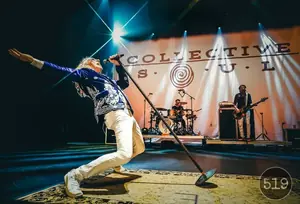
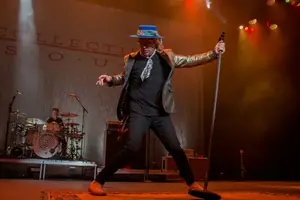
As the band prepares to take the stage at Caesars Windsor, there is no sense of a victory lap. This is a job. They are here to clock in and deliver the kind of show that justifies 25 years of survival.
The Windsor crowd is notoriously tough. They have seen everyone. But when the lights go down and the first notes of "Observation of Thought" hit, the room changes. It is not about the slots or the smoke anymore. It is about the music.
And that is the thing about Collective Soul. They are still here because they still care. They are not chasing the past. They are building a future, one ridged drumstick and one honest lyric at a time.
Seeing them live in 2019 is a reminder of why they mattered in the first place. The hooks are still there. The energy is still there. But there is a new layer of depth—a layer of blood.
If you are heading to Roxodus on July 11, do not expect a greatest hits medley. Expect a band that is still hungry. Expect a band that knows exactly who they are.
And expect Johnny Rabb to be back there, holding those 1/4 inch longer sticks, proving that if you are not living, you are definitely dying. Collective Soul is very much alive.