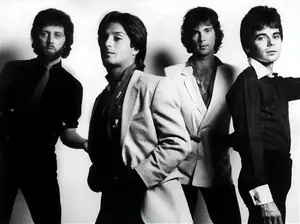

There is a specific kind of cognitive dissonance that occurs when you watch Einar Selvik, a man who once hammered out blast beats for the notorious black metal outfit Gorgoroth, sit in front of a laptop to discuss the esoteric vibrations of the ancient North. He is the architect of Wardruna, a project that has somehow transitioned from a niche Norwegian experiment into a global powerhouse now backed by the corporate muscle of Columbia and Sony. It is a strange marriage on paper. But when you hear the thrum of a deer-hide drum through high-end studio monitors, the logic becomes undeniable.
We caught up with Selvik via Skype just before the late January release of *Kvitravn*. The timing felt heavy. The world was still locked in the claustrophobic grip of the pandemic, yet Wardruna was preparing to drop an album steeped in the vast, open spirits of the wilderness. I asked him if the global craving for an escape was the catalyst for releasing such a dense project during a period of isolation.
"Well, actually it was set to be released on June 5th in 2020," Selvik says. "So we had to move it back down due to the COVID situation of the first wave and decided to postpone it six months. And of course, well, it was difficult to know even at that point, how long this would last. In one way, it’s of course unfortunate to not be able to support an album with concerts and such, but at the same time, this has been planned for such a long time and I do think that our listeners and fans are really excited about the release. On some levels, it felt like it was the right thing to do in any case."
The jump to a major label like Sony usually signals a softening of edges, a push toward the middle of the road to satisfy shareholders. And yet, Wardruna sounds as primal as ever. There is a fear among the purists that the "big machine" might demand a radio edit or a verse-chorus structure that fits a Spotify playlist. I pushed him on whether the suits had tried to put their thumb on the scale.
"It doesn’t have any effect whatsoever and that’s artistic integrity and artistic freedom," he says. "It’s something I’ve been very protective of from the very start and that was a very important part in the initial discussions as well. I would never enter a relationship where I would have to compromise my art in any way or not have the deciding voice when it comes to my art. But thankfully, they also see the value in that this is not a pop band in so many ways and it’s a very important part of the music as well."
The new record, *Kvitravn*, does not reinvent the wheel that Selvik started turning with the *Runaljod* trilogy. Instead, it greases the axle. It is a continuation, sure, but it feels more intimate. It moves away from the grand cosmic scale of the runes and looks directly into the eyes of the human standing in the woods.
"Well, the album wonders in the same landscape or world as the previous works as well in terms of the thematics and also musically," Selvik says. "So for me, I see it as a continuation from the trilogy. But I guess the album sums more into details and perhaps ventures more into the humans fair in terms of our relationship to nature. And also how we define ourselves as human beings when looking upon it or going back in time into the old ways of viewing it. In modern times, we have the definition of body and consciousness and if you’re a religious person, you also have a soul but in the old Nordic traditions, I would say it was slightly more complicated and even more layered and that’s one of the things this album explores. It dives into describing or giving voice to some of these concepts."
The title itself translates to "White Raven," a motif that feels particularly potent. In a world of grey, the white raven is an anomaly, a glitch in the biological matrix that carries a heavy weight in folklore. Selvik is a man who weighs his words as carefully as he tunes his tagelharpe.
"The Raven is a very central animal within the Norse mythical landscape and folklore and many parts of the tradition itself," he says. "So it’s a very central figure then. And in mythology, it’s seen as the animal embodiment of the human mind and memory. It’s seen as a messenger from the beyond. The Raven in itself has a strong role and also strong symbols attached to it. And then you have the sacred white animals, not only ravens, but these sacred white animals that in many ways is a global phenomenon. You have them whether or not it’s the white elephants, lions, ravens, serpents or reindeer, they are seen as prophetic and sacred messengers from the beyond, often representing some form of change and enlightenment, et cetera. In several native American tribes, we also have myths regarding the white ravens and the ancient Greece, so this is a global thing. Combining them, I personally feel it’s a very strong symbol and perhaps a message of hope and a message of change or awakening."
It is fascinating to watch a project so geographically specific—rooted in the soil of Norway—find a massive audience in places like Brazil, Australia, and the American Midwest. You do not need to speak Old Norse to feel the vibration of a goat horn. There is a primal, lizard-brain reaction to these sounds that bypasses language entirely.
"Yeah. That is of course, quite overwhelming, fascinating and interesting," Selvik says. "At the same time, I do see a lot of logic to why it speaks to people in all different ages and ethnicities and cultures. Even though I work within a Norse, my music has a Norse wrapping, but it’s based in an animistic tradition, a nature based tradition and I would say that all nature-based traditions wherever they arise, they are born out of their surroundings and the resources there, the people that live there. So even though my music has this Norse or Nordic wrapping around it, the mechanisms that created it are universal, they are timeless and that applies for the themes I’m singing about as well or even the tonalities."
And he is right. If you strip away the specific cultural markers, you are left with the basic building blocks of human expression: wood, skin, breath, and bone.
"If you go far enough back in time, you’ll see how strikingly similar all of these things are around the planet," he says. "In many ways you can say that a lot of the framework I work within is perhaps even coded in our DNA from so far back in time. So there is a logic to it, but also because my music is very much about nature and that is also something that is timeless and universal and perhaps why it speaks to us still. Then the fact that these old cultures and traditions I’m singing about, they are born out of the same surroundings we are still living amongst."
Selvik is a self-admitted history nerd. But he is not the kind of nerd who just collects facts; he is the kind who looks for the cracks in the narrative. He grew up in a world where these stories were often flattened by the education system into boring, two-dimensional myths.
"I grew up with a lot of these stories and also in terms of music I was exposed to a lot of different music, everything from metal to classical music and also traditional music," he says. "So it’s been a part of my life since I was quite young. But in my early teens, that’s when I found my own interest for them, this desire to understand it better and dig deeper. It fascinating, in school, the way I was taught a lot of these things in school was in a way that made it impossible to take serious because everything was so over simplified. But at the same time, I could see a contour of something that intrigued me. Here is this culture where time is seen more as a cycle. We see time as a line and that fascinated me. And there were no black and white thinking, nobody was just good or just evil. Everything was more like nature in a way and I guess that really intrigued me and it feels natural and logical more so than more polarizing belief systems in my personal opinion."
Wardruna was born from a vacuum. Before Selvik, the "viking" aesthetic in music was mostly relegated to metal bands wearing plastic helmets and singing about beer. Nobody was actually trying to inhabit the sonic space of the ancestors using the tools they actually possessed.
If my music does have one message... it subtly, softly promotes an animistic worldview or the benefits of us as a species to have a more animistic view on the world. I think things became problematic for both us and the world the second we took sacredness out of nature. The idea that nature is something sacred, something we are a part of and not the rulers of necessarily. That's the core perspective I have, I view nature as something sacred.
"Well, I would say it’s born out of the lack of being anyone doing this," Selvik says. "I just had these visions or I could hear music or I really wanted there to be music that interpreted these old stories and themes and traditions on their own premises, rather than just borrowing bits and pieces here and there, whether it’s imagery or an instrument here or lyrical. So I wanted to make music where I used relevant instruments and language, poetic structures, sounds and anything that could pull me as close as possible to the given theme I’m working with. So I guess it was born out of the void of there being such a project."
When I asked him for a gateway drug into the literary world of the North, he did not hesitate. Forget the pop-culture versions of Thor and Odin. Go for the sagas.
"Well, I have a favorite saga," he says. "I often say to people that if you’re going to read just one saga, it has to be the saga of, popularly more known as Egil’s Saga. Well, some of the sagas can be quite hard and feel a bit inaccessible and old when you read it. But I feel that the Egil’s saga has almost like a modern feel to it and it has some really interesting unique characters and insight into things that happened and a culture so far back in time."
It is also important to note that Selvik is not obsessed with the "Viking" era in the way most people are. To him, that is a brief, violent blip on a much longer timeline. He is more interested in the deep time that preceded the longships.
"Well, first of all I have to say that actually the Viking period is not what I find most fascinating from the Norse tradition," he says. "Of course, that’s what people think about when they think about Norse history, it’s always the Vikings but that’s just a small part of it. That’s just describing what a small amount of people did for a short amount of time. Personally, I find the period before that to be much more interesting and intriguing and inspiring, but also what we know about history, it’s very fragmented. It’s bits and pieces here and there. There are still many things we don’t know. So of course, in that process of filling some of those gaps, it’s only natural to look to neighboring traditions or other indigenous ways. Like I said, I find both history and culture and those things very interesting, not only the Nordic one. So it’s only natural to look for inspiration other places as well."
His studio is a museum of sorts. It is filled with reconstructions of archaeological finds, instruments that haven't been heard in a thousand years until he picked them up. He is constantly hunting for new sounds, new textures, and new ways to bridge the gap between the dirt and the digital.
"Well, I’m always hunting and of course, I always get very excited when there are new archaeological findings and so on," he says. "That’s something I pay a lot of attention to. I continue to acquire new instruments and variations of these instruments that I already have as well. How big the collection is, I haven’t counted, I keep most of them in my studio. But I might have to expand to have proper room for them all. Let’s put it like that, it’s many."
But among the dozens of strings and horns, the lyre remains his primary weapon. It is the storyteller's instrument, the bridge between the word and the melody.
"Not really because it totally depends and it varies," he says of having a favourite. "The liar instruments, which is a small harp and probably the most common instrument in Viking era, common string instrument that is. It’s an instrument that is very much linked to the poetic tradition and perfect for accompanying singing and storytelling. And since I really enjoy singing, I guess that’s perhaps the instrument that I use most at least."
Then there is the goat horn. If you have ever heard a Wardruna track, you know that sound. It is haunting, jarring, and incredibly difficult to master. It is one of the few technical critiques one could offer of this genre—in the wrong hands, it sounds like a dying animal. In Selvik’s hands, it sounds like a warning from the past.
"In terms of intonation, it can be quite difficult," Selvik says. "Depending on the size of the horn, the blowing technique can be quite challenging as well. The goat horn is extremely fascinating and the melancholy and the melancholic timber to it, it’s truly amazing and fairly difficult to play to get the intonation right. First you have to manage the blowing technique. For me personally, it’s an ongoing process of learning how these things work as well. On many levels, I still feel like I’m a novice and still have lots to explore and to learn."
On *Kvitravn*, the arsenal has expanded, though the DNA remains the same. He uses flutes, lurs, and longhorns to create a wall of sound that feels ancient but is mixed with a very modern precision.
"Well, there are new instruments that I haven’t used on any of the previous releases, but I would say that they all come from within the same instrument family," he says. "So they are basically variations of the same instrument types. It’s a selection of the oldest bowed instruments and flutes in different variations, like these lurs, longhorns and goat horns in different variations, the liar of course is part of it. And then there is the more ambient sounds. So exactly how many it’s hard to say, it’s quite a few that were in use. All of them will be familiar to people who have heard of the music before."
His process is not one of sitting at a piano with a notebook. It is physical. It involves the movement of the body through the world.
"In a way, it is perhaps more subtle process and our music is very much about nature," he says. "Of course nature itself is a huge inspiration. I would say my main muse is to walk. That’s often when I hear the music or see it or get inspired. But also the instruments themselves can provoke an inspiration or certain words or sentences or poetry. And sometimes the theme I’m working with itself has such a strong image to it that I just instantly hear it. And, then it’s about going back into the studio and chase down that vision or idea, try to paint the picture."
And often, that walking is done barefoot. In the "Kvitravn" video, you see him moving across the rugged terrain, skin touching the earth. It is not just a visual gimmick for the camera; it is a lifestyle choice that informs the music.
"Yeah, it gives you a totally different sensation and perhaps also how we were meant to do it at least," Selvik says. "So I do it quite a bit but not always. But it gives you also a higher level of grounding I would say, especially when it’s cold."
People often ask if he misses the adrenaline of the metal scene. There is a certain "craziness" to a black metal show that you don't necessarily get at a seated theatre performance of Norse folk music. But Selvik argues that what he is doing now is actually more taxing.
"No, I actually feel that performing with Wardruna is much more intense on so many more levels than when I performed with Gorgoroth for instance," he says. "But the intensity is in a different way, I would say. It’s not so apparent, but on the other hand it goes much deeper so it becomes more profound in a way. So there is no gap to feel by metal music in my book."
To connect with this music, you have to slow down. You have to listen for the frequencies in the silence. It requires a level of sensitivity that the modern world usually tries to drum out of us.
"Well, you have to open yourself to that mindset, I guess," he says. "For me, that’s something, I’m not a trained musician in terms of a school musician. I don’t write music in that manner, I don’t read notes. Music has always been something I hear in a way and then I chase it. So I can’t speak for how it is for other people but for me, that’s how I do it. I just feel it or hear it or see it. I guess when you read a book or if you visit a historical place, I think a lot of people get images in your head like imagination. And if you listen carefully, there might even be a sound to it as well. So I guess you just have to approach things with a higher level of sensitivity in a way. You have to open up for it to speak to you in order for it to do so."
At the heart of everything Wardruna does is Animism. It is the belief that the world is alive, that the rocks and the trees have a frequency worth respecting. It is a philosophy that feels increasingly relevant as we face ecological collapse.
"Well, Animism has always been a pillar of our work because it's predominantly about nature and of course the old Nordic culture is very much an animistic one," Selvik says. "It's a common trait for all nature based traditions, I would say. I guess the most common definition of what the animist is the idea that everything has a spirit or a consciousness or a frequency or energy depending on how you approach it and how you wish to view it. So that's the backbone but of course it's about so much more, but that's the most common definition of it. Well, if my music does have one message, I hate preaching and claiming to know the truth or anything like that. But if my music does have a message, it would be that or it's subtly, softly promotes an animistic worldview or the benefits of us as a species to have a more animistic view on the world."
He continues: "I think if things became problematic for both us and the world, the second we took sacredness out of nature. And that doesn't have to be a spiritual thing, that basically an attitude. The idea that nature is something sacred, something we are a part of and not the rulers of necessarily. That's the core perspective I have, I view nature as something sacred."
It is a perspective of consequence. If you believe the earth is alive, you cannot hurt it without hurting yourself. It is a feedback loop that the modern world has tried to ignore for too long.
"Yeah. We're painting ourselves up in a corner," Selvik says. "Just by applying that mindset, you automatically gain respect for it as well that you can't just do things without having a consequence or just disregard the consequence. That's not healthy for us and it's not healthy for the earth."
As for the rest of 2021, the map is still being drawn. In a world of travel bans and shifting protocols, even a man who sings about the ancient past has to deal with the messy reality of the present.
"Well, the gods know perhaps or not," he says. "No, it's really difficult to say and plan anything specifically. Of course, there are many plans. The plan A is of course that we will do some touring at some point later this year. But on the other hand, things might very well have to be changed and we might have to reschedule. So at this point, I'm just open and staying prepared for different scenarios. You just have to have a plan, A, B and a C ready. Stay constructive, I guess that's my go-to mantra when it comes to that."
Whether he is on a stage in London or walking barefoot in a Norwegian forest, Einar Selvik is doing something that few others can claim: he is making the past feel like the future. And that is a rare trick indeed.