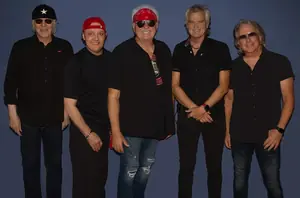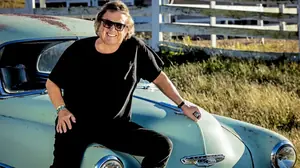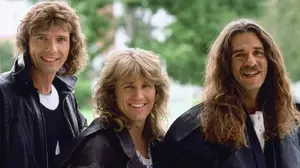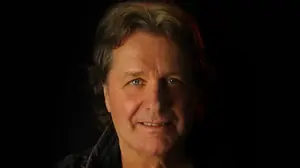

Sitting in a quiet living room in Windsor, you wouldn't immediately peg the man across from you as a titan of the arena rock era. John Power is not exactly a household name that triggers instant recognition at a grocery store checkout. But his fingerprints are all over the DNA of the biggest classic rock tours to ever cross a border.
He has spent decades operating in the shadows of the spotlight, serving as the skeletal structure for the industry’s most demanding acts. From Loverboy to Alice Cooper, Foreigner to Aerosmith, and the holy trinity of Canadian prog-rock—Rush and Triumph—Power has worn every hat the road requires. He is a tour manager, a sound and lighting engineer and a production manager.
And his office is a physical archive of that heavy-lifting history. The walls are not just decorated; they are reinforced by evidence of a life lived at high decibels. You see John posing with icons, and promotional 8x10s signed with the kind of personal warmth usually reserved for family.
The rest of the room is a collage of backstage passes. They represent hundreds of tours, thousands of miles and a million technical hurdles overcome in the dark. Tucked among the laminates is a stunning Gold Album. It was awarded to him by the Canadian Recording Industry Association, a rare piece of hardware for a man who usually works behind the board.
It is fair to say John Power has lived the exact life he envisioned as a kid. He is a pure music obsessive. His YouTube playlist is a curated museum of music videos and concert footage, each one serving as a trigger for a specific memory or a technical observation.
He points to a video of Tom Cochrane and Red Rider. He focuses on Ken Greer. He notes how Greer’s use of a steel pedal guitar for the solo in "Lunatic Fringe" fundamentally shifted the perspective on what a guitar solo could be. It is this level of granular detail that defines him.
John has spent the last 50 years deeply embedded in the music industry. His trajectory is a classic road-dog evolution: starting as a drummer, moving to the soundboard, ascending to road manager and eventually pivoting to filmmaker. He has seen the industry from every conceivable angle.
“A musician will go, ‘Man, you have no idea what it’s like to stand on stage in the middle of 30,000 people,’” John says during our sit-down. “I tell them, ‘You guys, you have no idea what it’s like to sit in the middle of 30,000 people with 300,000 watts of audio power at my control and when the song is over those people are cheering. I’m taking a little bit of pride for myself because I’m making you guys sound that way.’”
That pride is not misplaced. The sound engineer is the final filter between the artist’s intent and the audience’s ears. Power has taken that specific magic and translated it into the digital realm through his work as a producer.
A musician will go, man, you have no idea what it’s like to stand on stage in the middle of 30,000 people. I tell them, you guys you have no idea what it’s like to sit in the middle of 30,000 people with 300,000 watts of audio power at my control and when the song is over those people are cheering. I’m taking a little bit of pride for myself because I’m making you guys sound that way.
His standout project is a DVD for the legendary Toronto rock outfit Goddo. Titled *The Pretty Bad Boys Return: 35th Anniversary Reunion Concert*, the film eventually found its way into the massive distribution network of Entertainment One. It was a massive undertaking for an independent creator.
The concert was captured at Toronto’s Sound Academy in 2010. It was a high-stakes night for the band’s 35th anniversary, reuniting Greg Godovitz, Gino Scarpelli and Doug Inglis. They were joined by original drummer Marty Morin and a roster of guests including Ed Piling, Gene Scarpelli, Brad Lovett and Dr. John Bjarnason.
“I do these documentaries to show them how I hear them,” Power says. “Here’s how I see you, this is what you do for me and this is what I’m doing for you. With that Goddo concert film, there was no government money, no tax money, no nothing. That was all my undertaking. I got a little bit of money from a broadcaster who wanted to do it, but they changed their format before we even started filming. I got signed with eOne, that’s the world’s largest independent film and music company. How the fuck did that happen!”
The "how" is simple: the quality of the capture. eOne Television-Music Canada took the DVD-CD package and pushed it into the retail bloodstream. It hit HMV shelves and online outlets across the country. Super Channel eventually licensed the film for national broadcast.
But it wasn't just a home video release. eOne gave the project the prestige treatment with theatrical screenings in Toronto and Ottawa. This happened just a week before Goddo headlined the RBC Ottawa Blues Festival and shortly before the film’s national television debut.
John handled the audio production and mixing with a very specific philosophy. He wanted the audience to hear the sound at its source. He mixed it to mimic the perspective of the engineer sitting at the board, rather than a polished, sterile studio recreation.
This raw, authentic approach is what Buzz Sherman of Moxy famously dubbed “The Power Mix.” Sherman used the term to describe John’s live concert sound when they toured together in the 1970s. It is a badge of honour in an industry that often over-produces the life out of rock and roll.
Despite the high-profile credits, John remains grounded in the community. Over the last year, he produced a fundraising concert for Kim “The Commander” Kelly featuring Downchild Blues. He’s the kind of guy who can call in a favour from the members of Triumph to sign a photo for someone like Lesley Collett when they need a lift.
His criteria for taking on a project have narrowed over the years. He isn't interested in the purely transactional nature of the modern industry. For John, the work has to be personal.
“I will only work with those that I have a relationship with,” he says. “There has to be a connection in some way or I won’t do it.”
This insistence on a personal connection is why his work resonates. Whether he is pushing 300,000 watts of power through a PA system or editing a reunion concert in a basement studio, the intent is the same. He is there to protect the sound.
And if you ever find yourself in Windsor, look for the guy who isn't bragging about the Gold Album on his wall. He’s likely too busy listening to a Ken Greer solo and figuring out exactly why it works.
The industry has changed, shifting from physical media to streaming algorithms. But the "Power Mix" remains a standard for those who remember when rock and roll was about the air moving in the room.
John Power might not be the name on the marquee. But without him, the names on the marquee wouldn't sound half as good. And he is perfectly fine with that trade-off.