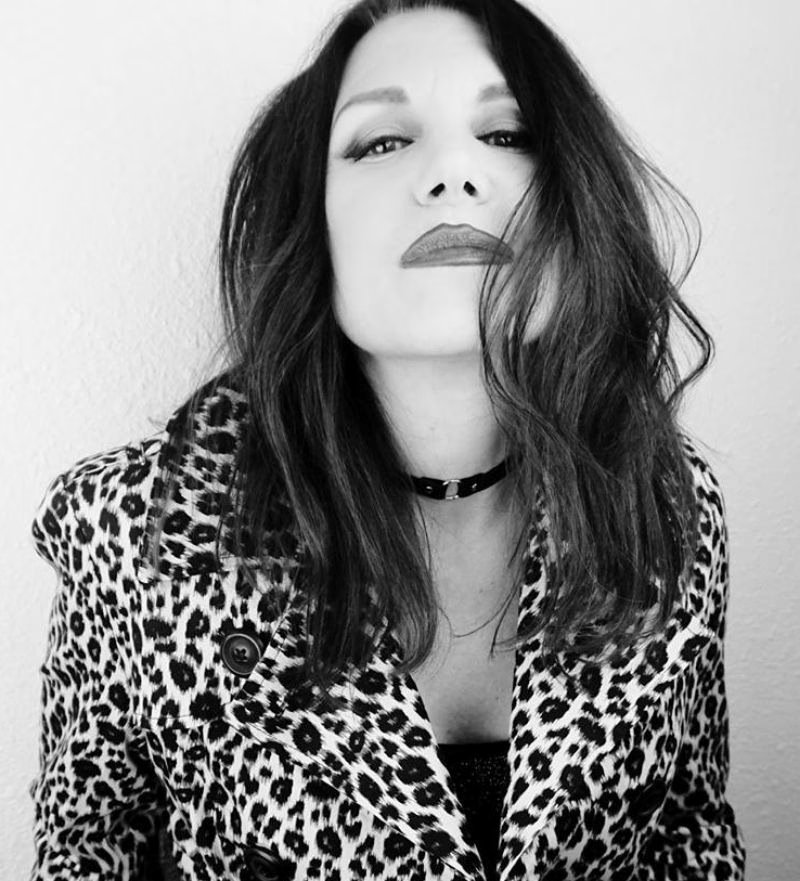
The air in the backstage lounge at the El Mocambo is thick with the scent of espresso and the faint, metallic tang of guitar strings being stretched to their limit. Lee Aaron sits across from me, looking less like a relic of the 1980s and more like a woman who has successfully outrun the ghosts of her own PR machine. She is a rocker, a mother and the immortal Metal Queen. But labels are cheap. Aaron has been grinding for nearly 40 years, churning out 17 albums that range from hair-metal anthems to jazz-inflected explorations. Her latest, *Diamond Baby Blues*, is a gritty, soul-drenched pivot that proves she is far from finished.
She’s back with a vengeance. And she hasn’t finished telling her story yet. We sat down with the Canadian icon for a chat about music, sexuality and the domestic reality of being a mom while maintaining a legacy that involves leather and pyrotechnics.
The industry is currently obsessed with "the comeback," but for Aaron, it feels less like a return and more like a reclamation. I asked her about the sudden surge in activity since *Diamond Baby Blues* hit the shelves. It feels like a resurgence, a tightening of the gears.
"I don’t know if it’s anything I’m doing anything different," Aaron says, leaning in. "You know I’ve sort of come back into the limelight a little bit now that my children are a little bit older. I was actually able to focus on writing and recording again and along with that of course becomes the whole gamut of doing videos comes along with it. I’ve had a greater video presence lately back again on YouTube and Spotify and all of those networks that are out there, as everything is digital out there now of course, right."
The digital pivot is a brutal requirement for any artist who survived the era of cassette tapes. But Aaron isn't just dumping old b-sides onto streaming platforms. She is producing new, high-calibre material that stands up to the scrutiny of the modern ear.
"There was Fire and Gasoline 2016 and Diamond Baby Blues of course that came out in 2018, so we’ve written and recorded a couple of studio albums just recently and I think the material is strong and I think that’s resonating with fans," she explains. "Some artists come back many years later and they do something but it doesn’t match the quality of what they’ve done in the past and I think the work we’ve done recently—and when I say that I am crediting my bandmates as well, not just myself—I think the work we’ve done lately matches the quality if not surpasses what we’ve done in the past and so I’m pretty excited about it."
There is a specific weight to her recent work. It lacks the hollow sheen of 80s production. Instead, it carries the grit of a musician who has actually lived the lyrics. This brings us to the inevitable live document. In an age of Auto-Tune, a live record is the ultimate litmus test for authenticity. I heard there’s a live album coming, and Aaron confirms the logistics with the precision of a tour manager.
"There is," she says. "I just got the release date into my inbox yesterday. It’s September 20, 2019. It is a live album DVD package. So it’s got a companion DVD. So what it is, is the best of two nights in the summer of 2017 when we were touring Europe, Germany, specifically. So part of it is from Bang Your Head Festival and part of it is from a huge nightclub called Hearst nightclub in Nuremberg. We recorded and filmed live both nights, so we’ve got the DVD on one side and the live album on the other side of the package. So it’s quite exciting and one of the coolest things I’ve done lately, so I’m excited about it."
Watching the footage from those German dates, you see a performer who understands the theatre of rock. But the theatre only works if the orchestra is tight. Sean Kelly has been the six-string anchor for Aaron for years now. They are a killer pair, a dual-threat of Canadian talent that seems to operate on a shared frequency.
"We do actually," she says of their chemistry. "We just have a lot in common. You know he’s a teacher and I work actually in the field of special education out here in BC also with kids and I think for both of us it’s a way of giving back, outside of our music careers."
It is a jarring image: the woman who sang "Whatcha Do to My Body" working in special education. But it makes sense. There is a patience to Aaron that likely serves her well in a classroom.
"We connect on a lot of levels," she continues. "We love children and we love inspiring kids to be musical and to reach their potentials. We both like similar styles of music, but then there is this area where he’s sort of stuck in and likes a lot of that glammy 80s rock and I like a lot of that but I dig in further of the past and I pull on blues and roots and blues and things like that, so it actually makes for a really interesting combination of influencing that we’re both bringing into the writing sessions and he’s just a lovely person. We get along really good, we both have families. We joke around; we’re like the Steven Tyler and Joe Perry of the Lee Aaron band."
Obviously when I look back at some of my songwriting back then, it was coming from the perspective of a 19 or 20-year-old girl which was lacking a huge amount of life experience and being full of piss and vinegar bravado, but not knowing completely what I was talking about... I can see now that perhaps it might have been misunderstood because it was presented to the public by a fairly immature person... When I play that song nowadays, fans in my age category who have followed me for years feel that it’s an anthem of empowerment for them, and that’s a great thing.
But we have to talk about the crown. It’s been a long time since the *Lee Aaron* project and the debut of *Metal Queen*. Can she still relate to the woman who recorded those albums? Or is that person a stranger?
"On one level yes, on one level no," she admits. "Obviously when I look back at some of my songwriting back then it was coming from the perspective of a 19 or 20 year old girl which was lacking a huge amount of life experience and being full of piss and vinegar bravado, but not knowing completely what I was talking about. Now I can look with wisdom and go okay I knew what I was doing then and I know that with Metal Queen I was trying to make a push back feminist statement but I can see now that perhaps it might have been misunderstood because it was presented to the public by a fairly immature person."
The misunderstanding was systemic. The video for "Metal Queen" was famously banned in England and Australia. The censors didn't see a heroine; they saw a victim. It was a classic case of the male gaze misinterpreting female power.
"I know that video from Metal Queen was banned in England and also Australia because they saw the video," Aaron recalls. "We were trying to create a 'comic book style' female heroine character who prevails against the forces of evil and all of the regulatory advisory boards back then all they saw was there’s a woman getting her arm set on fire, that’s violence towards women. That was such of the day and that was what they were looking for. I don’t think it was necessarily. I kind of think that it’s nice for me now that as a more mature artist to fast forward to the future and bring some of that material and present it with a new face and I really feel that songs and their meanings evolve and change over time. When I play that song nowadays, fans in my age category who have followed me for years feel that it’s an anthem of empowerment for them and that’s a great thing."
For years, "Metal Queen" felt like a battle axe she was forced to carry—a heavy, cumbersome burden. I asked if she’s finally come to terms with it, or if the stigma still lingers like a bad hangover.
"No I have definitely come to terms with it," she says firmly. "I don’t know, that stigma has largely kind of faded away in the last decade and I think again that comes with all of our audience. My audience is between 40-60 years old. Those are the people who remember my songs and I feel as the audience has grown up and matured with me, the music of their youth takes on a different meaning. They are able to look at it from a different world view, so I don’t feel that it carries that stigma."
The frustration used to be real. In the late 90s and early 2000s, Aaron seemed to be running away from her hard rock roots, diving into jazz just to prove she had the chops.
"Years ago, when I got fed up and I didn’t want to play it, it was because people would go oh along with that whole image Metal Queen, just the word Metal being involved in the title brought about a lot of negative ideas for people that I must be this woman who lives this certain type of lifestyle, doing drugs and alcohol, is promiscuous," she says. "It was like a tag hung on me that it is what it entails and comes along with that but it couldn’t have been further from the truth and that was frustrating for me because I was like oh my god, everyone has missed the feminist message here. For a while I was like, screw it, I’m not going to play it. Too bad."
But time is a great equalizer. The audience that grew up with her now has the financial means to support the circuit. Classic rock festivals are the new gold mine.
"Forward a decade where my demographic of audience has the most disposable amount of income, classic rock festivals are now bigger money makers than ever, everybody wants to see the music of their youth lives and why not because all us bands know how to play their instruments and perform," Aaron notes. "A lot of the new music today everything is so programmed and digitized. I find some of it un-listenable. So that’s what people want to see, so like I said, they are able to come out and experience the music from a new perspective, a new world view."
The physical relics of that era are gone from her closet. If you’re looking for the original "Metal Queen" outfit, you won’t find it in a cedar chest in her basement. It’s been institutionalized.
"I do not but I can tell you where it lives," she says with a laugh. "It lives at the National Music Centre in Calgary. The National Music Centre in Calgary, if you don’t know what it is, you should Google it. It’s this incredible, it’s kind of like the Canadian Rock and Roll Hall of Fame. It’s this incredible entertainment/education/archival venue. Maybe three years ago, I heard from the curator and he asked me if I had anything that I could donate and I still had the Metal Queen vest and I still had my vintage body rock black leather jacket with all the buttons on it. So I donated it to the National Music Centre in Calgary."
The sexuality of that era was overt, often suffocating. I asked if she felt that the "sex sells" mantra was forced on her by the suits in the boardrooms.
"To be completely honest, yes I felt like I was battling a lot," she admits. "I don’t like to say negative things about former work colleagues, people I’ve worked with, people I respect but there was a real agenda back then especially in the 80s. Women were, especially in rock and roll videos, sexualized. Quite often a video would have men parading around doing their thing and then there would be a bunch of scantily clad women that were pretty much ornamental to the video to prop them up to make them look more masculine."
The irony of the 80s was always the gender-bending aesthetic of the men. They were the ones in the makeup chairs.
"The irony being that they probably had more hairspray and makeup than the women did back then," Aaron says. "That was the ironic thing. There was definitely a push for me to fit into cultural marketing of the time. That is something that I was able to thankfully really pull away from and distant myself from later on. I actually went independent in 1992, I’m not sure if you were aware of that, I was actually one of the first acts in Canada to go independent off my label. I can wear whatever I want now. I can do the kind of music I want. Commercially, the next couple of albums weren’t quite as successful as they had been with a huge label behind me but I think I was a lot happier personally than artistically."
Now, she balances the legacy with motherhood. Her daughter is growing up in a world where pop stars leave very little to the imagination. I asked how she feels about her daughter seeing her own "provocative" past.
"To be honest with you, it’s a lot less shocking than some of the stuff like Britney Spears, Miley Cyrus, Katy Perry," Aaron says, dismissively. "A lot of the stuff that’s out there makes a lot of my former early stuff look mild. So honestly, it doesn’t really phase her. They’ve seen all my videos in the past. I know that when she was in Grade 2, she came home and she said my buddy Jaden said his mom showed him a video and there’s some giant robot thing and I’m thinking what video is she talking about, she must mean Metal Queen with the giant silly aluminum drum riser and she was literally lasted half the video and she said that’s it and I said yeah."
Modern kids, raised on CGI and high-speed internet, aren't easily impressed by 80s practical effects. But the conversation isn't just about the visuals; it's about the agency.
"She was bored because it wasn’t CGI and didn’t have all these special effects that she was seeing," Aaron concludes. "I have talked to my own daughter extensively about the fact that these are some of the obstacles that mom encountered when she was young and I maybe didn’t have the strongest support network around me like you have around you so you need to be aware that everything you wear sends a message. So we’ve had a lot of discussions around that absolutely."
Lee Aaron is no longer just a character in a comic book. She is the author of her own narrative. And she is still writing the chapters.