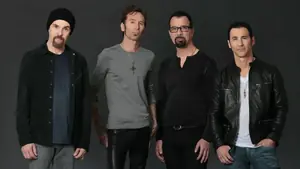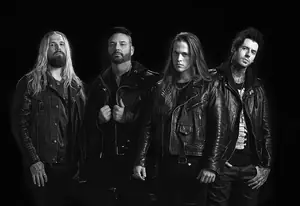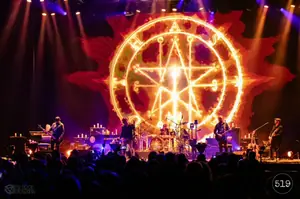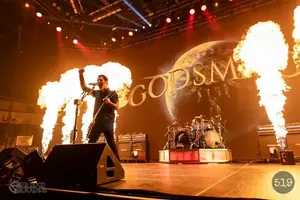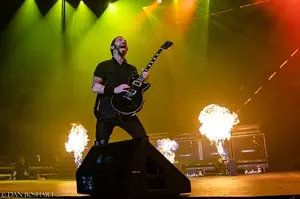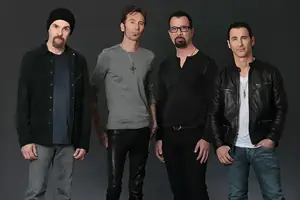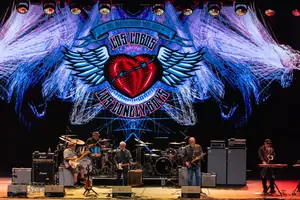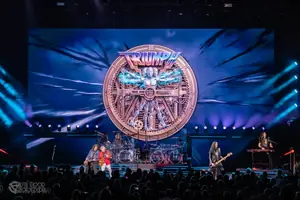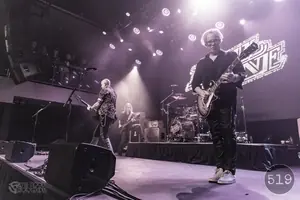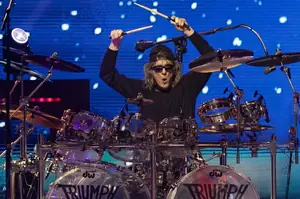

Standing in the wings of The Colosseum at Caesars Windsor, you can feel the humidity of a legacy that refuses to evaporate. It is Friday, April 26, and the air inside the venue carries the weight of a quarter-century of distortion and radio dominance. Lawrence, Massachusetts has exported a lot of things, but Godsmack remains its most resilient commodity. They are here for the Vibez Tour, a pivot that feels less like a retreat and more like a victory lap for a band that has clocked 28 top ten songs and 12 number one hits.
But this is not the pyrotechnic assault we have come to expect. This is an intimate, seated affair that attempts to humanize the machine. Their latest record, *Lighting Up the Sky*, is being touted as their studio swan song, a final statement from a group that has nothing left to prove to the Billboard charts. I caught up with Shannon Larkin, the band’s percussive engine and a man who carries the history of American hard rock in his DNA, to talk about this transition from arena gods to theatre storytellers.
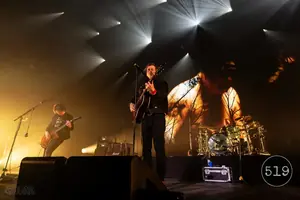
The Vibez Tour is a gamble on vulnerability. It kicked off Feb. 15 in Tulsa, Oklahoma and took a breather before hitting the West Coast. It is the first time in 20 years they have traded the wall of sound for something resembling a conversation.
Shannon explains the logic behind the shift, noting that the band had already exhausted the traditional circuit. “We beat up Canada and the US last year and went into the B and C markets and stayed out for almost eight months. Near the middle of it, our second single was doing well, so we knew we could extend our tour for this record cycle. So, I said, ‘Hey, man, what if we did it because we like to keep playing, keep moving? And what if at the beginning of next year, we do another kind of tour, an acoustic tour?’ And then Sully said, ‘Oh, man, that’s a good idea because we could do small venues.’”
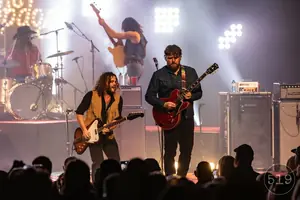
And while the marketing says "acoustic," the reality is more textured. This is not just four guys on stools. They have expanded the lineup to fill the sonic gaps that usually require high-gain amplifiers.
“Acoustic guitars come out, but we added some extra musicians, Chris Decato on keyboards and Tim Theriault on guitar, and they allowed us to realize some of these cover songs that we would never be able to play normally,” Shannon says. It is a necessary addition. Without the keys and the extra strings, some of their deeper cuts would feel skeletal rather than atmospheric.
The aesthetic of the show is a deliberate throwback. It is less about the digital precision of modern rock and more about a hazy, psychedelic warmth.
“It’s like the whole lava lamp mushroom inspiration is what we’re trying to do, and being able to play with a little more spontaneity. We learned, like, 28 songs total so that we could change the list up. It’s not the same thing every night,” says Larkin. This spontaneity is a rare currency in a genre that often relies on click tracks and rigid lighting cues.
There is a refreshing arrogance in Godsmack’s refusal to use digital crutches. In an era where even the "raw" bands are running 16 tracks of backing vocals and sub-bass through the front-of-house, Larkin is a purist.
“We toured almost eight months last year in support of Lighting Up the Sky and we’re one of the few and proud nowadays that don’t run backing tracks and all that crap. What we do is play the same every night and try to make it sound like the record. When I was a kid going to see Rush, if Neil Peart had changed his fills, it would have upset me because I spent hours learning his fill and I wanted to see it,” he admits. It is a valid critique of the current industry—the obsession with perfection has often killed the soul of the live performance.
But the Vibez Tour is the exception to his own rule. It is the one place where the band allows the edges to fray.
“So, this Vibez Tour gives us a chance to improv a little, you know what I mean? We don’t have to play everything the same every night. It’s not such a machine with bombs and fire and all this. It’s like a play almost when you’re doing the big concert, where with this, when a song’s over, we can take a drink of water or whatever and it’s really cool man. I’m loving it,” Shannon says. There is a visible relief in his posture when he talks about this. The pressure of the "machine" is real.
Larkin has spent decades staring at the back of Sully Erna’s head from a distance that usually requires binoculars. The physics of an arena show are inherently isolating for a drummer.
“I’ve never been about big crowds. As the drummer, when we’re on the big shows and festivals, it’s a 60 by 40-foot deck and the drums are at the very back of that deck. Right away I’m 30ft from the front of the stage and then it’s a 15-to-20-foot barrier to the front row. So now I’m 40 to 50ft away and I can’t see anybody, but I can feel that big energy. Playing a lot of these old beautiful theatres that were made for music, they’re acoustically designed so it sounds wonderful, and I can see every face in the place. Man, looking up at a balcony, I could see people mouthing the words, or smiling or crying, and that’s something man. At my age, it’s something special,” he tells me.
The setlist for this run is a deep dive into the catalogue, pulling out tracks that would normally be buried under the weight of the radio hits.
“This Vibez Tour is way better for us as it’s not as much pressure and we can play songs we haven’t played in 20 years that weren’t commercial rock. We do One Rainy Day off the IV record that’s just a blues song really. It’s like a Robin Trower trippy blues rock,” Shannon explains. It is a bold move. Most fans at Caesars Windsor are looking for the hits, but the band is betting on the fact that their audience has aged with them.
Of course, the elephant in the room is the "Batalla De Los Tambores"—the legendary drum duel between Larkin and Erna. It is a spectacle that defines their arena show, but it does not fit the theatre mould.
“There are certain songs that we break down in and make a jam section where we can improv, and Sully gets on the hand drums, so, we kind of simulate that. But that is the only thing that I feel people might miss from the big show, the Batalla De Los Tambores. But we do some fun jams and I get to go off and it’s a whole different thing, a different set list, completely different band,” Shannon notes.
I’ve never been about big crowds... Playing a lot of these old beautiful theaters that were made for music, they’re acoustically designed so it sounds wonderful, and I can see every face in the place. Man, looking up at a balcony, I could see people mouthing the words, or smiling or crying, and that’s something, man. At my age, it’s something special.
The vocal dynamics have shifted too. Without the need to scream over a wall of Marshall stacks, the harmonies have room to breathe.
“Our guy Tony can sing with Sully and it sounds fantastic. You put it on a smaller stage in a theatre setting and you’re really exposed. As a musician, when you’re doing the big show it’s so big and loud and there is fire and bombs and every hit you’re playing through the drum, and now I can be a bluesy player, jazzy player. I can be whatever I want on this stage. I don’t have to be the rock star guy,” he says.
The history between Larkin and Erna is one of the more storied bromances in rock. It predates the platinum records and the world tours. It goes back to the gritty club circuit of the late 80s.
“I knew Sully for 17 years before I even joined Godsmack. He had seen me in a band called Wrathchild America. It was my first band. We got signed in ‘88 to Atlantic Records and toured with Testament and Pantera. The night I met Sully he had the Wrathchild record and asked me to sign it. A couple of gigs later, he came out again and I’ll never forget it, because he was with Reed Mullin of Corrosion of Conformity, one of my favourite bands,” Shannon reminisces.
The bond was forged in hotel rooms and tour vans long before the money arrived.
“I had a party in my room that night and everybody was drinking, and we bonded. So, we just exchanged numbers, and from then until I joined Godsmack, we remained friends and stayed in touch. When Godsmack did that first demo, which ended up being the first record, he sent it to me. I was living in California and was with the band Ugly Kid Joe at the time,” he says.
There was a moment where the paths almost crossed sooner, but Larkin’s loyalty to his current projects kept him away from the early Godsmack momentum.
“A short time later I left that band for this other band. Amen, a punk band in LA when Sully called me and said, ‘Dude, we’re selling 5000 copies at a show out of a trunk of our cars and charting on WAAF in Boston with this song Keep Away. We’ve got every major label offering us deals. Come join my band, brother.’”
“I was like, shoot, man. I’m nothing if I’m not loyal, and Amen had also gotten a record deal with Ross Robinson and Roadrunner Records at the time, and so I couldn’t. Roadrunner wasn’t a major yet because Slipknot hadn’t happened, so they were still an underground label. But all that said and the carrot that he was offering me, I’m like a pit bull. So, I stayed with Amen and watched him get a drummer. Tommy Stewart, and watched my brothers’ first record come out and sell 5 million copies. I thought, maybe it’s just not in my cards to be a rock star because Amen, certainly we sold 5000 if they sold 5 million. But then five years passed, and he had his issues with Tommy Stewart and I got the call and the timing was just impeccable,” Shannon explains.
The transition to Godsmack was eventually born out of necessity and a change in life priorities.
“I had a baby girl and I couldn’t be in a punk band anymore, making 30 grand a year, and be gone for eight months and come home bloody and bruised. Amen was brutal. I loved it, by the way, but I had a kid, so I quit the band. Two weeks later, my phone rang and there he was. ‘Hey, man, Tommy’s out.’ And I was like, ‘Oh, wow!’ And that’s how it all started.”
“My point of that whole thing was that we knew each other as good friends. Like when Wrathchild would come through and play Boston, he’d show up at soundcheck and, take me to the Laundromat and we’d hang out while I’m doing my laundry on tour. Shit like that, man. So, you know, we’ve been brothers since 86 or 87, man,” he says.
But brotherhood in rock and roll is often tested by the bottle. Larkin has been sober for eight years, but the memories of the chaotic years remain vivid.
“It would only happen once or twice a year when I would drink too much. I drank every single day and was drunk every day, but I only became a mean drunk a couple of times a year. It’s not funny in retrospect, but it’s funny because I freaked out. There are not many countries in Europe that we are big in, but Bulgaria happens to be one of them. So, we show up, rock stars and shit, and there was this bar out in the middle of the woods and, oh my God, it was a gorgeous night. They said to an alcoholic, open bar,” he recalls.
The night in Bulgaria became a piece of band lore, the kind of story that only survives because of a deep-seated fraternal bond.
“I was a whiskey guy and next thing I blacked out. I don’t even remember any of this shit. I wanted to get a shirt that said, ‘I’m sorry’, so the next day, I wouldn’t have to tell all these people I’m sorry when they come up and tell me what I did. But anyway, the funny part is I, for whatever reason, started stripping off my clothes and quitting the band again, and I’m yelling at Sully and Robbie. I’m going home now, and naked, and I ran off into the woods, and Sully had to physically run and tackle me and wrestle me and put me in the van. Anyway, he is my brother, truly. He’s seen the good and the bad of the kid here.”
When Shannon finally joined the fold, he was chasing a specific kind of validation. He wanted the gold record—the literal physical trophy of success.
“He’s like, ‘No, platinum is better, dude. It means a million.’ And I’m like, ‘I don’t care. I want a gold record.’ I even sang to him, ‘Got me an office, gold records on the wall.’ You know what I mean? Like I grew up with that. You want a gold record, man.”
“And then they gave me that record.”
“We were on tour with Metallica, and he gave me that gold record. I still have it. It’s one-of-a-kind. They custom-made the gold for me and he put it in this really cool frame and it’s still my favorite record,” Shannon says.
The nostalgia for physical media continues with the upcoming reissue of *Awake*, the band’s sophomore effort, which hits shelves May 17 on black and limited edition green double vinyl.
“I’m super stoked about that. It’s the perfect opportunity for us to mark the 20th anniversary of the Awake release, and we hope to do it with everyone because vinyl records stopped being made by the time Godsmack’s first album came out. We never had vinyl up until the vinyl resurgence happened in 2015 or 2016. It seemed like everybody started getting the vinyl itch. So, people were making records again and we started releasing vinyl,” he notes.
But as the band looks back, they are also looking at the exit sign. *Lighting Up the Sky* is being framed as the end of the studio album era for Godsmack. They aren't retiring, but they are done with the treadmill.
Shannon is candid about the physical toll of the road. “I have all kinds of animals. I have over 30 turtles. I have 40 Koi fish that are huge, beautiful animals and a 35,000-gallon Koi pond. All this stuff that is my life beyond music. I’ve just been home for a short two-week break here, and after doing almost eight months last year, I just look forward to getting through this year. And I’m going to enjoy every show, don’t get me wrong, and every minute on stage. But I can’t wait for a big break where I can let the stillness come in.”
The grind of touring at 56 is vastly different from the grind at 26. The "carrot" of the industry still dangles, but it is less appetizing than it used to be.
“Last year was brutal at my age, I’ll say it, 56 years old. We’ve been lucky enough to afford the luxury to say we’re not going out for more than four weeks and we end up doing five because of the carrot and all that. But then you get a ten-day break and then four weeks and a two-week break and it’s non-stop, man. And so, you know, the fans, they think, ‘Oh, they don’t even like to be out.’ No, I like to be out there, but I can’t wait for a break.”
“When I’m home I get up early and I do all my yard work. I don’t have a yard guy. I’ve got a mower and I dig up my weeds and I plant all the plants and all the, but I’m not tired ever, whereas as soon as we get on tour after a week, you’re just tired all the time. It’s called road fatigue,” he admits.
He quotes a rock legend to illustrate the psychological weight of the lifestyle.
“David Lee Roth said it best. ‘It’s a road fatigue that doesn’t go away. It’s like being in the middle of the ocean and looking around you and there’s just nothing, just the horizon for miles.’ It’s an isolated feeling, I think, that makes our bodies physically tired, even though we do way much more work at home. Jim Carrey is probably the most famous, you might have heard him talking about stillness and just finding your stillness within. We all have it. It’s just finding it.”
But even in the stillness, Larkin cannot stop creating. He has a slate of side projects that allow him to escape the "commercial rock" box.
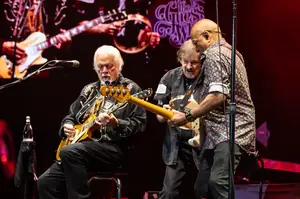
“I did a record last year with Terry Carter from Wrathchild and a couple of the Apocalypse guys and that project is called Spirit Wheel. I’m super excited about that. It’s a whole different thing from Apocalypse Blues Review. Tony (guitarist Rombola) needed time off from Apocalypse, so that thing’s on hiatus until Tony is ready because the Apocalypse Blues Review is me and Tony.”
“And then there are two other projects that I’m putting out next year too. So, I’m going to do my own, self-release, DIY stuff like it was back in the day in punk rock or whatever. I don’t care. I’m lucky enough to have been in Godsmack so I’m at the point where I don’t care if they sell or not. I’m going to make music that’s not commercial, but I feel it’s hooky and great. It’s psychedelic blues rock or whatever, but it doesn’t have all these rules. And I certainly don’t want to be jumped back into having to deal with labels, management, booking agents, and all that. They don’t call it the music business for nothing,” he says.
Godsmack may be closing the book on their recording career, but Shannon Larkin is just starting a new chapter of creative autonomy.
“And I’m not complaining here, but I’m just telling people that might see this that I will release a bunch of cool music next year,” he concludes. If the Vibez Tour proves anything, it is that Godsmack is finally comfortable in their own skin, even without the bombs and the fire.
Get Tickets