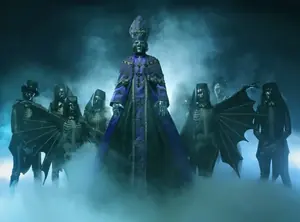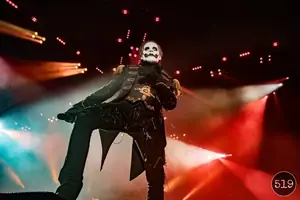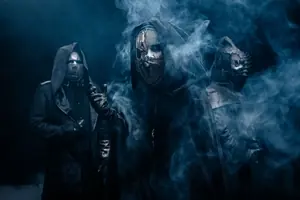


Sitting in the back of a darkened tour bus, the smell of incense and stale stage fog clinging to the upholstery, you realize Tobias Forge is less of a rock star and more of a meticulous creative director. He is the man behind the mask, the architect of a Satanic pop-rock empire that has spent over 10 years turning the blasphemous into the bankable. Ghost is no longer just a band; it is a sprawling, theatrical brand built on over-the-top costumes, high-concept videos and a rotating door of lead characters that Forge inhabits with the precision of a method actor.
The "Ultimate Tour Named Death" is the latest iteration of this macabre circus. It arrives alongside "Kiss the Go-Goat," a retro 7-inch single that feels like a lost psych-rock relic from 1969. Forge and his nameless ghouls have been pounding the pavement across North America, but the schedule is tight. For fans in the Great Lakes region, the only chances to witness the ritual are Oct. 14 in Grand Rapids and Oct. 17 in Hamilton.
But why the sudden shift to arenas? Ghost has spent years haunting mid-sized theatres, where the intimacy adds a layer of Victorian dread. The jump to the big rooms changes the physics of the show. Forge is acutely aware that the transition from a cramped stage to a massive arena floor is not just about selling more tickets; it is about the "vibe" of the crowd.
"The difference between what most people saw close to a year ago and this tour is that since it’s all in an arena setting, there are various production limits as opposed to last time, we went through Toronto," Forge says. "Especially a theater show. The theater shows that we did in the fall, we had no pyro, first and foremost, and then it was a crapshoot basically if we have all the staging or not. We did a lot of staging in many of the theaters, but many also ended up being no staging at all."
This inconsistency is the enemy of a perfectionist like Forge. In a theatre, you are at the mercy of the proscenium arch and the local fire marshal. In an arena, you bring the thunder. And you bring the floor. There is a specific energy that comes from thousands of people standing in a general admission pit rather than being strapped into velvet seats.
"There was just an inconsistency that was very annoying," Forge continues. "Another very important issue for me, and I think for the band, and I also think that at the end of the day, it becomes an issue for the crowd as well, is that we a have no seats now. Well obviously, if it’s is an arena, you’d have bleachers on the sides, but in front of the stage, you have a big general admission floor. You get a completely different vibe. The whole vibe is so much more vibrant, and way more in tune with the music rather than people sitting, and standing and being barred to their little confined space. Just the general vibe of the show will be dramatically different, and I am very happy also that we’re doing the same show for anyone. Everyone, be it if you come to the Hamilton show or if you’re in South Dakota or Fargo, whatever. Wherever we’re playing, we’re giving the same show to everyone, and that for me is a big, big, big step up."
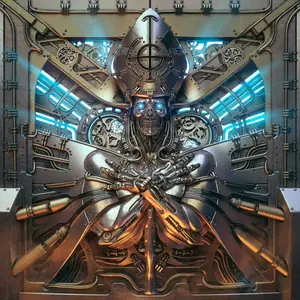
And then there is the gear. Ghost fans are notorious completionists, the kind of people who will hunt down every variant of a vinyl pressing. The "Exalted" deluxe collector’s edition of *Prequelle* is a massive, heavy box that feels like a piece of cursed furniture. But its existence is actually the result of a massive logistical headache behind the scenes.
Forge is remarkably candid about the fact that the original release of *Prequelle* was essentially an unfinished product. The music was there, but the visual world he had built for it was stuck in a production bottleneck. It is a rare admission in an industry where everything is usually polished to a fake sheen.
"The thing was that originally, what we usually did with our, or what we intend to do with every record that we put out is quite an extensive sort of graphical package, and unfortunately, there was a little of a, I don’t know, misunderstanding in the production line, and we ended up putting out the record, Prequelle without the artwork that we intended for it to include because we had to choose between two things, and it was we had all the artwork in, which was very unclear as to when that would be, and that would mean definitely pushing the record in to oblivion basically," he explains.
The pressure of the tour cycle is a beast that must be fed. You cannot delay a record when the buses are already booked and the nameless ghouls are waiting for their cue. Forge had to make a tactical retreat to keep the momentum going.
"It’s not very hard to realize that," Forge says. "Of course, we’re not going to do that because we had tours booked. Everything was depending on the record coming out at a certain point. I deliberately told the label, 'Let’s put it out. Let’s try to keep the pricing down, so that people at the end of the day, will somehow realize that we are not charging the same thing for the record now as we would have done if it had included all the artwork to begin with and all those things, and one day when we get all the artwork in, and we have to figure something out to vamp up the whole package.' That’s what we’ve come to now. Finally got all the artwork in, and then we had to re-release the album basically in the same spirit as it was supposed to be released in the first place."
But not all merchandise is about high art or gatefold sleeves. Sometimes, it is about a plushie doll of Cardinal Copia that looks like it was designed in a fever dream. Holding the physical doll, you realize it is intentionally bizarre—a soft, cuddly version of a man who sings about the plague.
The story of the plushie is one of those corporate accidents that Forge has learned to embrace. It is a weird intersection of brand expansion and the sheer absurdity of being a rock star with kids.
"Well, that is a good question," Forge says when asked about the doll's origin. "I’m not really sure how to answer that more than... Part of our business is the merchandise, and there are discussions about everything between heaven and earth, and beyond of manufactures that want us to, in one way or another, merge with their product. Let it be known that most of the things we actually do turn down because I am trying to be very selective in what we do, and I think that the plushie was definitely one of those where a year ago, I got the question, 'Do you want to do a plushie?' Like, 'Sure. What is it? What is a plushie?' 'Oh, it’s one of those.' 'Oh, okay. Okay. I have kids, so I recognize what a plushie is now.'"
The gap between the concept and the final product was apparently a long, strange trip.
Papa I was tailor-made to disappear in the mist of small clubs. I think that Papa II was better at emerging through that mist, and I think the third steps better, and then I think that Cardi is the best so far.
"Then eight months later, you get like a drawing saying that, 'Oh, this is a drawing of what the plushie would look like.' 'Oh, okay.' Then, four months later, you see a picture of this plushie online, and you’re like, 'What the flying fuck is that?' But it turned out pretty cool, and it was a big laugh, and I liked it too. It’s one of the most horrendous things I’ve ever seen, so that’s the plushie story," Forge says.
This sense of humour is what saves Ghost from becoming a po-faced black metal parody. Forge is playing the long game. The 2019 season has been a relentless grind of global expansion, including a high-profile run supporting Metallica. That tour, in particular, forced Ghost to refine their act for massive outdoor stadiums where the "spooky" atmosphere has to compete with the afternoon sun.
"This year, so far, 2019 has been predominated by tours out of the United States," Forge says. "You do these tours because you want to expand your brand and your band. You want to reach out to more people. You do so with a purpose, and that is to get as many people as possible out of all these 50s, 60s, 70, 80s, sometimes thousand people to come to your show next time."
It is about building a legacy, one city at a time. The goal is to reach a point where the production is bulletproof, regardless of the venue's limitations. Forge is finally starting to feel like the vision in his head matches the reality on the stage.
"That has been the thing that we’ve been doing for four months now, and even before that, we were doing a few festivals down in Australia. We were doing festivals in Japan. We’re slowly approaching the end of the Metallica legs, and we’re about to embark on the American tour, it really feels like we’re very close to the intended element of where I want the show to be. I’m very happy about the tour in the fall," he explains.
The frustration of the past—where only the biggest markets got the full Ghost experience—seems to be fading. Forge wants the fan in a small town to see the same spectacle as the fan in Manhattan.
"I’m very, very happy to be able to take that show and that original idea to as many people as possible without feeling that we are refusing people," Forge says. "In the same way that it felt like we’ve done in the past, we’re only in the fall tour a year ago, it was New York, L.A., and Montreal, that got the big show and then everybody else had to sort of, I don’t want to say settle, but they definitely got the lesser of the show just because of the confines of the venue. I wanted to be consistent. I don’t want to be segregating anyone. I want you to feel like you’re getting the same thing, regardless if you are in St. Louis and/or St. John."
But what about the men behind the masks? The lineage of the Papas has become its own mythology. Each character represents a different era of the band's sound and ambition. Papa Emeritus I was a static, frightening figure. Papa II was a bit more of a lizard-king charmer. Papa III was a dandy. And now, we have Cardinal Copia.
Forge is pragmatic about this evolution. He views the characters as tools that have become more effective as the stages have grown. If there is a critique to be made, it is that the early Papas were perhaps too subtle for the massive machines Ghost has become.
"I am going to disappoint you because I don’t have a long speech about each of them," Forge says. "I think that they’ve gradually got them better, and more suited for the purpose of entertaining bigger crowds. Papa I was tailor made to disappear in the mist of small clubs. I think that Papa II was better at emerging through that mist, and I think the third steps better, and then I think that Cardi is the best so far. That is known also that we are doing dramatically different things. We are playing in other settings than we were years ago."
He reflects on past performances with a critical eye, specifically citing massive festival slots where the band's confidence had not yet caught up to the size of the crowd.
"I definitely think that looking back, and there are some of the things that we’ve done historically, I definitely believe that if we have gotten the same chance today, we would have executed it better like Rock in Rio, for example," Forge says. "If we had done to Rock in Rio today, we would have been better suited for that. Not only suited, not physically, but performance wise, we would have done that more confidently."
Cardinal Copia, the current frontman, is a different beast entirely. He is not a Pope; he is a striver. He is awkward, yet arrogant. Forge draws from a deep well of character tropes to bring the Cardinal to life, blending European cinema with high-octane rock theatricality.
"I don’t feel that that is contradicting qualities because they are definitely parts," Forge says of the link between himself and the characters. "I think that any actor or anyone acting is drawing some sort of check from within, like some sort of observation of a character or a stereotype that you’ve encountered, and that you have an opinion on, and then you manage that stuff through your acting. I think that if it wasn’t so sweeping crosscut through the different Papas and Cardi, I think that he and the different heavens are pretty much a stereotype of this macho flash sensitive man that you’d find in definitely more southern cultures."
The comparison he makes next is perhaps the most accurate description of Ghost's modern era: a mix of classic horror and slapstick comedy.
"It’s some sort of weird match between Count Dracula and Jacques Clouseau. It’s a film thing and I love both. It’s very fun to play with this sort of character. As I said, it’s a macho man, but still pathetic and that makes him funny because he is a fool, but in a shitty kind of cute way. I think that most people know a person like that. Some grandfathers somewhere or someone’s dad or some restaurant owner down the street is always like that," Forge says.
Then there is the Satanism. For the uninitiated, the upside-down crosses and the talk of the Morning Star are a provocation. But for Forge, who grew up in the Swedish underground metal scene, this is simply the vocabulary of the genre. It is the water he swims in.
"Oh, absolutely not," Forge says when asked if he ever doubted the Satanic angle. "No, no, no, no, no, but in the beginning, I had no idea that it was going to become my livelihood. Like I said, if it’s something that were to be defined my entire aesthetic being. That is not to say that I would have done it differently now. It’s just that at the time, for me, doing something like this aesthetically was not very far. The apple didn’t fall very far from the tree because I come from the death and black metal underground where any sort of satanic attributes are, that’s just natural, it just comes with a trade. That’s what you do. If you’re in a death metal band, you use upside down crosses. At least now, that’s what the death metal bands that I was playing in, so when Ghost took form in my head, and subsequently in songs, merch, and all that, the satanic imagery was very natural. I feel very home within that."
To the mainstream, Ghost is an exotic curiosity. To Forge, it is a continuation of a childhood obsession with the darker side of pop culture.
"From a more mainstream point of view, that imagery and the message or the lyrics and all that might seem unorthodox and alien, but for me, it’s very close to home," Forge explains. "I have been a fan of bands and literature and art and whatnot that embrace the idea of the devil as a positive character since I was 10 years old maybe, maybe younger than that even. I loved Rolling Stones when I was a kid and I loved sympathy for the devil. Just to bring one example, I’ve always been a fan of horoscope. For me, the darkness and the devil, and that pop cultural eagle was always home turf, and it’s not until Ghost started having mainstream appeal that I started getting questions about the exotic nature of the imagery. Then, of course, as a grown person, I understand that it’s exotic and weird, but for me, it isn’t."
But if you look closer at the lyrics to songs like "Rats," you realize Forge isn't just praising the devil; he is performing a surgical strike on the hypocrisy of organized religion. It is a critique of the "linear religion" that has dominated Western culture for centuries. Forge sees the church as a mechanism for control, a way to keep the masses feeling small and obedient.
"Yes and no," Forge says regarding the research that goes into his songwriting. "The criticism, I think all stems from the same place or it’s the same angle in many ways. It’s just that what you might need to be inspired to do is just come up with a new angle. Also, just because poetically, you need to sometimes penetrate the issue from a new point of view with a different lingo or with new symbolism, or a new parallel. I believe that one of the most important things in today’s society and life on earth today is to question the tyranny that is linear religion. Linear religion has destroyed so much of our lives for such a long time, and it has really, really crippled our ability to develop and its whole purpose because it was designed to weaken people, and to make people submit to this greater power."
He points to the architecture of the church itself—the ornate cathedrals built to dwarf the peasant huts surrounding them—as the ultimate symbol of this psychological warfare.
"Nowadays, it’s very unclear as to what that power is because back in the dark ages, they were very simple because the main mundane collective was living in huts outside around this church, and the church was obviously a big giant ornate, beautiful building filled with artifacts and beautiful things that would completely make people enamored and feel completely inferior in front of, and the idea was very simple and that was to make people feel inferior and if you had people feeling inferior, you could somehow get them to do things to feel maybe not superior, but at least better and that usually came with a price," Forge says.
For Forge, the modern religious landscape is still plagued by the same "bullshit" levels, promising a heavenly reward for earthly submission. He rejects this in favour of a more "circular" worldview—one where empathy and individual freedom take centre stage.
"The idea hasn’t changed much," Forge continues. "It’s just that nowadays, our tolerance level for bullshit is different, but it’s still very much a cancer of our society that we have been taught to believe that if you do this and this and this, you will get whatever good thing that has been promised in heaven. You can behave like a fucking dick, but if you just do this and this and this, everything we believe, everything will be fine and that is a very bad thing for society. I believe in a very circular way. I believe you shouldn’t be more into circular philosophy basically. What goes around comes around. There’s definitely, yeah, I could talk about this for hours."
Ultimately, the Satanic imagery of Ghost is a mirror. It is meant to provoke, yes, but also to provide a home for those who find the church's rigid structures suffocating. Forge isn't interested in being evil; he is interested in being free.
"The criticism in what I’m doing, and the symbolism is there for you to either be enamored with the aesthetics of it or for you to wake up, but at the end of the day, what I’m thinking about and what I represent has nothing to do with evil," Forge concludes. "Actually, I’m singing about evil being the opposite. I believe in compassion and LBTQ, and freedom, and intellectualism, not the opposite and the opposite is what the church stands for. That’s what the linear religion stands for.