

I’m standing on the concrete apron of Riverfront Plaza, looking across the Detroit River at the Renaissance Center. The humidity is thick enough to chew. It is the kind of mid-summer Windsor heat that makes the air feel heavy. But the crowd doesn't care. They are here for the "Money Man."
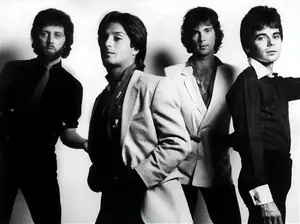
Eddie Money has been a fixture of the FM dial since the mid-70s. He is the blue-collar poet of the power ballad, a guy who traded a badge for a Gibson and never looked back. With hits like "Two Tickets To Paradise," "Take Me Home Tonight," "Baby Hold On" and "I Wanna Go Back," he has built a catalogue that serves as the literal soundtrack to a million high school reunions.
He is currently the centre of the AXS TV reality series *Real Money*, which pulls back the curtain on his chaotic, endearing family life. But today, the focus is the stage. He is headlining Bluesfest Windsor on Saturday, Jul. 14. We sat down to talk shop, and Eddie is quick to admit that this Windsor date feels less like a gig and more like a retreat.
I asked him if those decades-old hits still carry the same weight when he steps up to the microphone. He doesn't just give a PR answer. He leans in.
"Every time I sing 'I’ve got two tickets to paradise' it’s something special for me. I mean, music is a very nostalgic vehicle - it can really bring people back. I can take people back to a certain place and time in their life. It’s the same with 'Baby Hold On', 'Shakin’' or 'I Wanna Go Back'. I’m not a very religious guy, but I know God has been very good to me. I just appreciate the fact that I’m still around and have a lot of great hits to sing - it makes a lot of people pretty happy, you know," says Money.
There is a definitive power in that nostalgia. In a world of disposable pop, Money’s tracks have a structural integrity that keeps them on the air. But the "Paradise" he sang about in 1977 isn't necessarily the one he inhabits now.
The definition of escape changes when you’ve lived through the ringer of the record industry. I wanted to know if his version of paradise has evolved since he first penned that legendary hook.
"Everybody wanted two tickets to paradise when I wrote the song. Looking back, I was probably thinking of going to Hawaii or Bermuda or someplace place really hot and gorgeous. My mother, God rest her soul, used to say to me 'Eddie it’s not the state, it’s the state of mind!' You know two tickets to Paradise could be a bus ride to Northern California in the Redwood section or it could be something bigger. It’s anything to anybody. I mean if you had two tickets to paradise, where would you go?" he asks.
I tell him Australia. It’s the classic Canadian dream of getting as far away from the snow as possible.
"There you go. You know that’s a very good idea. I had a great time in Australia, it’s a great country. You’d have so much fun over there. You have to go there now!" he says.
I laugh and tell him it’s on the bucket list, but for the moment, the riverfront in Windsor is exactly where I want to be.
"Right on! Well, the show’s going to be great up there in Windsor. I called the promoter down there and I guess he didn’t know who Eddie Money was and he said to me on the phone 'Oh are you Eddie Money?' I said 'yes it is'. He said 'do you realize you have a guest list bigger than the Rolling Stones?' That’s because we’ve got a lot of friends there and it’s going to be a great show," says Money.
That guest list is no joke. Being a Detroit staple for years means his reach across the Ambassador Bridge is deep. He has played every theatre and arena in the 313, but Windsor offers a different flavour of appreciation.
Every time I sing “I’ve got two tickets to paradise” it’s something special for me. Music is a very nostalgic vehicle - it can really bring people back. I can take people back to a certain place and time in their life.
He has a surprising affinity for the northern side of the border. And it isn't just about the ticket sales.
"You know I envy you guys because you’ve got a way better national anthem to sing. O Canada is such a beautiful song. When I do hockey games up there and sing the Canadian anthem, it’s pretty exciting for me because it’s just a beautiful song - it really is. It’s amazing how many records I’ve sold up there and how many relationships that I kept up from Calgary to Toronto and from Montreal to Windsor. I’m very excited about playing there because I’ve got about 15 people on the guest list just from Windsor that are very good friends of my wife and me. I don’t drink anymore, so the Eddie Money show is kind of like life with Betty Ford at times. I’m not sure if you’re a girl that likes to knock down a bevi every now and then, but there’s nothing better than that Canadian Beer. I would die for that beer," he says.
The irony of a sober rock star praising Labatt Blue or Molson Canadian isn't lost on me. It’s that working-class honesty. He can’t touch the stuff, but he still respects the local culture.
His personal life is currently anchored by his wife, Laurie. They are closing in on 30 years of marriage, a feat that is practically unheard of in the meat grinder of the music business.
"We got married down in Mexico in a civic ceremony, but what I really want to do is turn it around and get married in a church. I want to get married with God as my witness. That’s what I really want do. She’s just awesome and she looks great. She’s number one in her spin class; she doesn’t eat red meat, but she’s not a vegetarian and she’s doing really well in everything as everyone gets to see on the TV show," says Money.
It is a long way from the streets of New York. Before the gold records, Eddie was Edward Joseph Mahoney, a trainee with the NYPD. It’s a piece of rock lore that usually gets glossed over, but it’s the foundation of his entire persona.
"I was in a rock band in high school, but they moved out to California and I stayed in New York because my brother was in Vietnam at the time. He was in the Marine Corps so my father said to me 'Why don’t you join the police department?' My dad was a good cop all his life and I went to the police department to basically help people like he did. You know my father never gave any black people tickets because he didn’t think it was fair and he thought they never had enough money to pay the tickets. When I thought about it, I couldn’t see myself in a police force for 20 years with short hair, working around the clock like that. So my band moved out to California and they said I had to come out and sing for them. I quit the police department, moved to California and eventually ended up getting a record deal from Columbia Records and Bill Graham," he says.
The transition from the precinct to the stage wasn't just a career change; it was a survival tactic. Bill Graham, the legendary promoter, didn't suffer fools. If he put his weight behind Money, it was because the talent was undeniable.
And that talent has had to endure. Many of his contemporaries from the 70s and 80s struggle to hit the notes that made them famous. Their voices are often frayed, thin or buried under backing tracks.
Money is different. He still has that signature gravel, but the pitch is surprisingly locked in. He attributes this to a technical discipline that most rockers ignore until it is too late.
"I want it to sound like it was meant to be – you know, just like on the radio. That’s how good we’re going to be when we come to Canada. To tell you the truth, my wife and I are more excited about this show than any other show this summer. That show in Windsor is going to be the highlight of my summer - seriously, it’s the highlight of my summer," he says.
The secret to that longevity lies in a lineage of vocal coaching that sounds like a Hall of Fame roster.
"I took vocal lessons from a lady named Judy Davis – she taught Judy Garland how to sing; she taught Frank Sinatra how to sing, as well as Sammy Davis Jr., Barbra Streisand and a whole bunch of singers. She was a great vocal coach. She always told me that cigarettes, marijuana and especially alcohol, are really bad for your voice. I took a lot of it back then, but I’ve taken less now for about four years. You really have to take care of your voice. You can’t be out there screaming. Your voice is a gift from God and I do everything I can to take care of it. I don’t drink, I don’t smoke cigarettes, I don’t smoke marijuana, I try to eat the right foods and I go to church on Sunday," says Money.
It’s rare to hear a rock star talk about "vocal health" with such earnestness. But when you’re performing songs written in high keys 40 years ago, you have to be a technician.
"Actually to tell you the truth, I have to say I really feel good about this. I don’t sound much different than my last album - I’m down maybe a half a step at the most. I have my vocal coach and sobriety to thank for that, you know," he says.
Dropping a song by a half-step is a common industry trick to save the vocal cords, but Money’s delivery is so forceful you barely notice the shift. He’s protecting the asset.
He’s also protecting his kids. His children are now following him into the industry, often performing as part of his touring band. It’s a family business, but he’s aware of the pitfalls he stepped into during his own rise.
"Well you know, I think they’re a lot smarter than I was when I was coming up. I went through a lot of drinking, smoking pot late at night and stuff like that, but the kids are a lot smarter than I was," says Money.
Sobriety is the recurring theme of our conversation. It’s the invisible guest at the table. He’s been clean for a decade, and that clarity has changed his relationship with the audience.
"I’ve been completely sober about 10 years, but before that I never used to get loaded. I was never like a Jim Morrison or guys like that though, because my job is very important to me and means the world to me. Back in those days I did some shows that weren’t as good as they should have been, but most of the time in my career I’ve always aimed do my shows pretty straight. My audience has always been very important to me. I want to make sure that when people see the Eddie Money show, they really do enjoy it and have a good time. I hope you’ll feel the same way when you see the show," he says.
Watching him prepare for the Windsor show, there is no ego. Just a guy who knows he’s lucky to be holding the mic.
Tickets for the Eddie Money performance at Bluesfest Windsor will be available at the gate. If you want a masterclass in blue-collar rock, this is the place to be. Just don't expect him to share that Canadian beer with you.
*This story is featured in the Jul. issue of 519 Magazine, which can be picked up at more than 200 locations in Windsor-Essex, Chatham, Leamington, Sarnia and London.