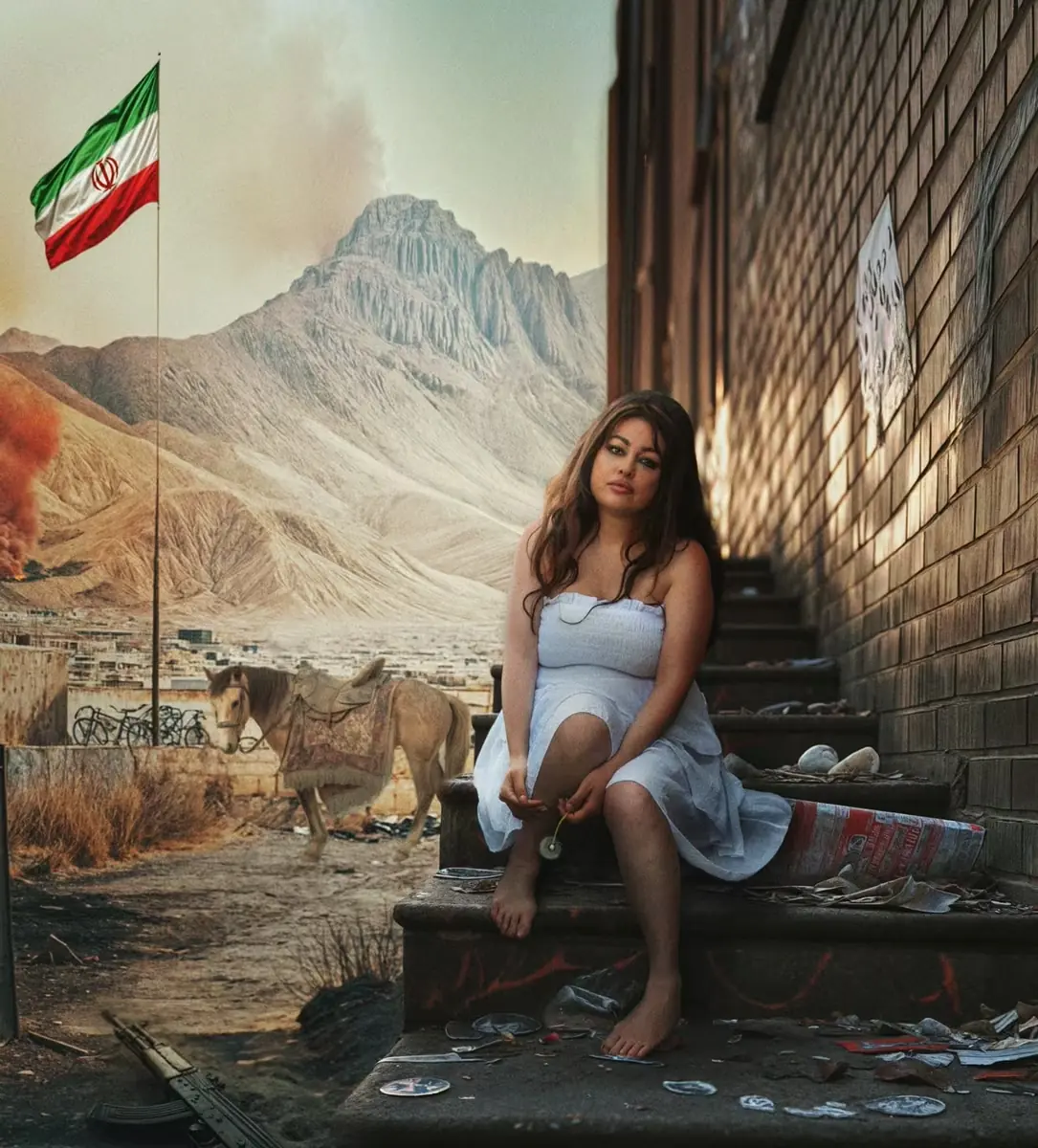

Listening back to these archival tapes from Aug. 5, 2010, is a trip. The hiss of the recording captures a moment when the last embers of 80s rock decadence were still glowing, albeit faintly. At the centre of it was Roxana Shirazi, whose memoir, The Last Living Slut: Born in Iran, Bred Backstage, was a Molotov cocktail tossed into the green room. Her voice, a mix of British polish and raw candour, cuts through the years with an unapologetic edge that still feels potent.
This wasn't just another groupie tell-all. It was never going to be. Shirazi’s entire project was built on a foundation of intentional provocation, a direct confrontation with her past and the culture she was born into. And she was acutely aware of the power in that contrast. It was the entire point.
“I wanted to present a work which had the contrast of Iran, of like the world I lived in which was like political and religious themes that I lived in, and make a contrast with really sexual explicitness,” she says on the tape, her words measured but firm. This wasn't just about shocking for shock’s sake. It was a calculated artistic and personal statement. It was her life, uncensored and unromanticized.
She makes it clear that the book was a rebellion against silence itself. After speaking at Iranian women’s conferences about child sexual abuse, a taboo within a taboo, she found a voice. The memoir became the next logical, albeit explosive, step. It was about dragging everything hidden under the carpet out into the harsh stage lights.
But getting that story published was a battle. The industry, even a decade ago, was terrified. “So many people were scared to publish it because they thought it was too controversial,” she recalls. “A lot of publishers would be sort of, ‘Well, you know, it’s got Iran and Islam and it’s got sex, lots of sex. So I don’t know. We can’t do this.’” It took a champion in editor Neil Strauss, no stranger to the underbelly of culture, to get it through the gates at HarperCollins. It’s a classic tale of the establishment fearing what it can't easily categorize.
The title itself was a gauntlet thrown down. Shirazi understood the semiotics of the word ‘slut’. She’d studied gender theory at university and was fascinated by the societal frameworks that vilify sexually active women while celebrating their male counterparts. She weaponized the insult, turning it into a banner.
“Your humanity should surely be defined by your human characteristics, you know, what kind of a person you are, not by your sex life,” she argues. It’s a simple, powerful thesis that runs through the entire conversation. She wanted to deconstruct the logic that stigmatizes women, and her own life was the primary text for this deconstruction.
Of course, the core of the book is the rock and roll world, a universe she navigated with a sober clarity that’s almost unnerving. She didn’t drink or do drugs, a fact that separates her from the typical narrative. “When I did everything sober, it felt so much more fun than when I used to be drunk because I remembered everything and everything was so much clearer and I felt it stronger,” she explains. This wasn't a haze of hedonism; it was a conscious pursuit of experience.
They talk about safe sex, but they don’t talk about safe love. And I felt like raped in my heart because it was just so intensely horrific.
Her breakdown of the backstage ecosystem is clinical. For smaller bands, access was a simple transaction of provocative dress and front-row placement. For stadium acts like Mötley Crüe or Guns N’ Roses, it was a different game entirely, a validation that felt like a “huge deal” because the walls were so much higher. It was a world with its own physics and its own brutal hierarchy.
But for all the talk of liberation and power, there was a profound darkness. The narrative turns when she discusses her experience with Dizzy Reed of Guns N’ Roses. The glamour vanishes, replaced by a chilling account of emotional abuse. It’s the most critical part of this interview, a grounding in the grim reality behind the fantasy.
“They talk about safe sex, but they don’t talk about safe love. And I felt like raped in my heart because it was just so intensely horrific,” she says, her voice lowering slightly. “I’ve never felt sexually violated. I always felt emotionally when things have happened like that. It’s an emotional violation.” This distinction is crucial. It reframes the danger, locating it not in the physical act but in the psychological manipulation that can follow.
The fallout was severe, leading to an overdose after a series of horrific text messages. It’s a stark reminder that the currency of this world is often emotional devastation. Her advice to other girls is born from that fire: treat rock and roll as a fun night, not your whole life. Don't fall in love. It’s a golden rule she learned the hard way.
She also has a sharp eye for the dynamics between the women in the scene. She describes the territorial older groupies, the naive younger girls who don't even know the music and the true fans who know exactly what they want. It’s a complex social structure, and she saw it all with an anthropologist’s detachment.
Her love for the film Almost Famous is telling. She identifies with the addiction to the lifestyle but is quick to point out its brutal realities. “I find it sad when girls watch that film and think how they romanticize rock and roll,” she cautions. “Rock and roll is not like a lovely Mary Poppins place. It is a dirty, raw place where bad things happen as well.” The scene where Penny Lane is traded for a case of beer resonates deeply with her, a perfect metaphor for the disposability of women in a man’s world.
The conversation pivots to a then-recent Steel Panther show in Vancouver, a perfect case study for her thesis on sexual double standards. The interviewer describes the band’s raunchy, male-centric performance being celebrated, while a female-fronted opening act with a similar message was met with discomfort. Shirazi isn't surprised.
It’s a dynamic she knows all too well. “You get someone like Tommy Lee, Dave Navarro, you know, members of KISS or anyone who flaunt how many women they’ve slept with… and they are looked up to,” she says. “But you never get a famous female being, you know, to that level of like, ‘Wow. You know, you go, you’ve had all these men, you’re lucky thing.’” The hypocrisy is blatant, and she calls it out without hesitation.
Interestingly, she points a finger not just at men but at other women for perpetuating these judgments, suggesting jealousy plays a significant role. The media, she argues, reinforces a subservient role for women, and any deviation is seen as a betrayal of their gender.
The interview ends on a lighter, more personal note, discussing her collection of 38 corsets. It seems like a non-sequitur, but it’s not. It’s about aesthetic control, about shaping an identity. From a white lace bridal-style corset to a scarlet red satin one with roses over the breasts, her collection is another form of self-expression, a visual manifestation of the burlesque-infused persona she cultivated.
Looking back, Shirazi’s story is a complicated one. She was both a participant in and a fierce critic of a deeply misogynistic scene. She used the master's tools to dismantle the master's house, leveraging her sexuality to expose the very culture that sought to objectify her. The book wasn’t just a memoir. It was an indictment.
519 Magazine Archive: We are thrilled to officially unearth the Rockstar Weekly Digital Vault. This isn't just a re-post; it's a high-fidelity restoration of a pivotal era in music journalism. By pairing original print dates with modern retrospectives, we’re bridging the gap between historical rock-and-roll grit and the lightning-fast performance of today’s web. These stories—once locked in physical print and lost URLs—are now back, fully searchable, and optimized for a new generation of fans.
We are thrilled to officially unearth the 519 Magazine Digital Vault. This isn't just a re-post; it's a high-fidelity restoration of a pivotal era in music journalism. By pairing original print dates with modern retrospectives, we're bridging the gap between historical rock-and-roll grit and the lightning-fast performance of today's web. These stories—once locked in physical print and lost URLs—are now back, fully searchable, and optimized for a new generation of fans.