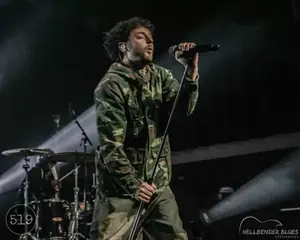

Standing in the back of a dimly lit venue, watching the road crew haul gear while the hum of a soundcheck vibrates through the floorboards, you realize that the music industry is less about the glamour of the stage and more about the grit of the transit. Aysanabee knows this better than most. He is currently the man of the hour in Canadian music, but he carries the weary, focused energy of a guy who has spent too much time in airports and van seats.
The two-time Juno Award winner recently found himself in Barletta, an ancient Italian town where the history is baked into the cobblestones. While most tourists would be hunting for the perfect espresso, Aysanabee was out at dawn, hunting for ghosts. He was recording the discordant, haunting melody of broken bells on his phone. It is a stark image: a Northern Ontario kid standing in an Italian sunrise, trying to capture a sound that felt as fractured as the life he was currently leading.
That moment of clarity became the DNA for "Edge of the Earth," a track that deals with the messy business of finding a path through growth and heartache. But the reality of his current existence is less about poetic bells and more about the spreadsheet. He estimates that 60% of his time as a full-time musician is now consumed by administrative labour. It is a far cry from his roots, where the only thing on the schedule was survival.
"I grew up in the bush with no electricity in the North. I didn't know how music career works. It took a lot of work and took a lot of discipline, perseverance," Aysanabee says, reflecting on a trajectory that seems statistically impossible.
Born Evan Pang, he represents a shift in the Canadian cultural guard. Before the Junos and the international flights, he was a journalist. You can hear it in the way he structures a song; there is a reporter’s eye for detail and a refusal to bury the lead. Choosing to perform under his mother’s maiden name, Aysanabee, was not just a branding choice. It was a calculated reclamation of an identity that generations of cultural suppression tried to erase.
His debut album, *Watin*, was a structural gamble that paid off. By weaving recorded conversations with his grandfather into the music, he created a documentary in song form. It resonated because it was honest. And the industry noticed. He became the first Indigenous artist to win Alternative Album of the Year at the Junos for his EP *Here and Now*, effectively shattering a glass ceiling that had been ignored for far too long.
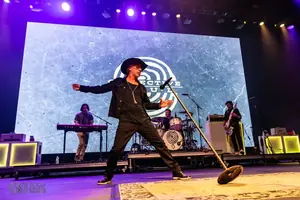
Now, he is navigating the "Now and Then" tour, a trek that feels like a victory lap and a mission statement all at once. It is about taking the disparate pieces of his discography and finally giving them a cohesive, live home.
"Now and Then, it's a little bit of a play on words from the last record 'Here and Now,' but it's also on the broader sense of just Watin, my debut record, Here and Now, my follow-up, and we've got the new song out. I never had a chance to tour any of those records as a headliner. So it's about bringing these songs on the road and presenting them the way they were always meant to be presented. Because obviously, I played a lot of shows, and some people got the full band experience, some people got solo experience," he says.
The logistics of this tour are a nightmare, but the intent is pure. Aysanabee is making a point of hitting remote northern communities that most booking agents cannot find on a map. These are the places where live music is not a Tuesday night option, but a rare, essential event.
"That's kind of why I went to the North as well. No one would really tour up to those places. I really love going to the regional places because even when I was in Australia and Tasmania, we're going to these places no one goes, the whole town would show up," he shares.
There is a specific kind of magic in playing for an audience that had to fight to get there. In the North, the weather is a physical barrier, not just a topic for small talk. He recalls playing in Red Lake, Ontario, a town that sits at the very edge of the provincial infrastructure.
"One of my fond memories from this tour is playing in Red Lake, Ontario, which is like a twenty-seven hour drive north. The furthest northern streetlight in Ontario," he notes.
The stories from these shows are the kind that keep a musician going when the hotel coffee tastes like battery acid. He talks about people driving hundreds of kilometres, navigating ice roads and treacherous conditions just to sit in a room and hear him play.
"There's someone who drove 500 kilometers to come see the show. There were people driving down on the ice roads to come see these shows, and people from everywhere from all different backgrounds," Aysanabee recalls. "Those moments really are this reaffirming feeling. I was honoured by so many people who turned up and were so attentive. I got a chance to speak with a lot of people after that show, and they're just so appreciative of that."
If I'm being completely transparent, it ruined me for a while. It definitely threw me through a little spiral. ...At a certain point, I just was like, 'You know what? People listen to everything, and they took something away from what I was doing. And they recognized it and found it worthy for me to join this club of all these crazy songwriters.'
But he is not just out there to build his own brand. He is using his platform to pull others up. The "Now and Then" tour features a rotating door of Indigenous talent as opening acts, a move that is as much about community as it is about curation. He is looking for artists who have the same "slog it out" mentality that got him out of the bush.
"I'm aware that there is music industry that pays attention to what I'm doing and so people have been following the artists. I am making sure it's a benefit to both people. I want the artist to be show ready. I want to see that they're working really hard towards where they want to get to," he explains. "Every artist is really doing such incredible works in their own markets. I think they deserve to be kind of listened to across the board."
When he talks about his recent single "Edge of the Earth," the conversation shifts to the collaborative process. He worked with Sean Sroka and Derek Hoffman, a producer who has become a vital part of his creative circle. It is a relationship built on the rare moments when their schedules actually stop spinning.
"I wrote that song with my friend, Sean Sroka, and my friend, Derek Hoffman. Derek Hoffman is a producer who I love to work with. We've become pretty close over the last few years," he says. "We get together in the winters and catch up. That's the only time our schedules align. And then we'll get together, go grab a tea, coffee, whatever, and just play and just talk for three hours. And then we'll start working on music."
The song did not come from a corporate mandate or a desire for a radio hit. It came from a conversation about the state of his soul. After the whirlwind of the last two years, his collaborators noticed a change in his frequency.
"It's always this massive catch up. The year before, we'd actually written somebody else together. And so this is almost somewhat of a continuation of that because we're just chatting, catching up on what happened with the last year. And they were just like, 'Wow, it sounds like you've found some calmness. It sounds like you've found some clarity. It sounds like you've found some moments of happiness,' and we kind of just started writing the song from there," he shares.
But that clarity was hard-won. Winning Songwriter of the Year at the Junos is a career-defining moment, but it also comes with a psychological price tag. Suddenly, every line you write is measured against the title. It is a recipe for writer's block and a massive ego-check.
"If I'm being completely transparent, it ruined me for a while. It definitely threw me through a little spiral," Aysanabee admits. "Initially, when I got that, I was starting to second guess myself a bit. I was writing songs and I was like, 'Oh, Canada's Songwriter of the year wouldn't write that stupid thing.' I was second guessing myself a lot and trying to live up to this thing. And it was just all in my mind."
It took time to realize that the award was a recognition of what he had already done, not a set of handcuffs for what he would do next. He had to remind himself that he was now part of a lineage that includes the heavyweights of Canadian songcraft.
"At a certain point, I just was like, 'You know what? People listen to everything, and they took something away from what I was doing. And they recognized it and found it worthy for me to join this club of all these crazy songwriters.' It's wild who's in this thing. Like Alanis Morissette, all these songwriters who've won that award before. It's obviously a huge sense of pride," he says.
That pride is deeply rooted in his family history. The decision to use the Aysanabee name is a direct confrontation with the systemic racism that forced his mother to change his name at birth. It is a story of survival that many Indigenous families know too well.
"I think it's just shifting the narrative and just breaking the cycle. Aysanabee isn't the name on my legal documents. It should be. But my mom changed it when I was born because she figured I would have an easier time in life if I didn't have an Indigenous last name, for getting jobs and stuff like that," he reveals. "I have a good sense of pride in who I am and where I come from, and that wasn't always the case. That wasn't the case for my mom. That wasn't the case for her mom. That wasn't the case for her dad."
This reclamation reached its peak on *Watin*. By merging his journalistic training with his musical instincts, he managed to document his grandfather’s life in a way that felt both intimate and cinematic.
"I'd never approached music in that way because I was working as a journalist. So it was like these two separate lanes. That was a record where it combined them," Aysanabee explains. "The record is very much like a call and response kind of record. The call is this conversation and the response is the song inspired by it. It was a different way to approach a record."
The process forced a level of vulnerability that is rare in northern families, where stoicism is often the default setting. His grandfather had survived residential school, a trauma that had been largely kept in the shadows of their family history.
"We never talked about a lot of those things before. We grew up in a lot of small northern towns, and there's an idea of what it means to be a man. You don't talk about your feelings. You show strength," he reflects. "I knew he went to residential school. I knew he had these really dark moments in his life, and we just never talked about it. I don't think he ever really talked to anybody about it except when the TRC came through and he and a bunch of other people gave their statements."
Recording those conversations changed the dynamic of their relationship. It turned a grandfather into a person with a history, a narrative and a set of scars that Aysanabee finally understood.
"Us talking about it was kind of the first time we'd ever talked about it and probably one of the very few times he talked about it. I just got to know him on a different level. It's wild that you just go through life with your family for all your life and then actually have a conversation and be like, 'Wow, I did not really know you as well as I thought.' You know the person they are, you know who they are, and you know their kind of humour, their jokes, and whatever. But getting to know someone's life story and all the things that shape them, that's something that really we didn't have," he says.
Now, as a trailblazer in the industry, Aysanabee is looking at the bigger picture. He wants his success to be a blueprint for other Indigenous artists who might think the gates are locked.
"I think, honestly, just the belief and self-determination. Obviously, there's still a ton of gatekeeping and stuff like that within the industry, but I think the biggest thing is people just seeing themselves in these places and not holding themselves back too," he says. "I hope that it inspires people to reach for greatness and reach for success and work towards it. Because that's the biggest thing too. It takes so much work and so much slogging it out and so many late nights and ten thousand hours, the whole thing."
The horizon is looking increasingly international. After a month-long stint in Australia, he is realizing that his stories have a universal weight that transcends the Canadian border.
"I'm really looking forward to going to more international places and still playing here because I have such an incredible fan base here. But I think going out and performing and sharing these songs and stories – I was touring in Australia for a month and already making plans to go back for next January," he shares. "To see that a song still carries the same wave and still moves people as much as they move people closer to home where the stories are from – music is this universal language that people just connect with."
But even with the world calling, he is yearning for the quiet of the creative process. He wants to trade the stage lights for the sun, and the tour bus for a backyard.
"I'm excited because there's actually these little pockets of time I have in the summer, which I haven't had for like three years. So I'm really excited to do more songwriting. I might actually go to the mountains. I'm always writing in the winter when it's cold and you got your tea and you're trying to spill your guts and trying to make art out of it," he muses. "I'm really excited about sitting in the backyard or getting out of the studio and getting a pen, paper, and bringing the acoustic while the barbecue is going. This different thing of just getting some vitamin D – I think the music will be impacted by it."
Local fans will get their chance to see this evolution up close when the "Now and Then Tour 2025" hits London on Mar. 20. He will be taking over Rum Runners, a venue that offers the kind of intimacy his music demands. Joined by Brothers Wilde and Thea May, it is a chance to see the full band vision he has been chasing. Doors are at 8:00 PM and the music starts at 9:00 PM. Just leave your backpack at home—this is about the music, not the luggage. This is Aysanabee as he was always meant to be presented.