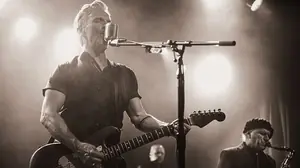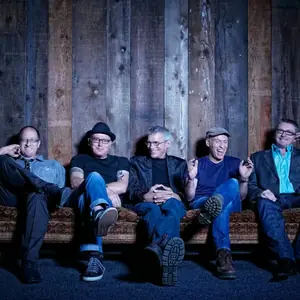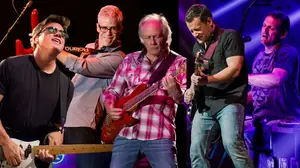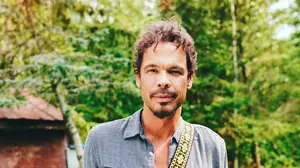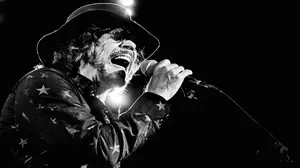


Standing in the back of a crowded room like the Velvet Underground in Toronto, you can feel the floorboards vibrate with a specific kind of frantic energy that only Rare Americans seems to harvest. It is a mix of DIY punk ethics and a polished, almost corporate level of narrative ambition. James Priestner, the frontman with a penchant for storytelling, does not look like a man crushed by the weight of a crumbling industry. Instead, he looks like a guy who found a loophole.
The world is currently a meat grinder of bad news and social fatigue. It is easy to sink into the couch and let the cynicism take over. But for Priestner, that is not an option. He has built a career on the back of resilience, turning the band into a vessel for a kind of aggressive optimism that feels more like a survival tactic than a greeting card sentiment.
“Our positivity comes from trying to give the message to myself in times where I can beat myself up a lot. You just got to remember, hey, things could be a lot worse here. Try to keep a positive outlook,” says James.
This is not just fluff. It is the core of the Rare Americans brand. They are not interested in the shoe-gazing aesthetic that defines so much of the indie scene. They want to provide a manual for getting back up. And it is this message of resilience and perseverance that Rare Americans seek to convey through their music.
The Vancouver-based outfit has been moving at a breakneck pace since they showed up in 2017. Their recent nod for the 2023 Juno Awards Breakthrough Artist of the Year award was less of a surprise and more of a formal recognition of what the internet already knew: these guys have cracked the code.
Currently on their Milk and Honey Tour, which spans the vast distances of Canada and the high-pressure markets of Europe, the band is doing more than just playing sets. They are building a world. But their music is more than just a source of entertainment. It is a powerful tool for inspiring hope and positivity in a world that often seems bleak.
The songwriting process for the band is a strange alchemy. It is a mix of raw acoustic foundations and a business-minded rigour that you do not often see in groups that lean this heavily into animation and lore.
“Songs will just start right on an acoustic guitar. My older brother Jared, who’s 11 years older than me, we actually write a lot together, and that’s how Rare Americans started. It was on this impromptu trip, a brothers’ trip that we took to the Caribbean in 2017, and at that point, he’d never even written a song. He was a businessman, and I didn’t know what we were going to do on this trip. It was like a reconnecting trip, and I was playing in bands at the time. I joked to him, ‘Ah, maybe we’ll drink a beer too and we’ll try to write a song,’ and he’s a very ambitious guy, and he said, ‘Write a song? Screw that, man. Let’s make an album.’ And I was like, ‘Ah, it doesn’t work like that. We’re not going to write an album,’ and sure enough, I underestimated our chemistry, and we were there, I think, for a week, and we wrote the first 15 Rare Americans songs,” says James.
Writing 15 songs in a week is not just a creative burst; it is a statement of intent. Most bands spend two years trying to find a cohesive sound for a single EP. The Priestner brothers found it in a fever dream of Caribbean heat and sibling intuition.
Their catalogue does not shy away from the dirt. They tackle heavy themes, but they do it with a narrative flair that makes the medicine go down easier. They use characters to explore systemic failures, which allows them to be political without being preachy.
Take the track “Rambo.” It is a blunt instrument aimed at police corruption and the rot within the justice system. In the wake of global protests and the Black Lives Matter movement, a group of guys from Vancouver had to figure out how to navigate those waters without overstepping.
Rambo is essentially a song about a total racist and corrupt cop... That song was actually written from the perspective of this corrupt cop’s dog, whose name is Rambo... the dog just says enough is enough, I can’t handle this anymore. And he turns on him and ends up attacking him. So that was just a little twist on the story and it’s even silly at the end of the day, but also it was a very deep topic.
“Rambo is essentially a song about a total racist and corrupt cop. That’s one of those conversations with the whole Black Lives Matter movement. It’s like, yeah, of course, we’re so for this cause, of course, but is it our song to sing, so to speak? That was one of those questions that we had. Ultimately, we decided, yes, because we think just being a part of the conversation is important,” says James.
The song works because it uses a bizarre, almost fabled perspective. It avoids the clichés of protest songs by shifting the lens to something unexpected.
“That song,” he continues. “Was actually written from the perspective of this corrupt cop’s dog, whose name is Rambo. And Rambo has had to watch his master and the cop, do all these terribly corrupt things and finally, the dog just says enough is enough, I can’t handle this anymore. And he turns on him and ends up attacking him. So that was just a little twist on the story and it’s even silly at the end of the day, but also it was a very deep topic. So that’s a good example of us.”
This is the Rare Americans' signature: the "silly" twist that masks a gut punch. It is a technique that has served them well in the digital age, where attention spans are short and the competition for eyeballs is fierce.
While their sound is a frantic blend of rock, hip-hop and pop, it is their visual identity that has truly cemented their place in the industry. They did not just stumble into animation; they leaned into it after seeing how the audience reacted to the medium.
“When we first saw the ‘Cats, Dogs & Rats’ video, we really liked the animation style and tracked down the director who did our first video, ‘Cats, Dogs & Rats,’” says James. “We had no idea what to expect, but once we put it out, we were getting hundreds and hundreds of comments from people who loved the animation. We followed that up with a few live-action videos, but the response wasn’t quite as intense. So, we decided to commit to the animation lane.”
It was a pivot that saved them from being just another indie band in a sea of plaid shirts. By moving into the "animation lane," they became creators of a visual universe. This strategy reached its zenith with “Brittle Bones Nicky.”
The video for “Brittle Bones Nicky” did not just perform well; it exploded. It has racked up nearly 100 million views, a number that most major label acts would kill for. It turned a character into a cult hero and proved that their audience was hungry for long-form storytelling.
“That was the moment that changed everything,” says James.
The success of Nicky was the proof of concept they needed to go bigger. They are no longer just making three-minute clips to support a single. They are moving into the realm of cinema. Their upcoming project is a 30-minute fully animated music film, a massive undertaking that requires more than just a few guys in a studio.
“It’s a team of 15 to 20 people working for a year,” says James. “It follows our bassist, who we call Django, and his story from growing up as a kid in Slovakia to eventually finding his way to Canada and to music and eventually to Rare Americans.”
This is where the band separates itself from the pack. They are investing in their own lore. The film uses a whimsical style of animation that feels both nostalgic and fresh, something James is confident will resonate with their base.
“It’s cool. It’s 35 minutes. It’s one story, start to finish, and I’m hoping that this new approach, Rare Americans almost as a multimedia brand, will be something that they’re going to eat up,” says James.
The term "multimedia brand" is the key here. They have founded Crooked City Studios, a partnership with Solace Animations. This is not a hobby; it is an infrastructure designed to develop intellectual property from the characters that inhabit their songs. They are building a stable of stories that can live far beyond the confines of a Spotify playlist.
“We’re trying to do something different in the industry and not just do singles and try to do these kinds of loftier projects,” says James. “So, we’re starting with this first one that’s 35 minutes. And then we actually have an even bigger project that’s about 25% animated right now, which is a 90-minute feature. It’s a full musical film, and we’re really looking forward to it.”
A 90-minute animated musical is an audacious goal for any band, let alone one that is still pounding the pavement on tour. But Rare Americans have never played by the standard rules of the Canadian music scene. They have bypassed the traditional gatekeepers by building a direct pipeline to their fans through high-quality visual content.
Their commitment to this hybrid model of music and animation has made them a force to be reckoned with. They are not waiting for a label to tell them what to do. They are creating the work, owning the studio and controlling the narrative.
As they continue the Milk and Honey Tour, the momentum shows no signs of flagging. They are a band that understands the value of the spectacle. If you have the chance to see them live, do it. The energy is visceral, and the connection they have with their audience is genuine.
The closest they get to the 519 on this run is the Velvet Underground in Toronto on Mar. 25 and 26. It is a small room for a band with such big ambitions, which makes it the perfect place to see them before they inevitably outgrow these club circuits.
For more, visit rareamericans.com.