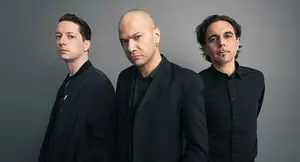
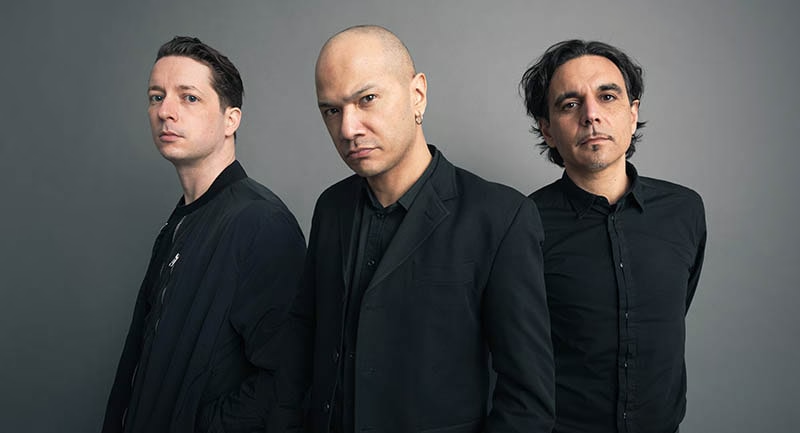
Sitting across from Danko Jones—even virtually—you get the sense that the man is a high-voltage wire looking for a ground. He has spent over 25 years as the unvarnished face of Canadian hard rock, a tenure built on grit and a refusal to pivot. While most of his contemporaries from the late 90s garage explosion have either softened into heritage acts or vanished into the digital ether, Jones remains a frantic, essential force.
His latest offering, *Power Trio*, arrives not just as another entry in a prolific discography, but as a survival document. It is arguably the best work of his career, a lean, mean collection of riffs that sounds like a band at its peak rather than one staring down a quarter-century milestone. But the road to this record was paved with a level of isolation that nearly broke the machine.
For a guy whose entire brand is built on the sweaty, communal exorcism of a live show, the pandemic was a physical blow. Jones did not just follow the rules; he retreated. It took the collective will of his bandmates to drag him back to the creative process. When I asked him what keeps a band like this functioning after 25 years in the trenches, his answer was as direct as a power chord.
"I think it’s partly to do with our stubbornness and natural tenacity, and no Plan B, really," Jones says.
That lack of a safety net is a recurring theme in the Jones narrative. There is no fallback career in real estate or artisanal woodworking waiting for him. This is a blue-collar commitment to a genre that the mainstream often treats as a relic.
"When we started 25 years ago, there was no plan B, we were just doing this and you do it for a long time," he explains. "We’ve been doing this for 25 years, this is what we do now."
Looking back at the mid-90s Toronto scene, things were different. There was a raw, chaotic energy to the circuit that felt like a movement. Jones remembers a time when the music was immediate, written in a fever and performed before the ink was dry.
"The shows were great. They were wild," he recalls. "We were writing songs and then just playing them the next show, if we wrote a song on Wednesday, we play it on Friday, those are some wild times and there is more of a scene back then with the kind of music we were doing. There was a garage, punk garage rock scene, and more vibrancy. There really isn’t one anymore, I don’t think."
It is a cynical but perhaps accurate take on the evolution of rock. Jones views the massive success of bands like The White Stripes and The Hives not as a rising tide that lifted all boats, but as a ceiling that eventually collapsed.
"I think when The White Stripes and The Hives took it over grounded the scene instead of growing, caved in on itself," he notes. "There are bands that still do it, but not to the extent that it was in the mid to late 90s, where it was worldwide. There are so many kinds of bands like this popping up every week, everywhere, but not so much anymore."
And yet, the "rock assault" continues. For Jones, the motivation is not about chasing a dead scene but about the visceral thrill of the performance. It is also about a long memory for every gatekeeper who ever told him no.
"It comes from the want and desire to be around rock music," he says. "I love rock music, and it feels exciting to play it live, it’s always been an exciting feeling. I think we’ve been rejected enough times where, we’ll always will have something to prove to all the people who rejected us even though they might have rejected us 20 years ago, you still kind of hold that and use it as fire. Also knowing that it’s a privilege to get up on stage and play and have an audience that wants to hear the music you wrote rather than cover songs and stuff, and it’s a nice feeling so that gets you excited as well. All these things funnel into getting you excited to get on stage."
That fire is the engine behind *Power Trio*. The album was born out of a necessity to adapt to a world that had suddenly gone quiet. For the first time, the band could not rely on the kinetic energy of a shared rehearsal space.
"We wrote it last summer during the pandemic and we wrote for the first time in our whole life as a band, we wrote it in isolation separate from one another," Jones says. "We write albums in a room together, jamming for hours until something kind of hits and something sparks, and that can be time consuming."
The logistical hurdles were immense. Writing in a vacuum is the antithesis of the Danko Jones ethos. But bass player John Calabrese (JC) refused to let the momentum stall.
"The pandemic just didn’t allow us to be in a room together," Jones explains. "So we cautiously, trepidatiously, skeptically tried to write songs, sending files back and forth. There were five or six ideas before the pandemic. But this first song that was realized within the pandemic was based on a riff that I came up with, during the pandemic. JC our bass player, all credit to him for pushing us to do this album."
The breakthrough came with a track called "Blue Jean Denim Jumpsuit." It served as a proof of concept for a band that was used to the old-school ways of the studio.
"He arranged the song, he put his bass down, he put it my guitars and vocals down and just had a metronome running through this demo track and when Rich sent us the drums on top of it, this raw skeleton, almost boring idea in its rawest form suddenly lit up and we could hear the energy and it was such a punch in the face that it really made us think that Yeah, we can really write this album in isolation, something that we didn’t really know we could," Jones says. "That song was called 'Blue Jean Denim Jumpsuit', that was written from beginning to end in isolation. That gave us the onus, the drive and the courage to finish this album, writing it apart from one another. And that’s what we did, we pretty much wrote the whole album apart from one another."
The eventual recording session was a masterclass in social distancing. Even when they finally occupied the same building, they were ghosts to one another, separated by physical barriers and a pervasive sense of caution.
"And when we had to go into the studio to record it, obviously, we, we had to rehearse it," Jones says. "And even then we went into our rehearsal room, JC partitioned the whole room, so we didn’t even see each other while we were practicing. So, we would say, Okay, well, let’s try it again, just yelling out into the ceiling."
It’s the only way that we can return to touring and shows. It’s the only way we can avoid people getting really sick and dying even. It’s the only way. I don’t know what the options are that anti-maskers and anti-vaxxers present... what is the option that will lead us away from sickness and death? That’s why I am for getting vaccinated.
The timeline was tight, and the atmosphere was clinical. The numbers in Ontario were fluctuating, and the band had to operate within strict capacity limits.
"I didn’t even see those guys until like the first day, of the session," Jones recalls. "Even then, I think numbers in Ontario, between Sept. and Oct. were 200 to 300 new cases a day, I think around that time anyway, cases were low enough that six people in a room were allowed. And we were five, with Eric Ratz, the producer and Chris Snow, the assistant engineer, and the three of us were five. So we were able to do it, we kept our distance in the studio as well, we wore masks for the whole time, unless I had to do vocals, and then I was already in a separate room. So that is how we painstakingly did this album."
But there was a silver lining to the lockdown. For a songwriter who is usually rushing between tours, the sudden abundance of time allowed for a deeper level of lyrical surgery.
"The good thing was that usually when we write a record, we also have tours pending," Jones explains. "And we have this to do and we have that to do, we had nothing to do during the pandemic. If the song needed me to rework lyrics, or if I had to come up with a new melody, I had days and days and hours and hours to do it. There’s nothing on the agenda for today. Nor is there tomorrow, it’s just doing this or eating or watching a TV show. So I had nothing else to do."
This forced focus resulted in a record that feels more intentional than its predecessors. Jones was able to live with the songs in a way that the road usually prevents.
"It allowed for me at least, to dissect the lyrics and go into it a little deeper than I would have on another album," he says. "So even though we weren’t in front of each other, and we weren’t doing that and kind of evened out that we were still able to like focus on the songs more so than maybe another album. I’m very proud of how this record turned out. It’s almost as if we didn’t skip a beat, whether we were apart from one another or not like we still came up, I think, with an album that’s on par with our previous albums. So I’m happy about the results. And it showed us that we can write in isolation, we can write apart from one another with the help of technology and sending files."
The experience changed the band's workflow forever. The digital divide, once a hurdle, has become a tool for future freedom.
"Yeah, that’s not out of the question, now," Jones says regarding repeating the process. "That has actually allowed us a little more freedom. We’re not tied to one another that way, as much as we were before the pandemic. It showed that we could write songs and stuff now. As things are opening up more, and there’s more things to do and more shows and now the touring, then maybe we’ll have a schedule that mirrors what it was like before the pandemic, I might not have the time to go over the songs at home as much. Maybe we can do a mishmash of both, but all in all our options are at least a little more open now than they were before, because before it was just like, Oh my God, we got to write this wreck, how are we going to do it during a pandemic when we can’t be around each other? And it’s the only way we know well, but now we know there’s another way."
The title *Power Trio* is a statement of intent. After years of clever or abstract titles, the band wanted something that functioned as a brand identifier.
"First of all, the last couple of albums, especially the last album, we didn’t have a title going into the studio," Jones admits. "And when the album was done, we still didn’t have it. And it was at the 12th hour that we had to submit a title. And luckily, we really liked the title at the very last minute, we liked 'A Rock Supreme'. This time, we said no, we’re gonna go in with a title. So we were already talking about it before the session started. And we decided on 'Power Trio', mainly because it’s a very succinct to the point, definitive title that speaks about us."
It is a move toward simplicity that extends to the visual presentation of the band.
"The last albums: 'A Rock Supreme' and 'Wild Cat', they’re good, but they weren’t very specific to the band," he continues. "Now, this is really definitive and simple, easy to remember. And it allowed for a very simple but blunt direct artwork for an album because our last album was pretty busy. And we wanted to make things a little simpler, and that included the title, so a simpler title with simpler artworks could maybe have more impact. I think it does, it’s pretty easy to understand."
Finding a title after 13 releases is a chore. The "preciousness" of the early years has been replaced by a pragmatic desire for consensus.
"Yeah, they’re pretty difficult," Jones says. "I mean, we’re 10 albums in plus, we have three other albums of compilations. So there’s 'I’m Alive and on Fire', 'Garage Rock', 'B-Sides', you see your 13 albums in, and most bands have no problem for the first two or three, but then you’re getting up to 13/14 it’s starting. At the point where we’re at, it’s like, well, what do you want to call it? Like it? No one’s really precious with titles anymore. We all got it out 3, 5, 6 albums ago. So it’s just a matter of agreeing on a title. No one’s really precious about oh, I have this title. I’ve had it since I was 17. It’s got to be the title of the album, none of that. So it gets a little harder. Although you would think it would get easier."
Lyrically, the pandemic is the ghost in the machine. Tracks like "I Want Out" are literal interpretations of the claustrophobia Jones felt in his own home.
"That was lyrically a result of living through the pandemic," he says of the single. "The chorus was written with me playing it, the chorus on my guitar at home, looking out the window. Just, feeling like I wanted out, it was a nice sunny day, and I just wasn’t going out and I was staring out the window. That was pretty much how the chorus came out. Then songs like, 'Let’s Rock Together', 'Start The Show' and 'Raise Some Hell'. Those are also lyrically results of the pandemic and reaction to it. So definitely, yeah."
Then there is "Saturday," a track that leans into the band's knack for anthemic simplicity. It started with a riff and a question from JC.
"That’s just another song," Jones says. "There’s no meaning behind it or inspiration past the Bobby’s. Elton John’s reference, but other than that, we all thought it was a pretty good riff. That was one of the ideas before the pandemic, we had that main riff and even the chorus, I didn’t have any lyrics, but JC said, what are you singing in that part of you singing Saturday? And I said, No, but I am now, because I had nothing else. So I took the word Saturday, and I said, Well, how do I put some meat on the bones of a word Saturday? And so the first thing that came to my mind was that Elton John song, and so I kind of turned it on its head and instead of fighting, obviously, I did what I did there. And that’s about the extent of it. I like the riff, and I like how the word sits in the way the verses go as well."
Despite the high-energy output, Jones is honest about the mental toll the last year took. He was not "bursting" with creative energy; he was struggling with a paralyzing sense of dread.
"No, not really," he admits. "We wrote it between June and August or May and August, I don’t know. But last summer, there was no energy. To be honest with you, it was paralyzing fear. And I didn’t want to do this album, JC was the one who pushed us and pushed me especially. If I had my way I wouldn’t have done anything. And I did nothing really other than this album."
The guitar became a lifeline—a way to stop the doom-scrolling for an hour at a time.
"When I started to write on the guitar and started playing guitar, I found that it was a nice distraction from my constant obsession with the virus and watching the news and just watching vaccines and watching this happen and numbers rising and numbers falling, tracking it going up and down and you know, kind of like going crazy over just this whole obsession and being able to break away from that for 30 minutes or 60 minutes at a time, during a day was mentally healthy. And I kind of channeled all of it into working on the songs."
The technical frustrations of home recording only added to the absurdity of the situation. Using outdated gear, Jones found himself in a loop of crashes and reboots.
"Also, I’m at home and I don’t have the most up to date equipment to lay down guitars and JC gave me stuff that allows you to record guitar into GarageBand and record the riffs and everything like that," he explains. "Only it needed an update, or I needed to update my apps, so it kept crashing all the time, and something that would have taken five minutes actually would sometimes take 40 minutes. But again, I wasn’t too mad about it, because I had nowhere to go, nothing else to do. If it crashed five times and I had to reboot my computer five times. I’m just like, well, all right, I’m not wasting time or losing ground on anything. I would be just watching the news for the time it took to lay down the guitars for Saturday or something."
In the end, time was the only resource he had in abundance.
"Endless amounts of time helped with putting this album together, regardless of technical foul ups or old technology that would usually have felt hampered my progress, actually, there was nowhere to go. So I had nothing else to do. There were times where I’m laying down the thing and I start getting into it, and two minutes go by and I look up to my computer and its crashed. So I have to do the whole thing over again. So those small, little annoyances really didn’t amount to anything when you have endless amounts of time to finish it."
As for the return to the road, Jones isn't romanticizing it. He wants his job back. He wants his income back. He is a realist who knows that 25 years in, there is no other path.
"I am dying to get back my career," he says. "That, I guess, of course, means touring and shows. But I’m not one of these guys who just can’t wait, I’m bursting at the seams to play or I’m bursting to get out. I’m an indoorsman, I stay indoors all the time. The isolation and the lockdown part wasn’t a problem for me. It was the anxiety and fear of vulnerable family members, the idea that this might take two to five years to be resolved. The idea that I don’t have a source of income, because this is my job. Maybe it’s easy for others to pivot careers, but at this point 25 years in, all my options have kind of become obsolete. So, that’s why I am hopeful and wanting shows to return. But not for the reason that I think people would think. I’m not bursting at the seams."
When the band finally did play a show in Calgary, the muscle memory kicked in instantly.
"When we played in Calgary, I even wrote it on Instagram, it felt like a week had gone by it wasn’t like, Oh my god, I haven’t done this in 17 months. This is like, No, not really. When you do it for 25 years, and you do it as often as we’ve done it for 25 years, it’s second nature. After the first song, you’re just kind of like, Oh, yeah, yeah, you know, that’s this is it? This is how it is."
Outside of the album, Jones made a cameo in Kyle Gass’s "Vaccinated" video, a star-studded endorsement of the only way forward for the industry.
"Someone on their team reached out and asked me to be a part of it," he says. "I really didn’t know what they wanted me to do. I think I sang the whole song. I didn’t really know it was gonna be what it was. I think I even recorded the vocals. I didn’t know what I was supposed to do. Then they sent it back and said no, just record yourself singing the song. I think that’s what happened, I can’t remember. But it was nice to be included. It’s a short list of people who ended up in a video, I don’t know what I did to get in. We played with Kyle, a few years ago in Germany at a festival, but I didn’t end up meeting him. Maybe that show left an impression on him. I’m not sure, but it was nice to be asked. And of course I agree with that sentiment. To be in a video with Samantha Bee, Amy Lee, Jack Black, Kyle Gass, Steve Lukather and John C. Riley, who’s one of my favorite actors, if you had told me that was going to happen during the pandemic, I would have embraced the isolation and the lockdown a little more."
For Jones, the vaccination conversation isn't about politics; it's about the survival of the theatre, the club and the stadium.
"Well, it’s the only way that we can return to touring and shows," he states. "It’s the only way we can avoid people getting really sick and dying even. It’s the only way. I don’t know what the options are that anti-maskers and anti-vaxxer present. When they say, don’t get the vaccine, what is the option that will lead us away from sickness and death? That’s why I am for getting vaccinated."
We ended on a lighter note, discussing Ralph, the rescue dog who has become a fixture in the Jones household. Ralph is a Mexico City street survivor with a specific set of grievances.
"Where is Ralph? I don’t know where he is?" Jones says, looking around. "Usually when I do interviews he’s either under the desk or on the other side of the room, resting, but he doesn’t seem to be here. He’s a rescue dog. We got him three years ago and he hates other dogs. We have a feeling that it’s because he’s had a rough time on the streets with other dogs. He hates dogs that look like Boxers or Bulldogs immediately. He was attacked by a Boxer a couple of years ago, so he’s been through a lot. They sent us photos of when he was found on the streets of Mexico City and he was in bad shape. We got him through Save Our Scruff, which is a place that rescues dogs and stuff. I’m allergic to dogs, and Ralph is a hypoallergenic dog so we’re lucky to have found him because most of those don’t come through the rescue service, so we’re lucky to get him. But yeah, with vengeance he hates most dogs, so it’s interesting, but he loves people. So it’s nice for that. It’s been great having a rescue dog, for sure."
Danko Jones is still here. He is still loud. And he is still arguably the most honest man in Canadian rock. *Power Trio* is out now, and if you have any sense, you’ll turn it up until the neighbors complain.