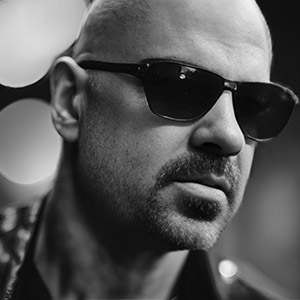
Sitting across from a stack of vintage Charisma Records pressings, you realize Steve Hackett isn't just a guitarist; he is the curator of a very specific, high-concept museum of British eccentricity. While the rest of the Genesis diaspora spent the 80s chasing gated-reverb pop glory, Hackett stayed in the trenches of the avant-garde, the orchestral and the complex. Holding a physical copy of *Selling England By The Pound*, you feel the weight of an era where music was allowed to be difficult.
Hackett is currently hitting the pavement to remind everyone why that 1973 record remains the high-water mark of the Gabriel era. It is a dense, pastoral, and occasionally terrifying record that refuses to age. He is not just playing the hits; he is reconstructing a moment in time when the boundaries of rock were being pushed by guys who probably spent too much time in libraries.
When asked about the mechanics of the current tour, Hackett is quick to highlight the breadth of the setlist. He says, "Yes, absolutely. We do stuff from three different albums. We do *Selling England By The Pound* in its entirety. From 1973, I know it sounds like a long time ago, but it was from a time when John Lennon said that Genesis was one of the bands that he was listening to, so I'm still very proud of that album from that time. Plus solo stuff, covers, *Spectral Mornings*, and *At The Edge Of Light*. So the solo stuff gets served. It's a long show, two and a half hours. We take a break in the middle of about 15 minutes, just so everyone can draw breath."
This isn't a nostalgia act; it is an endurance test. The decision to play the full 1973 masterpiece is a bold move, especially considering the technical proficiency required to pull off tracks like "Firth of Fifth" without the safety net of studio overdubs. But Hackett knows his audience. They are not looking for a "best of" package; they want the deep immersion.
He explains the logic behind the revival: "I'd been touring the show last year and its back by popular demand as it's one of the favourite albums of that period, when Genesis was closer in spirit, perhaps, to Pink Floyd and other albums bands before the era of having lots of hit singles as successes. It's from a time when albums were adventures in themselves, and we like to think that music changed the world for the better, that it brought the world together. And so I think people like to take those aural journeys again. The material from that time has really stood the test of time. I think it was the best Genesis album, so I love doing that. There's no sense of compromise. I'm proudly showing my wares again, the stuff that was group-written, and it's been going down phenomenally well."
There is a distinct lack of cynicism in his delivery. Most legacy acts look like they are punching a clock, but Hackett seems genuinely enamoured with the 1973 versions of himself and his bandmates. He is even digging into the archives to unearth the "what ifs" of the recording sessions.
"Last year was a great year touring, and I'm bringing that back again for part of it, and we're changing it around slightly because some of the areas we've hit up before, so we'll be celebrating 40 years of *Defector*, which is another one of my solo things," Hackett notes. "We do a couple of things from that. Plus we also do a couple of other Genesis classics, *Watcher of the Skies*, and *Musical Box*. And also in doing the whole of *Selling England By The Pound*, we do the missing track that was intended to go on the album, which didn't make the final cut, a track called 'Déjà Vu'. I love playing that live as well. Very personal track that was originally written by Peter Gabriel, which was a co-write between Gabriel and myself. So it's been a busy time last year, and I'm looking forward to having a very busy year this time out."
The inclusion of "Déjà Vu" is the ultimate "information gain" for the hardcore fans. It provides a glimpse into the Gabriel/Hackett writing partnership that often felt like the atmospheric counterweight to the more structured Banks/Rutherford/Collins axis. But one has to wonder if the old wounds of the band's eventual fracturing still sting.
Hackett is remarkably candid about the friction that defined the group. He says, "Yeah, and my passion for the material doesn't diminish. We were originally a five piece, and then we became a four piece when Phil took over on vocals, and then after I left it became a three piece. I left to do solo stuff. It was too restrictive working within the band. Even though I felt I was playing guitar in the world’s best band at the time, nonetheless, I didn't want to only do that, I wanted to do solo stuff as well. And that wasn't an offer. I was given an ultimatum and I decided to take my knees with me and go elsewhere, but I never abandoned the music that we wrote as a group. I think that it was very, very strong, we all kind of sweated blood in the nicest possible way to get that material written."
That "ultimatum" is the stuff of prog-rock legend. It highlights the classic struggle between the collective and the individual. Genesis was a democracy that often felt like a polite war. Yet, the music that emerged from that conflict is what Hackett continues to champion.
He reflects on the internal battles: "We locked horns at times. But I think essentially it's very strong, that stuff that was group written out that time. Tracks like 'Dancing with the Moonlit Night', 'I Know What I Like', 'Firth of Fifth', 'Cinema Show', they're all absolute classics that the band and I hadn't played 'At the Battle of Epping Forest' for a very long time, and I realized, when I was jamming with the band in South America, what a really strong song that was hearing it live. It's one thing being on stage doing it, and then it's another thing doing it live. Sometimes it takes another band to show you how strong something was that you did at one time. It's quite nice to be a member of the audience sometimes, and just watch that and say, yeah, we can go with that and we can do it authentically without being slavish. We don't have to do every note exactly the same. Solos can vary, but the spirit of the band that was, I like to keep that intact."
And then there is the inevitable question. The one that haunts every interview with a former member of a legendary outfit: the reunion. It is the white whale of the prog-rock world.
Hackett is realistic, almost blunt, about the prospects. "Well, we tried to do that back in 2005," he admits. "We all had a get together, but I don't think there was enough common ground for everyone to agree on what we should play. There are many versions of Genesis, and the band that existed from 1971 to 75, the boat has sailed with that. It seemed impossible to turn the clock back to a time when we were all happy just to pitch in together. So I think those aspects of power play tend to come into it, and so it's unlikely that the band will reform in that way. It's possible the band may reform in another sense, there might be the 80s version, but then that calls into question all sorts of issues about who's involved with that, and who's able to play that material still and what have you."
It is a sobering take. The "power play" he mentions is a polite way of saying that the egos and artistic directions of five grown men rarely align after decades of independence. Instead of chasing a ghost, Hackett focuses on the legacy of *Selling England*, an album he holds in the highest regard.
"Oh, it is, yeah," he says when asked if it is his favourite. "It's my favourite Genesis album, and it's one of my favourite albums by anybody. And the fact that I happened to be involved with it is all to the good, I think. As I say, John Lennon picked up on it at that time. And so I'm very proud having spent a lot of time in the company of John Lennon, listening to his extraordinary work, to get the sanction from there means that something that I regarded as classic when we first did it, over time it had the sanction, right from the very top. And it still rides high in the affections of fans and listeners. I'm still very proud of that. I'm at one with that material and there's no compromise there."
I was trying to play a classical keyboard player, and I thought if you treat the fretboard like a keyboard, you can hammer on and off with both hands. The technique wasn't named, but I was using it on that track, The Musical Box, on the guitar solo, and I was using it on the intro of Return of the Giant Hogweed.
There is something visceral about the way he describes the music. It is not just notes; it is a physical reaction. "Playing that live again, these songs are like old friends, but the moment you start out with the opening line, 'can you tell me where my country lies', straight away there's that thing where it's a bit like the bagpipes, the hackles go up and it's that clarion call to whatever it is that the music stood for at that time. I mentioned time, but I think it's timeless. It will always be a great album. It's something I've heard on the radio when I've been in places like Brazil. I've heard it all over the world in places where English is not even the first language. So what they make of it, I don't know. Nonetheless, it's proved itself on the airways."
But the creation of such a "timeless" piece was anything but serene. The studio sessions were a pressure cooker of competing visions and high-IQ bickering.
Hackett recalls: "Well, I think that they were fraught with tension, but then there was also this tension and release, because there were great songs and ideas being put forward by everybody. There's a certain degree of compromise that goes with being in a band. Genesis was a band of guys who were all leaders, really. They were all born band leaders. And there was an article in *Time* magazine which noted the fact that we were all in the top 20, whether the band was intact or not."
The mid-80s were the peak of this phenomenon. The Genesis tree didn't just grow; it colonized the charts. "I think the year was 1986 when I did GTR with Steve Howe, and we had 'When the Heart Rules the Mind', Peter Gabriel had 'Sledgehammer'. Phil was just everywhere with hits. I'm not sure what his current hit was at the time, but he was having hits after hits. And Genesis of course was a hit factory in itself. We had all those, it couldn't have been a coincidence that we had hits with the band, and that we'd had solo hits, and hits with other projects. And Mike, of course, had Mike and the Mechanics."
He paints a picture of a label, Charisma, that was a breeding ground for the surreal. "It was an extraordinary team to be part of. And when we were signed to Charisma Records, the original record label, one of the acts that were signed to the label was Monty Python, of course. Monty Python, who had yet to make successful films, but with this very English, very eccentric sense of humour was storming the ramparts in places like Dallas. And you think, well, what did Dallas make of? I was talking to Michael Palin about this. What did Dallas make of this English humour? Surely they must have misunderstood practically everything, and every reference."
The cultural gap between the UK and North America in the early 70s was a chasm. Hackett notes how the British bands were often more "Americanized" than the Americans were "Anglicized."
"Whereas, when we were in England at least, we were hearing so much American and Canadian humour, so we were Americanized and Canadianized," he says. "But on your side of the water, they had yet to be Anglicized, you know, this English thing. I think a lot of people thought that England was full of policemen or Bobby's riding around on bicycles in black and white in the fog. I think that was the view of England. England was still, Queen Victoria was still on the throne, whereas things have moved on a little bit since then."
Despite the cultural disconnect, Hackett had the bravado to push the music. He was the one telling DJs they were looking at a hit before the needle even hit the wax.
"Yeah, I used to joke to journalists, 'Oh, have you heard our latest hit single,' before it was even a hit, and it became a hit. But that was the arrogance of youth, or my quirky sense of humour. I thought that the best way to get a hit single was to tell DJs it was already a hit. And I was absolutely brazen about that. It seems like hype begins at home, and that's what you should always do. You should always say, 'Oh, have you read my latest million seller?' That's the way to go if you're an author. Go for it."
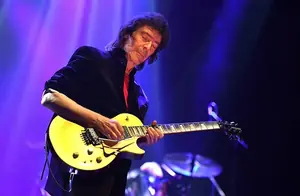
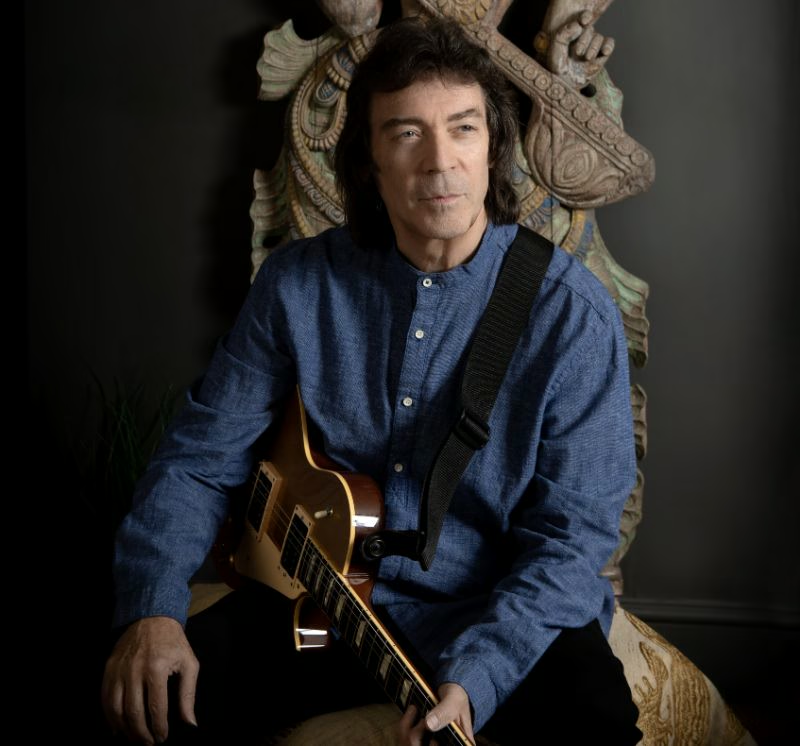
The sound of those records was anchored by a specific piece of mahogany and maple. Hackett’s tone is inseparable from his gear. "I used a Les Paul, which I bought in the States," he reveals. "A guy came to one of the shows and was selling a number of guitars, and I bought this gold top, which sounded absolutely amazing. I've still got that guitar, and it's on most of those Genesis hits from that time."
But the Genesis years were only one chapter. His solo career, particularly the 1979 classic *Spectral Mornings*, showed a musician coming into his own, away from the democratic stifling of a band. The recording process for that record was a literal icebox.
"Sure. Yeah. I was working in a studio in Hilversum with my band at the time, and it was 15 degrees below zero," Hackett remembers. "There were frozen lakes, people were driving cars across the lakes, doing handbrake turns, spinning their cars around, and it was so cold. All you could really do was to work and party. We were just trying to keep warm a lot at the time. So we made that album on plenty of scotch and Coke, and so we were kind of fuelled up, but we were having a party. We had a blast on that album, and that's how it came out. So I think that there's a certain kind of joy that you hear from the first moment on that."
The energy of *Spectral Mornings* came from the thrill of a new band and the momentum of success. "And it was my first touring band, my first solo touring band that was suddenly let loose in the studio together, and we were all relatively young guys in this phenomenally-huge 40 foot long studio at Phonogram headquarters. I was just having a ball doing that album, and getting very little sleep. Rather stupidly, there's something that happens when you're working on an album that you realize is not just great fun, but the chances are there's an audience out there that were at so many of the shows. So we were doing great business on the road, and I knew that there was this audience."
He draws a parallel to the greats of the previous decade. "I mentioned John Lennon earlier, and the Beatles, and I think maybe the similarity is the fact that when you're riding a wave of success, it's very easy to write something which is extraordinarily expressive and up-sounding. And it makes the process a lot easier if you know there's an audience that is really hungry for it. It was a great period in my life. All I had to do was keep up that level of energy, function without sleep, and produce an album in two months, which is what I did. And then right at the end of it, I was completely exhausted physically, emotionally, and economically. In every sense of the word, I was depleted. But it was worth it to get that album out of it. Sort of being in the eye of the storm, the vortex, but it was wonderful to be in the midst of that stampede of emotions."
The toll was real. "Yeah, and then I fell sick and couldn't get up for a couple of weeks. I was clinging onto the walls and thinking, I'd better pace myself for the next one if I want to do another. And, you know, there have been about 30-odd albums since. I still love making albums. They are always a challenge. Every album that you start is always daunting, the process of thinking, 'Well, you know, we climbed Everest last time, or so it feels, and how do I top that? Or how do I do something of relevance?' And so the better the work you've done in the past, the tougher it is in the future. But, nonetheless, the process of climbing that mountain, it's a personal battle. It's like shadow boxing. Yeah. How do you do that? You're never going to beat what you've done. You're just adding to it somehow."
Looking back at the genesis of Genesis, it was a slow burn of classified ads and Mellotrons. "Yeah. Joining Genesis was the culmination of five years of ads in the back of *Melody Maker* in England. I met loads of musicians, loads of bands. I formed loads of bands, broke them up, and made an album a year before Genesis with Quiet World. And then Peter Gabriel phoned me up, and wanted to know if I'd heard of Genesis, and I said, 'Yeah, I'll check out the band, listen to it, come and see you in live concert.' And then the guys decided they liked me, and I joined them at the beginning of 1971, a very long time ago now, nearly 50 years ago. But it was a thrilling time. We were playing for about six months, and I was determined that the band ought to be able to get a Mellotron, and some pals of mine in King Crimson were selling one of their Mellotrons, and Tony Banks and I went along to meet Robert Fripp for the first time. And that was very, very interesting."
The Mellotron changed everything. It gave a bunch of schoolboys the power of a symphony. "I'd already befriended Ian McDonald, first of all, and we did some work together in subsequent years, but lovely. So over time I got to meet Greg Lake, and Michael Giles, and we got this Mellotron and it's a bit like we never looked back, really. It transformed the pulling power of the band, and where we could take it. We could go orchestral. It was a bigger sound palette, in a way. So that was great fun making that album, I think, *Nursery Cryme*, was the first truly professional album I think I'd ever been involved with. Yeah, I'd been recording but this felt like the real deal. It starts here. And I think the same thing for Phil Collins too. It was the start of something monumental."
Hackett also revolutionized the technical side of the instrument. Long before hair metal made it a cliché, he was tapping on the fretboard to achieve baroque speeds.
"I was trying to play a classical keyboard player, and I thought if you treat the fretboard like a keyboard, you can hammer on and off with both hands," he explains. "The technique wasn't named, but I was using it on that track, 'The Musical Box', on the guitar solo, and I was using it on the intro of 'Return of the Giant Hogweed'. And Eddie Van Halen picked up on that technique, and many others. It's part of the language of speed metal players, it enables you to play so fast tape can barely capture it. The notes. If you slowed it down, you wouldn't believe how many notes you could get into a phrase with that one technique, because you didn’t have to synchronize both hands hitting the note at the same time. Each finger was a kind of incendiary device. The grenade goes off everywhere. Bam, bam, bam, bam, bam, at a phenomenal rate. It's a way of playing faster than you can do when you're picking notes individually."
It took more than just speed to conquer America, though. It took the theatre of the absurd. "Well, I think the music was very British, and until we incorporated an aspect of theatre into it, until Peter Gabriel started dressing up, and when we had our own light show and sometimes our own stage scenery, that made all the difference. Once it became a visual show, whatever the complexity with the music was, it was easier to absorb it and easier to understand the stories, and gave the band a level of depth that I think you need when you're doing this kind of long form stuff. So suddenly, that meant that we were commercially acceptable."
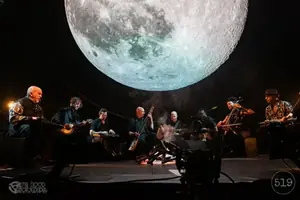
In recent years, Hackett has returned to the orchestral roots that the Mellotron once mimicked. His *Live at the Royal Festival Hall* release is a culmination of that fusion. "Yes, wonderful to work with. I've been privileged enough to work with several orchestras over time. I worked with the Royal Philharmonic, American orchestras, Icelandic, German, and that's an ongoing commitment for me, to both record and sometimes tour with orchestras. That's an extraordinary thing, to have that mixture of different schools of approaches and traditions. So that came out really well. The Royal Festival Hall show is, I think, the best live record I've ever made and the best live DVD I've ever made. Because it takes it onto another level."
The power of a full orchestra behind a track like "Musical Box" is undeniable. "You mentioned the track 'Musical Box'. Right at the end of it, the orchestra set it out, but they come in right at the end. And then the power of that, when they kick in for the finale, like the denouement of the film, it's mighty. I love that combination of what the classical world threw up, and what we produced in rock, and the fusion of the two when it comes together. When it works, it can be extraordinary."
The logistics of such a feat are daunting, but Hackett has built a global network of collaborators to make it happen. "Well, we had charts done by different people at different times. Some of it was from the Icelandic stuff I'd done with a band called Todmobile, who I'd heard working with Jon Anderson, and they sounded marvellous coming up with orchestral arrangements of some Yes stuff. And then I got to work with Bradley Thatcher, and his brother Steve, with the Buffalo Philharmonic. I think it was the Buffalo Philharmonic or the Buffalo Symphony Orchestra. And that was extraordinary, working with them. So we had charts from two different places to draw from."
His latest studio effort, *At the Edge of Light*, continues this expansive, global approach. It is an album that feels like a travelogue. "Well, actually, I think it's my best studio album, because there are so many different kinds of music on it, and there are people from all over the world on it. It's the second of albums that I've done where we have players from India, from Azerbaijan, United States, United Kingdom and Sweden. It really is a United Nations of music, and I'm proud of that. It has lots of different kinds of music, and I think the album doesn't really falter. It just goes from scene to scene. It's a bit like the kind of film I always wanted to make for the ear, really, the film for the ear that takes you places. It's got real orchestral and sample stuff. It's got real players and it's got stuff doubled with the mechanical side of things."
Hackett describes the sonic textures with the precision of a master craftsman. "It's that combination of men, women, and machines that makes us something mighty. So right from the first note, you get guitar from Azerbaijan twinned with the cimbalom from Hungary, and then the first drum notes are put through a Marshall cabinet, distorted. And so even in the first few seconds, you get this strange hybrid of things that have happened before. It sounds a little bit like a rock band, but a little bit like a folk band. And then it sounds like an Indian orchestra with bendy strings, so it is a little bit like Bollywood on 33 and a third, slow, powerful rhythm. If I heard that, I'd be going, 'Who the hell are these guys? Where does this come from?' And it comes from everywhere."
In an industry that rewards the safe and the familiar, Steve Hackett remains a beautifully erratic outlier. He is a man who would rather shadow box with his own legacy than let it sit on a shelf gathering dust. Whether he is resurrecting 1973 or distorting drums through a Marshall stack, he remains the most vital link to the era when Genesis was a dangerous, unpredictable beast.