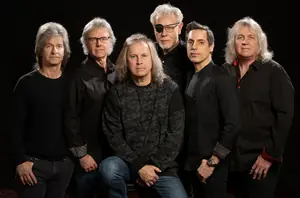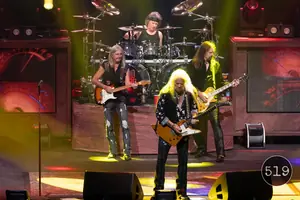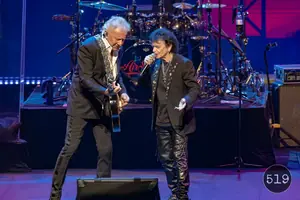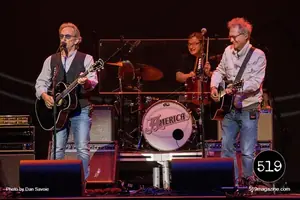

The Colosseum at Caesars Windsor has a specific kind of gravity. It is the sort of room where legacy acts either prove their staying power or fade into the velvet curtains. On Mar. 5, the band America brings five decades of folk-rock history to the 519, marking one of only two Canadian stops on their 50th-anniversary trek. This is not just a nostalgia trip; it is a victory lap for a group that managed to define the breezy, sun-drenched sound of a continent they barely knew when they started.
Founding member Gerry Beckley has a way of speaking that suggests he is still slightly surprised by the whole thing. He does not lean into the typical rock star myths. Instead, he views the band’s half-century run with the pragmatic eye of a craftsman. When I sat down with him to discuss the milestone, the sheer scale of 50 years seemed to be the first thing on his mind.
"Well, to be honest, that's an incredible scope of time," Beckley says. "I don't think it's unusual that at the start of something like this, you would sit down and go, 'You know what? Let's make a 50-year plan.' I can see that if we had the benefit of quite a bit of foresight, we might've looked ahead and tried to conceive a five-year plan or what are we going to do if this happens or that, but there's just no way you can comprehend that number of decades, I don't think."
The band has spent the last few years curated by their own history. Fans have been treated to massive box sets and the *Archives Vol. 1* release, which feels like holding a physical piece of the 1970s in your hands. But for a long time, the vault remained closed. There is a technical reason for that, and it usually involves finding the right person to sift through the dust.
"Well, to be honest, we were still recording new material fairly regularly, nowhere near as often as we originally used to, kind of one a year," Beckley explains. "We actually have a dear friend, Jeff Larson, who is kind of our archivist and was going through all of the boxes and all of the hard drives and it was that particular step of putting a guy on the case that started to give us a pretty clear idea of just the abundance of stuff that was there, and then we'd think about it, and say, 'Okay. Now, how do you wrap each one of these? What's the best way to present this stuff?'"
And the floodgates are not closing yet. The industry likes to package anniversaries in tiers, and America is currently in the middle of a multi-label retrospective. Warner Brothers and Capitol have both been active, but the real deep cuts are coming from across the pond.
"Yes, there are," Beckley confirms regarding future archive releases. "This last year we had two pretty major releases from the two major labels that we were on for most of our career. Warner Brothers released a variety of different versions of a 50th anniversary collection. There was a two vinyl issue. I think there was a four CD version and a one CD version, but Capitol reissued basically, every one of our Capitol albums. It was a nice box. This year we have something that's a far deeper dive, as the term goes, that is a multi-disc thing coming out of a company in the UK called Gonzo, and we're very excited about that because it includes some video and DVDs and things."
There is a distinct divide in the America fanbase. You have the purists who swear by the Warner Brothers era and the George Martin-produced tracks, and then you have the 1980s enthusiasts who latched onto the Capitol Records output. The latter era was undeniably more commercial, often sounding like a different band entirely as they adapted to the slicker production of the decade.
"Well, the people that run the distance, I would think are pretty familiar with all of it, although honestly, the Capitol years didn't sell as well as the Warner years," Beckley admits. "There were hits during the '80s. You Can Do Magic of course was a big hit for us. But yeah, sometimes those albums don't get as much attention, and it's interesting. We will find certain people that cherry pick one of those and say that's their favourite album. It's always a little bit of a surprise to me. Dewey and I were, I would say a little, in general, less involved in those because they were done by a series of different producers depending on the project, whereas the Warner Brothers years were either things that we produced or George Martin produced. It was a little bit more cohesive. Having said that, the '80s are a decade nearer to now, so in theory, those memories should be a little bit clearer, but it doesn't always work out that way."
The band’s origin story remains one of the great ironies of rock. They were three American sons of US Air Force personnel stationed in London, gigging in the UK while naming themselves after a place they were mostly seeing through the lens of pop culture. It was a branding masterstroke, even if it was born from a jukebox.
"Well, my recollection is that there wasn't another name considered," Beckley says. "It wasn't something that we switched to this idea of America, but I do recall pretty clearly that there was already kind of an established thing where the group Chicago already had a few albums out. Their first album was called Chicago Transit Authority, and they shortened it by the second album to Chicago, and we thought, 'That's one way to do it. You can call it after a place.' And there had been briefly on CBS a group called the United States of America that had come and broken up by then and we thought, 'Well, just call it America,' and you're right, from that jukebox. But it was also a way to tell a bit about the group. We were a group gigging around London, like many other bands. And it was a way to have the name a little bit of a backstory about us."
Despite the myth that bands need years of toil to find their feet, America’s ascent was remarkably vertical. They were writing at a feverish pace in 1970 and by 1971, they were already in a studio in the UK.
"No, it was a very inspiring time," Beckley notes. "It wasn't two years. We started in 1970 and we actually recorded the first album in the UK in '71, so it was pretty quick. In fact, the songs on the first album were virtually to attune our first batch of songs. There was a couple that were left off and a couple of last minute substitutions. You might know the story. Horse With No Name wasn't really part of the first album. It wasn't released in the UK until afterwards, but it was, as far as careers go, a pretty quick start."
The moment they got signed sounds like something out of a film. No demo tapes. No polished press kits. Just three guys in a room playing live for an executive who had to keep his poker face together.
"Well, we went in because we didn't have any tapes," Beckley recalls. "We went in and played live in Warner's UK office in London and we stayed in touch with Martin Wyatt, who was the vice president, kind of that we played for, and he was quite open over a variety of different interviews saying one of the hardest things he ever had to do was to not just whip out a contract right away and getting signed to us. We sat in the room and played Riverside and I Need You and Three Roses and Sandman that really became pretty pivotal stuff on the first album. So it was a pretty charmed beginning all around."
Canada’s relationship with the band was immediate. "A Horse With No Name" hit number one here, and the Great White North actually served as their introduction to the entire continent. Their first North American show was not in New York or Los Angeles. It was in Kitchener.
I think Dewey and I usually pick the same one, which is Ventura Highway. Not that Horse isn't a signature tune, but there's something about Ventura Highway that features the acoustic guitars and the three part harmony that I think if you had to pick something, it's a better summation of the overall sound.
"Well, we do, because there's an interesting anecdote," Beckley says. "We were of course in the UK, and by no means did everything that the Warner's office in UK signed get an automatic release in the rest of the world. But because we had success with the album and Horse as a single was a big hit in the UK, Burbank, the main offices in the States said, 'Well, we should probably put this out. Will they come over and do a tour?' which of course we agreed to. So pretty hastily, a club tour was arranged and somehow, there was one more month show in a college in Kitchener, Ontario. So our very first ever show in North America was up in this school."
The band also has a habit of taking Canadian songs and turning them into international staples. Ian Thomas’s "Right Before Your Eyes" is a prime example. Beckley views these covers not as fillers, but as transformations.
"Right Before Your Eyes was brought to us by Bobby Palumbi, who was an A&R guy and producer at Capitol when we switched to Capitol," Beckley explains. "So we had always looked at outside material, but it was never really going to be the bulk of an album. And so we would usually write most of the album and then take one, maybe two cover songs. Right Before Your Eyes, obviously Ian Thomas, somewhat of a national hero. Dave Thomas' brother, as I understand. And I think he had a hit there with Painted Ladies. And so we just thought it was a beautiful song and that we could really do it justice."
Beckley’s philosophy on covers is rooted in the inescapable nature of one’s own voice. You can try to mimic the original, but the "America sound"—those specific acoustic strums and vocal stacks—will always take over.
"One of the things that we have found in the inevitability of listening to your own voices, and we were producing our own music for a lot of this time, is that no matter what you do, when you perform it, it becomes yours," he says. "You put your signature on it, whether you want to or not. Even if you started with the intent of exactly cloning whatever the demo you'd heard, by the minute you put your voices and your harmonies and your guitar strumming style, it swings pretty sharply towards you regardless. But in our case, we have certain elements that we think are what make up the America sound, acoustic instruments and a certain kind of approach to production that I think are the signature features for us, and so Right Before Your Eyes, is a pretty good example and I'm very happy with that. We did it onstage for many years. It hasn't been in the show for a while, but a beautiful song and a very talented songwriter."
Then there was Eddie Schwartz’s "Special Girl." This track came from a more fractured period for the band, where the production was being handled by a committee rather than a single vision.
"Special Girl is slightly different," Beckley notes. "It was, again, brought to us by the producer, but I think that one was produced by Richie Zito. We were doing the next album or the particular album that's on with a variety of producers, and so that one was quite a disjointed project for us because we had three different producers using three different studios and each one had cherry picked, with our approval songs, that they thought they could do justice to with our performances. So Special Girl was one of that and we were a little bit less involved in the lead up to the record. The producers were searching for outside material, but I always liked Special Girl. Again, that was in the show for a while and I sing it. It was a lot of fun to do."
But we have to talk about "Horse." It is the song that everyone knows, yet it almost did not make the cut. In a move that would be unheard of in today’s data-driven music industry, the label asked for more after the album was finished.
"We made the album in the UK and it didn't include Horse, and although the album was getting some attention on the radio, the label came to us with a very unusual request of, 'Do you have anything else?'" Beckley says. "Nowadays, the label after making the commitment of finance and time would not go back right away to a band and say, 'Now, what else you got?' But for whatever reason, and everybody's of course elated that they did, they came to us and said, 'You got anything else?' And we did. We were very keen in writing daily and there were three or four new tunes of Horse. So we went back in the studio and they picked that and said, 'This is great. We'd like to polish this up and make this a single.' So we weren't opposed to that idea."
The logistics of that release were a mess. Warner Brothers in the States ended up pressing thousands of copies before they realized the hit single was not actually on the LP they were shipping.
"To be honest, the uniqueness of that kind of dynamic of going right back in to cut more stuff was really a little bit lost on us," Beckley says. "We were just going with the label's direction. Neither had been released in the States. So when it came time a few months later with the success of both the album and this, in a sense, follow-up single, Warner said, 'Oh, we've got to put that out,' and we shipped the parts, as they call them, to the States for pressing. And it wasn't until they'd run up about a hundred thousand copies of each that they even realized that the single wasn't on the album. They were pressing them as two separate things and thinking of course that's the single featured from the new album. So there are some collector's items of the American release without Horse on it."
If you are looking for those rarities, you are looking for a very specific pressing. Aside from the addition of "Horse," the reissue was left largely untouched, though the UK got a slightly different package.
"No. Horse was added," Beckley clarifies regarding the reissue changes. "We did release Horse in the UK as what was called a maxi single. And one of the other songs we cut after the first album was a song by Dan called Everyone I Meet is from California, and that was included as one of the three tracks on this maxi single, but it wasn't put on the US release of the first album. Only Horse was added."
But if you ask Beckley what the definitive America track is, he will steer you away from the desert and toward the coast. "Ventura Highway" is the song that captures the technical essence of what they do best.
"Well, obviously just a few hits to pick from, but I think Dewey and I usually pick the same one, which is Ventura Highway," Beckley says. "Not that Horse isn't a signature tune, but there's something about Ventura Highway that features the acoustic guitars and the three part harmony that I think if you had to pick something, it's a better summation of the overall sound."
The partnership between Beckley and Dewey Bunnell is one of the longest-running in rock. They were not born into a musical dynasty; they were kids on a track team who happened to own guitars.
"We met in high school," Beckley says. "We were graduates of the class of '69, but we met as juniors in the year '67, '68. We were not initially friends as musicians. We were on the track team together, and it wasn't until we got to know each other that you discover, 'Oh, me too. I play a little guitar.' So we were together on and off, and then the next year, we were joined by Dan Peek, and started to play in different high school bands. It was a group called The Days. These were all kinds of top 40 bands that played every Friday at the teen club, but mostly cover stuff, no original material. And it wasn't until we graduated that summer that we realized we were all starting to pen original material and that switched. And of course the name is really the official birth, although we knew each other and played together in bands before."
Interestingly, for a band known for their harmonies, they rarely wrote as a collective. The credits usually went to the primary songwriter, even if the others provided the structural support.
"Well, there was not a lot of co-writing typically, if you read the liner notes, but there was often some help from me or the others," Beckley explains. "Basically deferred the writing credit to whoever wrote the majority. And in most cases it was, if not the entire song, the majority. But I was kind of the guy for a bridge. So if somebody needed a bridge, I might write the bridge for somebody else's tune, but it wouldn't show up in the credits."
Beckley was a prodigy in his own right. He was penning hits while most kids were still trying to figure out how to pass their driving tests.
"I wrote quite a few as I was getting going when I was 14, 15, but I often say one of the first I ever wrote was I Need You, which was our follow-up from the first album, the follow-up single to Horse With No Name," Beckley says. "And I was 16 when I wrote that. But it wasn’t my first song I ever wrote. There's quite a few that are bouncing around on the internet and I'd be wrong to guess which one was exactly the first."
The turning point for the band’s sound came when they teamed up with Sir George Martin. After the Beatles, Martin could have worked with anyone. He chose America, and he brought a much-needed discipline to three young men who were suddenly very wealthy and very famous.
"Well, George was an immense presence for all of the years," Beckley reflects. "We did seven consecutive projects with George. The word I use usually to sum that up simply was focus. He brought focus back into the thing. We were starting to get a little bit crazy with concepts, and when you give three young kids in their early 20s unlimited budgets and some initial success, it really needed to be put in the hands of somebody who could grab the reigns and gain control of the wagon again, and he did exactly that."
While Martin’s influence was massive, Beckley is quick to point out that the band’s demos were often quite advanced. "Sister Golden Hair" was not a studio creation; it was already there in Beckley’s home recordings.
"The arrangements for most of these tunes were pretty set," Beckley says. "Dewey, Dan and I were pretty clear on what we had in mind. There's a demo of Sister Golden Hair that I had done by myself in my own little home studio that's virtually identical to the arrangement of the eventual master, but that would in a sense be unfair, because it sounds like it's diminishing both his and Geoff Emerick, the incredible engineer that we had for all of those sessions too, because they were vital to just capturing the right tracks and the right things."
Still, Martin was not just a supervisor. He was a player. He would get his hands dirty on the keys when the moment called for it.
"George was very hands-on on occasion," Beckley says. "The piano part in Tin Man, the little lick that goes all the way through Tin Man, was his idea and it's him playing. So he was never opposed to, 'Get out of the way and let me play this thing.' There's a nice little barrel house piano in the middle of Lonely People. And I was playing that and he said, 'Can you do a barrel roll kind of thing where you kind of trill your fingers?' And I said, 'I'm not really great at that.' And so he came out and he said, 'Move over.' And so the piano that you hear in the middle of Lonely People is actually the two of us with four hands on the piano. It's a duet of both of us playing. So it was a fascinating time. Incredibly creative, and you're right, we kind of group all of those years as the highlight of the 50 years and is really the George Martin years."
As they head back to Windsor, Beckley remembers the cold. It is a recurring theme for their Canadian tours. But despite the freezing temperatures, there is a warmth in the reception that keeps them coming back.
"Well, we've been to Windsor," Beckley says. "We'd been up there a few times, and I wish I could be a little bit more specific, but for some reason we end up there very, very often. When we do come, it's the winter, so I do remember cold and some pretty restrictive conditions. We did play a fantastic street festival up in ... was it Ottawa? What's the oldest city up there with the Walden city? We did a beautiful festival in the summer, I think a year or so ago. It was really beautiful. But this time, of course, it'll be winter again. And we're all for it and we go where we're asked, and it will be very happy to see you guys again.