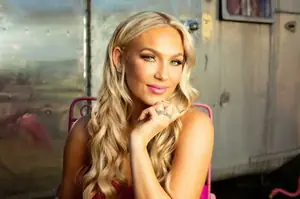

Sitting across from Lindsay Ell, there is a frantic, focused energy that only comes from someone who spent 280 days a year on a tour bus before the world hit the brakes. We are talking in a space that feels lived-in, the kind of room where the air is thick with the scent of guitar polish and stale coffee. Ell is not just a country star; she is a survivor of the Nashville machine who has finally stopped trying to outrun her own shadow.
The Calgary-born singer spent the better part of two years in the strange, silent vacuum of the COVID-19 lockdowns. For a woman whose identity was forged in the fire of 235 shows a year, that silence was deafening. But it was also necessary. It forced a reckoning with the choices that led her here. And the result of that introspection is "Right On Time," a track that functions less like a radio single and more like a manifesto for anyone feeling the crush of societal expectations.
"I believe so much in this song. I feel like it’s my theme song right now," Ell says, her voice carrying the weight of someone who has finally stopped checking her watch. "Shortly after I turned 30, I felt like all of my friends were getting married and having babies and checking all of these life boxes that I was nowhere near close to checking off. In 2019 before the world shut down, I was playing 235 shows a year on the road for 280 plus days. I was just moving so fast and focusing so much on my career that I wasn’t focusing on any of those other categories of life. Then you go through a global pandemic and everything kind comes to a halt. You look in the mirror and then you start playing the comparison game and feeling societal pressure and social media pressures. It makes you feel like you’re doing everything wrong when you’re comparing yourself to these filtered five-second perfect versions of somebody’s life. That’s not good and it’s not even close to their reality, but in social media scrolling we always think it is."
The honesty is blunt. In an industry that demands women remain perpetually 22 and unburdened by reality, Ell is leaning into the friction of aging in the public eye. And she is doing it by dismantling the curated lies of Instagram. The track was born out of a Zoom session with Jeff Warburton and Jordan Schmidt, a digital collaboration that somehow managed to capture a very physical anxiety.
"I was definitely feeling this at the beginning of the pandemic, and I ended up hopping on a Zoom with my friends Jeff Warburton, who’s a fellow Canuck, and Jordan Schmidt," Ell says. "We were talking about it, and I told them I want to write a song that speaks specifically to women. I think this message can be heard by anybody, and hopefully resonate with anybody, but I think that women feel this pressure at certain times of their life. When is the perfect time to be beautiful? To maybe be a mother? To decide to have kids? To go after the career of their dreams?"
There is a technical precision to Ell’s writing here. She is tackling the biological clock not as a cliché, but as a structural constraint that dictates how women move through the music business. It is a sharp critique of the "timeline" we are all sold from birth.
"We feel all these things with biological clocks and I really wanted to write a song that focused on that whole thing," she says. "You don’t need to live your life according to someone else’s timeline, you can only really live your life to your timeline. And sometimes we don’t even know what that timeline should be until you’re right smack dab in the middle of it."
But the song is also a reminder that the race is a solitary one. Ell uses the image of a river to describe the individual path, a stark contrast to the crowded, competitive lane-swapping of the Nashville charts.
"It’s very human of us to be able to look left and right and try to set our pace to someone else’s, but at the end of the day, we’re rolling our own race down the river," she says. "It’s hard to remember that I think sometimes societal pressures are so entrenched in the subconscious of our brains that we don’t even realize they’re there anymore. Right On Time just speaks to exactly where you’re supposed to be in life and things are happening as they should in your life for all the right reasons, and you can never be late to your own party."
Songwriting has been Ell’s primary mode of processing since she was 10. It is a therapeutic exercise that often bypasses the limitations of spoken dialogue. While the "music is a universal language" sentiment can often feel like a tired industry trope, coming from Ell, it feels like a genuine admission of her own communicative boundaries.
"I’ve always looked at songwriting as something that is very satisfying, and very therapeutic," she says. "To be honest, I started writing songs when I was 10 years old and I think that songwriting is a way for us to help process our emotions, when we don’t really even know what we’re feeling sometimes, or don’t even know how to articulate those things properly. Listening to music and writing a song is definitely a way of communicating that. Sometimes it’s just hard to do with plain English or whatever language you may speak - it’s not as easy as a thing to communicate. Songs are amazing things that tap into this universal language."
The visual component of "Right On Time" leans into this healing aspect. The video features a support group for people struggling with their own perceived lateness. It is a clever bit of staging that turns personal failure into a collective celebration.
"I’m so happy with the music video. Shooting this music video was so important to me and we had so much fun shooting," Ell says. "We had an incredible group of humans from all different walks of life, all different ages, all different stories, and it was so healing and empowering to come together and be like wow, we are all fighting similar battles from completely different sides of the fence, but we’re all fighting similar things. It was truly like a Right On Time support group. I saw that there were so many things that have not happened in our lives the way that we wanted them to, or the way that we planned them out."
And yet, Ell admits she is a chronic offender when it comes to being "late" by traditional standards. But there is a hard-won grace in her acceptance of that fact. She is no longer trying to force the universe into a schedule.
I’ve always looked at songwriting as something that is very satisfying, and very therapeutic. ...Songs are amazing things that tap into this universal language.
"I feel like I’m consistently late to the party in so many ways, and in that same sentence, in that exact same timing, I’m so grateful because now I am in certain situations that I would not have been if I had willed or planned out, or my life had happened the way I planned it out to be," she says. "Sometimes being late to the party is the best blessing than you could have ever imagined. It’s part of letting go and trusting the process and trusting that the universe helps things get into gear exactly when they should be in your life."
This trust is paying off in high-visibility ways. From billboards in Times Square to a hosting gig on *Canada’s Got Talent*, Ell is currently inescapable. But she still reacts to her own success with a touch of disbelief, a trait that grounds her in an industry full of manufactured egos.
"You know, anytime I see my face on a billboard, it still feels pretty surreal," she says. "Obviously just finishing this season of Canada’s Got Talent and seeing my face on those things is a weird feeling. Seeing the Amazon Music billboard and knowing I’m going to open up for Shania Twain later this year makes for an incredible life. This is insane."
She views these milestones not as a destination, but as a byproduct of the chaotic, non-linear path she has taken. And she invokes a fellow guitar virtuoso to explain the geometry of a career.
"But I think that’s kind of in the same vein of everything we’ve been talking about. I could never have planned those things out the way they have happened. And I wouldn’t want to change any single piece of them," Ell says. "I’m just so grateful that things are falling into place and clicking in line as they are. As frustrating as moments of my journey have been in the past 20 years of me trying to build my career in the music industry, I remember John Mayer saying that if he were to retrace the past 20 years of his career, it wouldn’t be a straight line from A to B, it would be a zigzag and up and down and backwards, and the like."
The beauty, according to Ell, is in the lack of predictability. The "pinch me" moments only happen because the plan failed.
"There isn’t really a way you could retrace all of those steps - and that’s the beauty of it. That is the thing that creates all of these incredible opportunities or lets you meet the right people when you should and let’s let people join your team when they should join your team," she says. "It’s such a crazy intricate process that to repeat it or to predict things like walking down the street and seeing your face on a billboard or on a bus, you probably could never do it. But when they do happen, they’re definitely “pinch me” moments."
Ell is 14 years removed from her debut album, *Consider This*. To the casual observer, her rise might seem sudden, but the reality is a nearly two-decade grind. The girl who recorded with Randy Bachman at 16 is still there, but she has been tempered by the industry.
"That’s a beautiful question," Ell says when asked about her younger self. "I started in the music industry when I was really little. I just wanted to be able to write songs that made people feel things and be able to go around the world singing them. That was definitely the nature of why I recorded that album Consider This with Randy Bachman 14 years ago, and that is still the nature of why a record music up to Right On Time just a few months ago. I am grateful that I can still record music and sing it and want to perform it from the same place. My perspective for the music industry and just my own journey with it has definitely evolved and morphed over time."
The evolution is evident in her confidence. She no longer feels the need to "piece the world together" through someone else’s lens.
"In a way, I’m so grateful that I’ve led the journey that I have. I feel like I’m much more grateful for everything that happens now. There’s like a deeper level of appreciation, and I just think I know who I am much better than I did when I was 16 years old trying to piece the world together and trying to sing from a place of honesty," she says. "I feel like touring around the world and writing and recording music for the past 18 years has really helped me more with that."
Her second number one single, "Want Me Back," came from her previous album, *Heart Theory*. That record was a conceptual deep dive into the stages of grief, a project that required a level of vulnerability that few country artists are willing to exhibit.
"Want Me Back was off of Heart Theory, my last album, and I’m just so grateful for that record. You know, I really needed to write and release that record," she says. "It was sort of like my musical diary and a roadmap for anyone navigating through a difficult time in their life, whether that time is going through a breakup or a global pandemic or losing a loved one."
The album was an exercise in emotional architecture, moving from shock to acceptance with a clinical precision.
"Whatever that may be, I wanted it to be the journal that you could listen to top to bottom and feel the process of shock to denial, to anger to depression, to questioning to acceptance - the transition that we go through as human beings to be able to feel something, understand it, and then look back on it with gratitude and acceptance," she says. "To being able to move forward as a more insightful, appreciative person. Want Me Back was part of that album and part of that process for me, and so it’s a really close song and a special song."
Even with the heavy emotional lifting of her career, Ell found a way to bring some levity into her life during the pandemic. Enter Hendrix, a Pomeranian-Chihuahua rescue with a badass name and her own Instagram following.
"I have always loved dogs ever since I was a little girl and I always wanted one, but just thought I traveled too much. Throughout the pandemic it felt like the right time. I couldn’t live alone in the house by myself anymore, I need some other life in here," Ell says. "So I rescued a little pom chi. She is like the sweetest thing that I ever could have asked for. We call her the tiny fox, because she kind of looks like a tiny one. I named her a boy name, after my favorite guitar player, Jimi Hendrix and I thought Hendrix is kind of a badass name for a girl. She is like our band mascot. She comes on the tour bus with us and she’s just one of the brightest lights in my life."
The name Hendrix is no accident. Ell is a guitar player first, a musician whose technical ability often overshadows the "country singer" label. She abandoned classical piano for the six-string because it felt more dangerous, more connected to the icons she admired.
"Guitar has been a love of mine ever since I was a little girl. At eight-years-old, it’s a lot cooler to play Shania Twain songs on the guitar compared to classical piano lessons that I was in at the time, and so I just picked it up and it became another limb off my body," she says.
Her apprenticeship with Randy Bachman was the turning point. He didn't just teach her chords; he gave her a different sonic palette.
"When I was 13, I started working with Randy Bachman and Randy was the one who really got me listening to blues and jazz and rock guitar that as a musician gave me just a completely different vocabulary to pull from," Ell says. "I’m so grateful for Randy for helping open my eyes in terms of my musicianship and moving to Nashville. I came back to my country roots, obviously, but, but now our live show is a big mixture of a whole bunch of different influences from a number of different directions."
This all leads to Aug. 7 at Boots and Hearts, where Ell will provide direct support for Shania Twain. It is a full-circle moment for a girl who used to play Shania songs to escape piano practice. Stepping onto that stage in front of 50,000 people is the ultimate validation of her "late to the party" philosophy.
"I am truly so excited and it is definitely going to be a “pinch me” moment getting to open that stage for Shania," she says. "There’s always such a special vibe onstage at Boots and Hearts - like nothing can top that feeling of stepping on that stage in front of 50,000 people and now to open for one of my idols is gonna just feel such like such a blessing. Shania is just the coolest; she’s the ultimate."
For Ell, Twain represents the blueprint for the modern female artist: uncompromising, creative, and unapologetically feminine.
"She’s the perfect combination of being so wise, so smart, and so creative. As a woman, she says what she means and still does it in a sexy and completely feminine way," Ell says. "That’s a very fine line and hard line to walk as a woman and Shania does it so well."
As Ell prepares to take that stage, it is clear she is no longer worried about the clock. She is right where she needs to be. And for a woman who has spent 18 years navigating the zigzag of the music industry, that is the only timeline that matters.