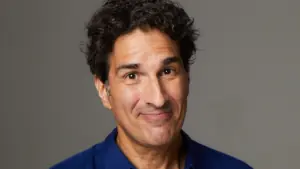


Rick Mercer is leaning back in a chair that looks slightly too small for his energy, his trademark Newfoundland cadence cutting through the pre-show hum of a quiet theatre. He is the closest thing Canada has to a secular saint with a sharp tongue, a man who spent 15 years as the nation’s unofficial ombudsman of common sense. Now, he is bringing that energy back to the road.
Mercer returns to Southwestern Ontario with his newest keynote, *Canada Coast to Coast to Coast*, hitting Windsor on Sept. 28. He follows that up with a blitz of *Just For Laughs* shows in London on Oct. 29, Kitchener on Oct. 30 and Hamilton on Nov. 1. It is a grueling schedule for most, but for Mercer, it is just another Tuesday in a life defined by the 401 and the airport lounge.
We sat down with the icon to get past the polished rants and find the gears that make him tick. He looks rested, which is a rarity for a man who spent over a decade chasing politicians and jumping into freezing lakes.
"Things are very good, actually. I’m having a great summer. I got to spend some time in Newfoundland and more time than I normally do. So, post show I’m enjoying myself," Mercer says.
The transition from the relentless cycle of *The Rick Mercer Report* to a life of keynote speeches and stand-up sets could have been a disaster. Television is a drug, and the withdrawal usually involves a desperate pivot to reality TV or a bitter podcast. Mercer, however, seems to have landed on his feet with the grace of a man who knew exactly when to exit the party.
"I knew I would. I know I wasn’t going to be the person who would completely freak out, but it is a big adjustment because 15 years is a long time. So you had your work family, for example, people that you see almost every day. I was on the road with the same three guys for 15 years. There was never a change whom I traveled with, so we obviously go way back now and I miss that because we just traveled very well together," he notes.
But the road remains his primary muse. The new show is less about the politics of the day and more about the absurdities of the 15 years he spent in the trenches of Canadian culture. He is finally telling the stories the CBC lawyers probably would have flagged in 2012.
"But that’s part of what the show is that I’m doing, talks about my adventures on the road over the 15 years, because while people who watched the show saw what I was doing, that was always just one part of what was happening. Because there was a lot of stories on the go that never ever made it on the show," Mercer explains.
He traces this obsession with the medium back to his childhood in St. John’s. While other kids were playing hockey, Mercer was dissecting the mechanics of regional television. He was looking for the "bug" before he even knew what to call it.
"Oh, the broadcasting bug. Cool. I’ve never heard it called that, but I absolutely came down with it. It was pretty early on, when I was about 10 or 11, there was a TV show in Newfoundland, called the Wonderful Grand Band. It was comedy of music. It was about Newfoundland. It was a regional show just for Newfoundland," he says.
The *Wonderful Grand Band* was a cultural phenomenon in the Maritimes, a mix of satire and song that proved you could be local and world-class simultaneously. It was Mercer’s blueprint.
"It went on to have some national exposure, but essentially it was just for Newfoundland and it was a monster hit in Newfoundland. Everyone watched the show. And so like everyone else, I watched but I was kind of obsessed with it. I was enthralled with it. I couldn’t believe that these people got to... but they got away with what they were doing and people loved it so much. I went to the theater and comedy and performance, but it was always with the goal of someday being a broadcaster, someday being on television. That’s what I wanted to do. A lot of actors who started in theater, they end up in television. But their first love is for theatre. Well I went to theatre, but my first love was always television. I just had to do it backwards," he says.
And he did it backwards with style. But the landscape has changed. We are currently living through the Trudeau and Trump era, a period of political theatre so loud and garish it almost defies satire. You would think a satirist would be salivating at the prospect of another four years of this chaos. Mercer disagrees.
"There are always things that happen that you think, 'Oh, I could certainly talk about that.' Although I would never wish ill will on my country just so I would have something to talk about. I’ve always pined for good, boring, honest government. That’s what I think we all want. And I’d be happy with that, believe me. But I don’t miss that," he says firmly.
There is a certain dignity in his refusal to chase the outrage cycle. He is content with the live stage, where the feedback is immediate and the stakes are purely comedic.
"Right now I’m enjoying getting to travel around the country, do this show, in front of live audiences. That’s something that I enjoy immensely and I’m just really enjoying myself and trying to figure out what’s next. Because 15 years is an incredibly long run in television, and I just really felt it was time to hang it up and do something else. But I knew it would take a while to figure out what that something else was," Mercer admits.
The decision to quit while he was ahead is a rarity in Canadian media. Most hosts wait until the network cancels them or the audience shrinks to a handful of people in nursing homes. Mercer watched the clock.
"It was very important to me, all along, everyone who’s in show business always wants to go out at the right time and very, very few people do for different reasons. I was always cognizant of that. So, I started asking myself at year five if it was time, year six, if it was time. Because that’s the length of a television show. I mean that’s the life expectancy of a TV show that’s a hit. And, I just felt after 15 years it was time to go. Also our numbers spiked again in season 15. I was very proud that I went out with healthy numbers," he says.
I went to the theater and comedy and performance, but it was always with the goal of someday being a broadcaster, someday being on television. That’s what I wanted to do. ...Well I went to theatre, but my first love was always television. I just had to do it backwards.
Mercer has become a modern-day Stompin’ Tom Connors, a man whose brand is inextricably linked to the geography of the country. He has seen more of Canada than most prime ministers, and he has done it without a security detail.
"Oh boy. I wouldn’t have been able to travel nonstop for 15 years if I didn’t. I can’t tell you how many times I’ve been in interviews where they’re like, 'What is your favorite place in Canada?' And I always answer, 'St. John’s, Newfoundland,' because I’m from here and I’d be killed if I didn’t say that," he laughs.
But the diplomacy of his position prevents him from naming a "worst" city, even if he has one tucked away in his mind.
"But it also is my favorite place. And then, of course, people want to say, 'Where’s your least favorite place?' And I would never answer that question because while I’m not a politician, I know you don’t answer questions like that. But the truth is I don’t have one. There’s no place to me where I’ve gone, 'Ooh, I’m glad I’m never going back there again.' That’s just never happened to me. So, yeah, there’s a love of country there that’s pretty deep," Mercer says.
This deep-seated patriotism is the result of thousands of flight hours and countless small-town diners. It is an education you cannot get in a classroom.
"And I feel it’s pretty influenced because of the travel. I think most Canadians want to explore Canada and it’s a very difficult country to explore because it’s just so big and there’s so few of us, it’s prohibitive. And so, I really feel like I was blessed that it was my occupation every week, literally every week, I would get on a plane and I would go to two completely different places in the country," he notes.
When asked about hidden gems, Mercer doesn't hesitate. He points to the places that look like postcards but feel like another planet.
"I could start listing places and still be here if you want to phone this time tomorrow. That’s why people really liked the show. I mean, off the top of my head, when we went to Haida Gwaii, British Columbia. I mean I’d kind of heard of Haida Gwaii. I knew it was like a sort of national park. I assumed I had seen pictures. Well, when I got there, I mean my mind was completely blown. It was one of the most spectacular things I’ve ever been. And I can go on and on. My travels being able to stand above the tree line, being in the Arctic circle, that’s something that very few people get to do. But I think Canadians have an innate interest in the north and they’re proud of the north," he says.
The sheer volume of his travels is staggering. At one point, his office tried to visualize the data, only to realize that Mercer had effectively "conquered" the map.
"I don’t have the numbers off the top of my head, but I remember we were kind of figuring that stuff out near the end and there were like 460 unique places, I think. Because obviously some places I’d visit more than once. No, it was more than that, I remember at one point someone in the office wanted to create a Google map. You can have Google map load in all the places you’ve been. So, we thought that’s a great idea. So, this fellow loaded in all the places that we’ve been in 15 years and then he hit load and all the dots appeared and the entire country disappeared under one big dot. So, we actually created an RMR Atlas that allowed us to show all the places we’ve been. And I was very proud when you looked at the map of Canada and you saw the dots," he recalls.
Despite the vastness of the country, Mercer admits there are still pockets he hasn't touched, though they are few and far between.
"There are areas in the north that we didn’t get, but we were right across the north and in every province, every territory, and every part of every province. I mean, sure we’re a big country, thousands of places left for me to visit," he says.
Mercer’s career hasn't just been about scenic vistas and bungee jumping. He has been a fixture in the Canadian political consciousness, often providing more insight in a 90-second rant than a night of cable news. He remembers his time filing for *Maclean’s* with a particular fondness.
"That’s a tough question. I mean, I’ve been lucky that I got to cover, and I use the term loosely, a bunch of elections. When I wasn’t doing it for the television show, I would get on Maclean’s and do it for Maclean’s magazine. And for me, that was very exciting because growing up, I only had two interests: comedy and politics. And the idea of being on the prime minister’s plane, being on the leader of the opposition’s plane and being on leader of the third party’s plane, like all within a 10 or 12 or 14 day period, filing pieces every day or two to a national magazine. It was like a dream come true for me," he says.
But being a satirist in a dark news cycle is a heavy lift. He recalls the early days of *This Hour Has 22 Minutes* when the news wasn't just absurd—it was tragic.
"Whereas the natural journalists, they don’t have the privilege or the luxury of choosing what subjects they’re going to talk about. I remember way, way back in the olden days of 22 Minutes, and we felt our mandate was to cover the news, no matter what was happening. We went into this very dark period where it was the tainted blood inquiry that was dominating the news for months on end. It was just one tragedy after another," Mercer remembers.
The "Rant" became his signature move—a fast-paced, alleyway walk-and-talk that distilled national fury into digestible bites. It was never a gimmick; it was a genuine reaction to the bafflement of Canadian governance.
"I never faked or feigned outrage and I felt over the years like I wasn’t always outraged, but there’s always something to be baffled by once you cover Canadian politics," he says.
Even without a weekly show, Mercer is still watching. The current political climate in Ontario and Ottawa provides plenty of fuel for the fire he usually reserves for the screen.
"This week, we have the findings of the ethics commissioner in relation to the prime minister and SNC-Lavalin. I mean there’s plenty to rant about here. Also, this week, in Ontario if you own a private gas station, the premier of the province is saying you have to put a sticker on your gas pump that promotes his political ideology or he’ll fine you up to $10,000 a day on your private property!" Mercer exclaims, his voice rising with that familiar edge.
He is particularly amused by the absurdity of Doug Ford’s "sticker" solution to complex policy issues.
"I’ve never seen anything like that in my life. I don’t think I’ve read about anything like that happening in Canada or the United States in history books. It’s patently insane. So, I would certainly be ranting about that. You can be against the carbon tax, which this is what it’s about. But it’s a sticker. And, of course, the other irony is, this is Doug Ford’s solution is a sticker because he’s in the sticker business. There’s a sticker solution to every problem. Can we get a sticker maybe? How are we going to solve unemployment? Is there a sticker maybe we could get?" he asks.
While the political rants are his bread and butter, it is the human rants that have left the biggest mark. A segment on bullying once went global, proving that Mercer’s reach extended far beyond the Ottawa bubble.
"The rants are very much of the time. There was a rant about young people being bullied that certainly went all over the world. And certainly I received far more feedback that was deeply personal than I had expected. I mean, I just thought it was a rant like any other rant," he says quietly.
But being a public figure with an opinion means you will eventually alienate someone. Mercer views the audience-performer relationship like a long-term marriage.
"There have been rants that have gone viral. There’s been rants that resonated. There were rants that people got really upset about because I think people often think, if you like someone, and hopefully they liked me, they liked the show, they kind of all think, 'We’re all on the same page on every issue.' Then suddenly, they realize I have kind of a different opinion than they do, I assume and get really upset. Like it’s their spouse. Like you look at your wife or husband and go, 'I never knew you believed that. How would I know that?'" he explains.
Does he have regrets? Not many. He views his work as a product of its time, and if he was wrong, he owns it.
"Oh, there have certainly been rants where I was proven perhaps wrong. I wouldn’t say regret. There’s a few rants that have been removed. I publish the rants and they’re, of course, flying around the internet. Always have been and probably always will be. I don’t have many regrets in the show," he says.
Despite the accolades, including a Governor General’s Award for lifetime achievement, Mercer remains aggressively humble. He is a man who still feels like he’s pulling a fast one on the establishment.
"I don’t even know if I told my mother. That was incredible. And it was an incredible night and it’s still, even as you say it to me on the telephone, I do kind of think like, 'Wow, how did that happen exactly?' My entire life I’ve always felt like I’ve snuck into the wrong room, so in events like that, I certainly still feel that to a certain extent," he admits.
But if you want to see him truly beam, don't mention the high-level awards. Mention Logy Bay-Middle Cove-Outer Cove, the place that gave him the key to the town.
"That was phenomenal. That was a great, great afternoon. It was in the local school, in the gym, primary school and the Mayor spoke. It wasn’t so much about me as it was about that era, that time. Because it was one of those places where there was a pack of 30 kids running around in the street at all times. So a bunch of them were there. It was just a fantastic event," he says.
The interview ends as abruptly as a Mercer rant, with a quick note of surprise that his hometown still holds him in such high regard.
"No, that completely shocked me," he says, and with that, the icon is gone, likely off to find another corner of the country to document, defend and occasionally dismantle.
Get Tickets