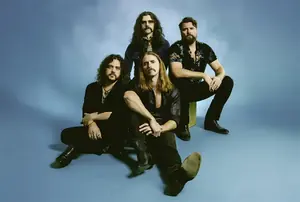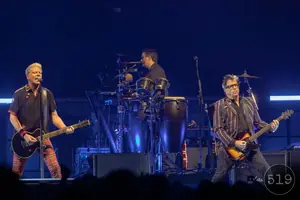


Sitting in the back of Sarnia’s Imperial Theatre, the air smells of stale popcorn and floor wax, a far cry from the sleek, polished pop-rock sheen of Theory’s latest effort, *Say Nothing*. The Vancouver-by-way-of-Delta outfit has spent the better part of two decades shedding the post-grunge skin that once linked them so tightly to the Chad Kroeger era of Canadian rock. Today, they are just Theory. The "Deadman" has been buried, replaced by a band that seems more interested in social commentary than strip-club anthems.
The transition is jarring for some. But for Joe Dandeneau, the man behind the kit for the last 11 years, it is a necessary evolution. We are looking at a band that decided to stop being a caricature of 2000s rock and start actually saying something. The new record, released Jan. 31, follows the trajectory of 2017’s *Wake Up Call*, leaning heavily into a radio-friendly aesthetic that prioritizes hooks over heavy distortion.
It is a risky move in a genre that often rewards stagnation. Yet, the band has doubled down on the intensity of their message, swapping out lyrical tropes for heavy-hitting discussions on racism, domestic violence and the messy political climate. When I caught up with Dandeneau before their Feb. 17 show in Sarnia, he seemed unbothered by the purists who might miss the old grit.
For Dandeneau, this fourth album with the unit represents a mental shift as much as a musical one. He admits the change in direction has forced him to strip back his technique, focusing on the space between the notes rather than the notes themselves. It is a discipline many rock drummers never master.
"Is it all fresh and relevant? In the sense, we have made a rather large leap in a new direction, lyrically and musically from where I started with the band," Dandeneau says. "That alone will obviously create a massive freshness to everything we do, because as a drummer I have to think of the music completely different from the way I would have done it in the past."
This isn't just a job for him. Dandeneau’s connection to the band borders on the preordained. While some musicians fall into gigs through luck or proximity, he spent years eyeing the drum throne from a distance, convinced he was the missing piece of the puzzle.
"Without a doubt, yeah. To where I came from to where I am now. I don’t know where my life would be right now without this band," he says. "I’m sure I’d be doing something, but getting into this band for me was something I wanted long before I even met these guys. I always wanted to be in this band, the moment they came out back in 2002 I always had this weird, odd, thought process in my brain that I always said I would be perfect for this band. Just funny how that all worked out."
The story of how he actually landed the gig sounds like something out of a Hollywood screenplay, complete with a high-stakes audition and a psychological fake-out from frontman Tyler Connolly. It started with a tip from Brent Fitz, the former Theory drummer who left to join Alice Cooper’s touring circus.
"I got a phone call from my friend who was the drummer before me. Brent Fitz was playing for these guys and he called me to tell me that he had decided to leave the band," Dandeneau recalls. "He was a hired gun and he decided he was going to go play with Alice Cooper because he got the call from Alice. He felt like that was a better place for him and better decision. He called me and said 'I think you’d be perfect for this band.' I was like 'Man, yeah I think I would to, but.' Brent said he’d make some calls and got back to me and said 'look, they’re doing an audition process in Los Angeles, they’re finishing up their third record, it’s kind of being mixed right now so they are going to go through the audition process now so that when the record comes out, they have a drummer ready to go.' He said it’s going to be a cattle call, so you’re going to have to go there and have to audition against all these big-time drummers from L.A. So that’s what I did."
The Los Angeles audition was a meat grinder. Theory saw 20 drummers, most of them seasoned session pros with resumes longer than a CVS receipt. Dandeneau was one of only two who made the cut for the final round in Vancouver. But even after the final session, Connolly decided to have a little fun with the newcomer's nerves.
"They had 20 guys there and 18 were let go that night and I was one of the two that survived the first audition," Dandeneau says. "They flew me out to Vancouver and I did my final audition. A week later, Tyler, the singer, called me personally to thank me for coming to Los Angeles; thanked me for coming to Vancouver and that he really appreciated the time I spent with them, but they have decided on a drummer. He basically made it sound like, 'thanks for coming out but we found somebody else.' And then he kind of paused and said 'so we’ve decided on a drummer, and we’d like it to be you. So if you’re interested just let us know.' I was like, 'WHAT! You bugger.' So that was how that went down."
Dandeneau’s obsession with the kit started long before the L.A. auditions. He claims he was playing before he could properly hold a conversation, a bit of family lore that sounds like hyperbole until you see the evidence. Most kids are playing with blocks at three; Joe was playing with kitchenware.
"I was three years old when I started. It is not that believable, but it is true. I didn’t believe it either until my family showed me pictures and videos back then," he says. "I was three years old and I was able to start a beat and finish it to make sense. I would set up pots and pans, taking my little toy cars and propping them up underneath the cans so there was an angle, like a tom-tom on drums. It was like breathing to me. There was no reason. You don’t know how to do it; you just do it. That was drumming for me and that’s how it started. I got my first set of drums at age 4. I broke them on the first day I got them. It was one of those Fisher Price kind of things. Destroyed them first day."
His musical education was a mix of family tradition and the aggressive sounds of the 90s. His father played in a touring family band, providing a front-row seat to the mechanics of life on the road. But while his uncle taught him the basics, it was the heavier, more technical players that eventually shaped his style.
They had 20 guys there and 18 were let go that night and I was one of the two that survived the first audition. ...Tyler, the singer, called me personally to thank me for coming to Los Angeles; thanked me for coming to Vancouver and that he really appreciated the time I spent with them, but they have decided on a drummer. He made it sound like, 'thanks for coming out but we found somebody else.' and then he paused and said 'so we’ve decided on a drummer, and we’d like it to be you. So if you’re interested just let us know.' I was like, 'WHAT! You bugger.'
"My dad was in a family band and they toured all over Canada way back in the day, so I used to watch them play a lot and my uncle was the drummer of the band, so I watched him play and I learned a lot just by watching," he says. "As time progressed, I started to move into more drumming influences as I got older. I got into the rock music scene pretty early. The first sort of rock/metal drummer I listened to was a guy named John Tempesta. At the time, he was playing for a band called White Zombie and that was before high school. I had to have my mom take me to the music store to buy the record because it had explicit lyrics and I wasn’t old enough to buy it on my own. John was the guy who started it all for me. Then I started listening to bands like Sevendust. Morgan Rose just blew my mind right open. He was one of my most major influences as a rock drummer."
The transition from White Zombie fan to professional drummer involved a detour through the world of jazz fusion and session greats. Dandeneau started obsessing over *Modern Drummer* magazine, absorbing the "chops" of virtuosos like Dennis Chambers and Dave Weckl. It gave him a technical depth that many of his peers lacked, allowing him to navigate the cover band circuit with ease before landing the Theory gig.
"And then my brother introduced me to guys like Dennis Chambers and Dave Weckl—these virtuoso kind of drummers who play for everybody. All the sudden I started getting into Modern Drummer magazines and those guys took me into playing with grooves and playing with chops and learning all these different styles of music," he notes. "When I came into Theory, that was the style I brought to them, so I knew how to play hit songs because I was also using that in the cover scene. All you do in those bands is play hit songs all night long, so it all just seemed so natural to me."
That natural feel is being tested on *Say Nothing*. The album is a departure, and the band knows it. There is a palpable sense that they are tired of the "party band" label. Connolly’s songwriting has shifted from the cheeky, often juvenile humor of their early hits to a grim, sobering look at the world.
"Every record is like the first time, it doesn’t get old. Especially now for us. We’re going in a different direction that we are so excited for people to listen to," Dandeneau says. "We know that there are people out there, and you can’t please everybody, but there are a lot of people out there that aren’t liking the new Theory and we get it. We don’t have as much guitars and maybe we don’t have as much style that they used to love, but we are growing as a band and as songwriters. Our new style is something we’ve wanted to do for a while—lyrically more so because we are touching on darker, deeper situations. Tyler has always written about current events, but he used to do it in a comical kind of way. Now he’s like diving into some more touchy subjects whether it be drug abuse or domestic abuse or political situations. We’re certainly not leaning towards one side or the other, we're just trying to make the audience more aware."
The visual component of the new era is equally stark. The music video for "History of Violence" deals with a woman trapped in an abusive relationship who eventually takes matters into her own hands. It’s heavy stuff, and the band made the conscious choice to stay out of the frame entirely, a move that signals a shift in ego.
"We spoke with the director, same guy who directed World Keeps Spinning, because he did such a great job on History that we needed to do it again," Dandeneau explains. "We decided as a band that we weren’t going to be in the video for first time. We thought we’d design this video and try to make it as real as we can. We felt like it would just ruin it if we were in it. It’s such a dark and real issue—it’s not about us. The song is about the issue at hand so we don’t need to be in it, we don’t need our faces there. We’re not trying to be the stars of this. That was the best decision we could have made. The video came out just dark, it’s big, and it proves the point. We are extremely happy with the way it turned out."
The same director handled the clip for "World Keeps Spinning," which tackles the crushing weight of anxiety and depression. It’s a narrative-driven piece that trades rock star posturing for emotional resonance.
"It’s basically about how there’s so much pressure in the world and everybody has their issues or their problems. It doesn’t matter if some are big or small, everybody has something. Sometimes you just feel like nothing is working, so the video is basically about that," he says. "It’s two different people; it’s two stories and at the end it’s kind of the interesting part, it’s shows them meeting. In the end you think something bad is going to happen, but something good actually happens and there is a big twist to it."
Dandeneau believes the message of the video is one of resilience, even when the production feels a bit too clean for the subject matter.
"Even though all this garbage happens to everybody all day long and they stress, have anxiety and depression, something good can happen and all the sudden you realize the world just keeps going," he adds. "It just keeps spinning and you just have to keep going no matter what because there is always something good. That is kind of the whole story behind it. When I watch the video, the end really tugs at the heart strings and that’s basically what 'Keeps Spinning' is about. Even though you’ve got all these issues, there’s always something good. Keep your head up and just keep going."
Much of the sonic shift can be attributed to producer Martin Terefe. Known for his work with Jason Mraz and Train, Terefe isn't exactly a name associated with hard rock. His approach is minimalist, focusing on a dry, intimate sound that leaves no room for error. For a drummer used to "heavy everything," this was a psychological battle.
"The thing I learned the most from him was how to keep everything simple—he likes it dry and simple. No thrills and no gimmicks, but at the same time he understands what a pattern does and how a groove can create a mood—he understands all that," Dandeneau says. "We came from a place where it was heavy drums, heavy guitars, heavy everything. Now we have to create a sound with very, very little. I don’t know that he did it on purpose, but a lot of things I did in the studio were based on the thought process that he might replace some of my patterns with samples. So, I tried to keep everything as simple as possible. Everything you hear on the record is us playing live because that’s how he does it."
Terefe’s method involved keeping the band on their toes, pushing them to play with a restraint that felt almost unnatural. It was a "mind game" that ultimately paid off, though Dandeneau was skeptical until he heard the final mixes.
"He’ll do overdubs and stuff, but for the most part, everything that you hear is live. And that’s the cool part," he says. "It was almost like he would play with my head, because he knows that I know that he might do this. It’s almost like that was his mind game. But it worked, because we would play the parts and I was playing so simple—but I still need to make my parts matter because it still needs to create this mood for the band to play their parts properly. At the end, we listened to it and he’d say 'that sounds awesome, we’re keeping that.' And I’m like 'wow, I didn’t really think we’d do that.' I don’t know if it was intentional, but it worked and that’s how he taught me. All the stuff on the record that I thought was going to get replaced, didn’t, and that was just me trying to be super effective with very little. I look back and know that I can take that knowledge and skill with me."
This move toward simplicity has forced Dandeneau to rethink his entire identity behind the kit. It is a humbling process for a musician with his level of technical proficiency. He views it as a necessary expansion of his toolset, even if it feels like he’s starting over.
"Quite a bit—it’s a big change. My whole life I’ve been trying to learn how to play a certain way and now it’s like we are flipping a switch so it’s like I’m re-learning from the beginning all over again," he admits. "It kind of feels like you’re going backwards, but at the same time, I’m just learning how to do new things. So as long as I keep my mind open, I realize that this is a whole new avenue for me. Now I’m just broadening my abilities as a drummer. It’s not a bad thing at all."
Despite the new sound, Theory isn't walking away from the hits that built their career. The tour, which hits London Music Hall on Feb. 18 after the Sarnia date, features a mix of the new, introspective material and the high-octane rock of their past. Interestingly, the new songs take on a different life in a live setting, regaining some of the grit that was polished away in the studio.
"No, not necessarily. We still have to play our old songs that we’ve recorded in the past. We’re not ashamed of them, we love them. They have given us success and we are not ditching them," Dandeneau says. "And when people hear them, they want to hear them live like on the record. So we perform them as we would have when they came out. The only difference is now when we play our new stuff, we have to make them cohesive to the old stuff. Now this is where it gets a little tricky."
The trick, it seems, is in the delivery. On stage, the band can't help but lean back into their rock roots, providing a bridge between the old fans and the new direction.
"Now that people have heard the new stuff, they say we play it heavier than the way it is on record. It’s actually makes the music more impactful," he explains. "We are still a rock band at heart. We haven’t had anyone complain about it and a lot of people actually like it more that way so I think the songs are more impactful live and they’re certainly more fun to play that way. It’s just the way we are—it’s Theory!"
The rebranding to simply "Theory" was the final step in this transformation. It wasn't just about aesthetics; it was about clarity. The old name carried baggage that no longer fit the band’s mission, often leading to confusion among radio programmers and casual listeners alike.
"It happened for many reasons, but I think 'of a Deadman' scared people sometimes or worse, they didn’t really know what to think," Dandeneau says. "I know I’ve spoken to people and they’ve asked what the band name is. They go 'theory of a what?' Some people thought we were a black or death metal band. So clearly, that is not right. Radio would get it wrong sometimes too. They’d forget the Deadman part and say 'Theory of a Fireman' or something like that, so as a band we decided to just shorten it. It’s very easy to remember; easy to put in block letters on a billboard and our fans always call us Theory anyway. We didn’t get rid of it; it’s just a rebranding. It’s a little easier on everyone to say Theory."
Whether this new, socially conscious version of Theory sticks remains to be seen. But watching Dandeneau prepare for soundcheck, there’s no doubt the band is committed to the bit. They’ve traded the party for the protest, and while the guitars might be quieter, the message is louder than ever. In an industry that usually demands more of the same, Theory is gambling on the idea that their audience is ready to grow up with them. And if they aren't? Well, the world just keeps spinning anyway.