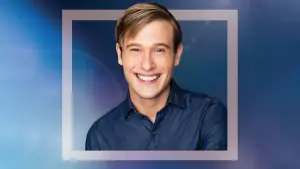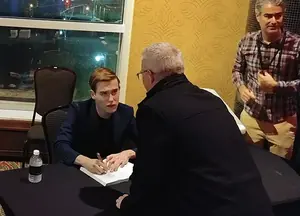


The neon glow of Caesars Windsor usually signals a different kind of gamble. But tonight, Feb. 23, the stakes at The Colosseum aren’t found on a felt table or inside a slot machine. They’re etched into the faces of the thousands sitting in the velvet-wrapped dark, waiting for a blonde 22-year-old to tell them something—anything—about the people they’ve lost. Tyler Henry, the so-called Hollywood Medium, is in the building. He is less of a showman and more of a conduit, bringing a live version of his E! Canada series to a room that feels half like a theatre and half like a wake.
The evening is structured with a clinical precision that belies the messy nature of the afterlife. Henry spends the first half of the night laying out the blueprint of his life, explaining the mechanics of how a kid from a small town ends up reading the auras of the Kardashian clan. It is a crash course in mediumship followed by a high-pressure Q&A session.
“It’s a pretty comprehensive show,” Henry tells 519 Magazine. “In the first half I’ll try to help people understand the valuable life lessons I’ve learned from those who have passed away. It’s all about helping people better themselves right here in the here and now.”
There is a pragmatism to Henry that feels jarring when you consider he claims to speak with ghosts. He isn’t interested in the theatrics of a Victorian séance. He doesn’t dim the lights or use a crystal ball. Instead, he focuses on the "here and now," a phrase he uses to ground the ethereal in the practical. The goal isn't just to prove life after death, but to improve the lives of the living.
Henry was born with what he calls a unique gift, though "gift" feels like a lightweight term for the burden of carrying other people’s grief. He has built a career on providing closure, comfort and proof that consciousness doesn't just stop when the heart does. He calls himself an evidential-based medium. This is niche terminology for someone who deals in specific, verifiable details rather than vague platitudes. It’s the difference between saying "I see a father figure" and "Your father died of a specific ailment in a specific room."
His track record has moved beyond the Hollywood hills. His ability to provide detail-oriented specifics has reportedly led him into rooms with medical professionals and investigators working on missing person cases. It is a heavy mantle for a young man who looks like he should be worrying about midterms.
“I liken my job to like that as a mailman,” Henry describes. “I’m not responsible to the message as much as it is my job to deliver the message as accurately as I can. Sometimes there are things that need to be brought up for a person to move forward and when the topics are a little tougher it can be hard on both of us. I think it’s helpful to leave them in a better place than when I found them.”
When I was 10 years old, I had a premonition from my grandmother and I just woke up knowing that my grandmother was going to pass away. ... Before I got the chance to tell my mom, I ran into the room and as I did the phone rang - when she picked it up it was news that my grandmother had just passed.
The mailman analogy is a brilliant bit of branding. It removes the ego from the equation. If the message is bad, don’t blame the courier. But sitting in the third row, watching him scribble frantically on a notepad—a process he calls "scribbling" to clear his mind—you see the physical toll. The "tougher topics" he mentions aren't just footnotes; they are the traumatic ends of human lives. Delivering those accurately requires a certain emotional detachment that Henry seems to have mastered, yet he still aims for a net positive outcome.
The origin story of the Hollywood Medium sounds like a script from a mid-2000s indie film. It was 2006. His grandmother was terminally ill with cancer. Henry began having intuitive hunches—fleeting thoughts that felt too heavy to be mere imagination. These hunches soon morphed into profound visions. He was a child navigating an adult’s nightmare.
“Growing up we never really talked about the subject matter,” Henry recalls. “When I was 10 years old, I had a premonition from my grandmother and I just woke up knowing that my grandmother was going to pass away. I didn’t know how to explain it, but in my mind, it had already happened. Before I got the chance to tell my mom, I ran into the room and as I did the phone rang—when she picked it up it was news that my grandmother had just passed. I kinda’ liken it to a muscle, the more you use it the better you get. Just like how some people are more susceptible to doing better at basketball or certain sports, the same rules apply to intuition.”
The basketball comparison is a sharp bit of rhetoric. It democratizes the supernatural. By framing intuition as a muscle rather than a divine decree, he makes it accessible. But he also acknowledges the inherent talent involved. Some people can shoot three-pointers; Henry can apparently sense the exact moment a soul exits the room.
The world of paranormal investigation is a cluttered one. It’s filled with terms like telepathy, precognition, clairvoyance and psychokinesis. Most people lump these into a single "spooky" bucket. Henry, however, operates on a different frequency. He doesn’t see full-bodied apparitions standing in the corner of the room. He picks up on sensations and impressions. It’s a subtle, almost annoying hum of information.
“A lot of people think it’s like a sixth sense and thankfully it’s not,” he says. “The way it works is that the sixth sense uses the other five senses to communicate, so most of the time it’s really subtle. When I interact with a person, I pick up on impressions and I just deliver those impressions. Largely, a lot of those impressions are of those that have passed away. The way I receive that information can vary quite a bit—I can hear a voice, get a smell, feel a physical sensation that corresponds with how someone had passed. It’s very immersive and I just have to interpret all these sensations, figure out what it means and deliver it to the client.”
This sensory overload is where the technical work happens. He might smell cigarette smoke when no one is lighting up, or feel a sharp pain in his chest that isn't his own. It’s an immersive, often exhausting way to exist. He has to act as a translator for a language that has no alphabet.
Is there a critique to be made? Of course. The very nature of "live" mediumship at a casino resort invites skepticism. The skeptics will point to cold reading or high-level observation. But watching the audience in Windsor, you realize that for many, the "how" matters far less than the "what." If Henry can tell a woman something only her late husband knew, the mechanics of the "sixth sense" become irrelevant.
The show at Caesars Windsor starts at 9 p.m. tonight. Tickets are still floating around, starting at a modest $28. It’s a small price to pay for a seat at the table of the afterlife. Henry’s profile has never been higher, especially with Hollywood Medium returning to E! Canada last month for its third season.
He stands on that stage, a slight figure against the massive backdrop of The Colosseum. He is a young man in a very old business. And whether you believe he’s talking to the dead or just reading the room, there is no denying the weight of the silence he creates when he starts to speak. He isn't just delivering mail; he's delivering a kind of peace that most people in that room haven't felt in years. And in the world of live entertainment, that is the rarest commodity of all.
Get Tickets