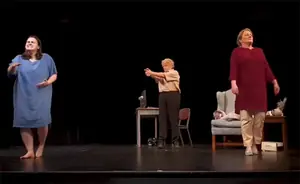

Sitting in the cramped, expectant hush of the Hatch Studio Theatre at the Jackman Dramatic Art Centre, you can almost feel the weight of the air. It is heavy with the kind of institutional dread that Judith Thompson has spent a career dissecting. The Windsor Feminist Theatre is bringing *Watching Glory Die* to the city for a run from July 23 to 27, and it is about time. This is not just a play; it is a jagged piece of Canadian history that we have tried, unsuccessfully, to bury under bureaucracy and silence.
Thompson is the high priestess of Canadian heartbreak. Her work does not just sit there; it vibrates with a low-frequency rage. We sat down for a raw, unfiltered conversation about the 2014 drama and the ghost that haunts it: Ashley Smith.
When asked why she felt the need to birth this particular nightmare, Thompson is blunt. She says:
"I wrote it, I am not sure how many years ago, maybe seven or eight years ago in response to the tragic death of Ashley Smith, who was a young girl from New Brunswick who was incarcerated initially just for, basically mischief, throwing crab apples at a postman, literally. She was a mischievous girl. She would dine-and-dash, and playfully knock into people, strangers, that kind of thing. But nothing criminal, ever. Basically like a lot of young boys at that age."
It is the "crab apple" detail that sticks in the throat. In a country that prides itself on "peace, order and good government," the descent of Ashley Smith into the bowels of the correctional system over fruit is a stain that won't wash out. Thompson captures the absurdity of the escalation—the way a spirited girl becomes a "case file" to be managed rather than a human to be helped.
The playwright continues to dissect the institutional machinery that ground Smith down. Thompson says:
"Nothing criminal, ever, and they were looking for a reason to lock her up and these crab apples gave them the reason. And then, because she didn’t have a lot of control, she was really lacking. The rest of us would sort of put our head down and do what we were told to get out of there. She just couldn’t do that. She would swear at the correctional officers, she would throw her lunch on the floor, that kind of thing, because they were hurting her, and it was difficult, and she couldn’t control herself. She didn’t have whatever it is in our brains that allow us to do that, so she kept getting institutional charges. She was then transferred at 18 to a federal prison. Grandview Valley Correctional Centre in Kitchener where she tried numerous times to take her life, because she kept getting charged for anything. Literally, they’d put handcuffs on her and she’d say, 'Ow, that hurt,' she’d get another six months."
The tragedy is documented, digitized and perpetually available for the morbidly curious. Thompson points to the digital footprint of Smith’s suffering as a primary source for her fury. She says:
"You can see it all on YouTube. Her mother insisted on even her death remaining on YouTube, because she wants the world to know. And if you watch all of these videos, Ashley is never out of turn. She just says, 'Please, you’re hurting me,' kind of thing. What any of us would say. They illegally gave her drugs for psychosis, which she didn’t have. She was never properly diagnosed. They would come into this young, sweet, chubby girl’s cell in full riot gear. Like six men. To transport her on an airplane, they kept moving her to institutions, because even then, legally, you were not permitted to have an inmate in segregation for longer than 45 days. Now, to me, 45 days is extremely excessive anyway, but because basically they were too lazy to do the paperwork, and the paperwork would not justify keeping her in. They just didn’t know how to handle her."
The logistics of Smith's incarceration read like a Kafkaesque horror script. The moving of inmates to reset the 45-day segregation clock is a bureaucratic loophole used as a weapon. It is a shell game played with human lives. Thompson notes the moments of missed connection where Smith could have been saved if the system had any capacity for empathy. She says:
I wrote it... in response to the tragic death of Ashley Smith, who was a young girl from New Brunswick who was incarcerated initially just for mischief, throwing crab apples at a postman, literally. Nothing criminal, ever, and they were looking for a reason to lock her up and these crab apples gave them the reason.
"For instance, when she was sent to Saskatoon to a prison for the criminally insane, which is ridiculous, she wasn’t at all. There’s a whole video in *The Fifth Estate* documentary of a nurse coming in, and at first, Ashley was difficult. I think she threw her lunch in her face. But then, the nurse just kept talking to her, and she was absolutely fine. She was fine with her mother. They moved her so much that her mother would buy plane tickets to visit her, and then be told, 'Oh, she’s been moved,' and of course, she’d never get the money back. I could talk forever about it."
But the talk eventually has to lead to the end. The "blue" order. It is the most chilling aspect of the Smith case—the literal command to watch a child die. Thompson recounts the finality of that negligence. She says:
"And then, what finally happened. She’d tear ligatures from her own gown and store them in her orifices, because the guards have to get consent of the prisoners to check them now, and she would try to strangle herself a lot. That happened quite commonly. So, the psychologist at the prison said, 'Well, don’t go in until she’s blue, until she’s completely blue and stopped breathing.' So, the guards were ordered to wait. One day, they did as they were told. She was blue, and you can see this on YouTube, and she had died. It’s so horrific, the whole thing, start to finish. Even if she had been a criminal, but she wasn’t. She was just obstreperous and maybe needed some medication."
The legal aftermath was a typical exercise in Canadian scapegoating. The big fish swam away while the frontline workers were left to drown in the fallout. Thompson’s play does not just focus on the victim; it looks at the guard, Gail, as another casualty of a broken hierarchy. Thompson says:
"Finally, in civic court, it was ruled a homicide, thank God. But who was punished? The frontline guards, not the evil psychologists, or the warden, or any of those in charge who, in fact, ordered the guards to stand there. And I wrote the character of the guard, Gail, as well as the character of Glory, who is my fictional representation of Ashley, just inspired by her story, and her mother, too. Her real mother is named Coralee and this person’s name is Rosellen. And I’m very sympathetic with the guard, and a lot of correctional officers came to the show. It was both here in Toronto and Vancouver. What they have to endure, and they’re forced to endure is unbelievable. This is their job. They have pensions that they couldn’t risk. People are blaming the people on the frontline who are just tools. It’s easy to just up and quit and start a riot if you have a trust fund, or you can lose your job without worrying. But it’s very complex. They were undoing these ligatures every day, and they have no help, they have no guidance. One of them, you will see if you watch the video, screams out when she sees Ashley’s dead, 'My God, I haven’t had CPR in 11 years.' Well, what is a frontline correctional officer doing not having had a CPR in 11 years? I have a friend who is a lifeguard, and they have to redo it every year."
And that is the crux of the play’s empathy. It refuses to offer an easy villain. By including the mother, Rosellen, Thompson completes a trinity of female suffering. When asked if Smith’s real family has seen the work, Thompson confirms the emotional stakes. She says:
"Yes. Coralee, her mother, has in Nova Scotia. There was a tour in Nova Scotia with one young actor playing all three roles. She was very gratified that the play was created, and wants as many people to see it as possible. So, that was very important to us to have her blessing, even though it is completely fictionalized, it’s inspired by Ashley’s story. And there are some true details, too."
The 2014 premiere was a milestone for Thompson personally. She stepped onto the stage as Glory, marking her first time acting since 1980. It was a move born of necessity and a bit of professional prodding. Thompson says:
"I did, but I wasn’t going to act in it. But this Iris, this dramaturge is a very pushy person, and she said, 'You get on the stage. You’re a director, you’re a writer, and you’re an acting teacher. You’ve got to remind yourself of what it takes.' And she was right. It was really important that I did it, and really hard to memorize my own lines. Oh my God, when I was young, I would have three rehearsals, and I’d know them all, because I’d had years as an actor, from basically 11 to 30, or so. And I had a terrible struggle. But once an audience was there, I was fine. Strangely, the old muscles kicked in. It’s really exhausting though. I don’t know how they do it. I’d much rather be sitting there as a director or a playwright and giving notes."
While the solo version has its own intensity, the Windsor production utilizes three actors. It is a different beast entirely, allowing for a more traditional, though no less harrowing, theatrical experience. Thompson explains the evolution of the casting. She says:
"Well, my director dramaturge and I felt that... I had originally wanted three women, but A) It’s the cost. It reduces the cost of the production, and B) She felt that all three women are one woman in a sense. We all have deep thread of commonality, that we are all sisters. There is a mother in us, there is a daughter in us, there is the guard in us, the person having to work for the man kind of thing. It was fun switching between the characters, but I really love having three incredible actresses, Kelli Fox, who has been at Shaw for years, and years, and years. Just extraordinary. And Kathryn Haggis, who I’ve worked with before, really brings a depth and an earthiness to the guard. And a wonderful young newcomer, Nathanya, who brings the energy, the innocence of Glory to life."
Kelli Fox is a powerhouse, and her presence here elevates the material. But what is the end goal? Is it just to make us cry? Thompson wants something more visceral. She wants us to look at our tax receipts and feel the blood on them. She says:
"I hope that they will be as outraged as I am by the system that they support by paying taxes. I hope that they will also have an empathy and understanding of what it is to be absolutely in the grip of a system the way the guards are, that they can’t, really, don’t have the resources to fight. And I hope they understand the pain of a mother, whether it’s in this case, Rosellen, whose daughter’s in prison and she’s absolutely helpless. Even though she has really good people fighting for her. She had Kim Pate, who’s now a senator, fighting for Ashley. It didn’t do any good. And many mothers are in that position. The mothers of many missing and murdered indigenous women, for instance. Young women who go missing, who become addicted to opioids, that kind of thing. Just that absolute helplessness."
Thompson followed this work with *Who Killed Snow White*, another descent into the dark side of the female experience, focusing on the harrowing realities of cyberbullying and sexual assault. She seems drawn to the stories that the rest of us want to scroll past. She says:
"I think that, although they do come out in the news, and we heard about, speaking of *Who Killed Snow White*, of Amanda Todd and Rehtaeh Parsons taking their own lives after being sexually assaulted, and then harassed online, or blackmailed online, in the case of Amanda Todd. And there’s something about public humiliation and online trolling that is almost worse than the assault itself for these young women. This is what’s happening now in the contemporary world. I know what it’s like to get bad reviews. I’ve got them in the past, believe me, and that is very humiliating. Even if we know its nonsense and people love the play, it’s to have something public. And we know, from grade school and middle school, something spread around about you, or there’s a public shaming, is something I think humans fear, maybe more than anything. We look at a lot of people in powerful positions are rightly being shamed now, and this is a good thing, but when it’s for no reason, for something online, or flashing online, or something like that, it’s horrifying to a young person, especially."
It is a generational divide that Thompson observes with a mix of pity and distance. The digital world is a cage that the youth cannot escape, whereas Thompson can simply close the laptop. She says:
"They cannot withstand it, partly because they are unable to stay offline. Whereas, people my age, I don’t ever check about myself online. It’s easy for me to stay away from because I’m almost 65. Most of my life, I grew up without it. But I think if you are young, you sound young, it’s almost impossible to be offline, right?"
But the truth is, whether it is the digital cage of a smartphone or the concrete cage of Grandview Valley, the entrapment is the same. *Watching Glory Die* is a reminder that the system is only as good as the people who refuse to look away when things go "blue." Go see it. And then try to sleep.
Get Tickets