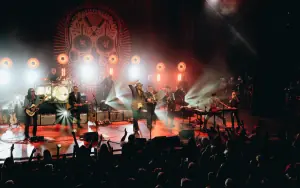


There is a specific kind of sweat you only see at a Mavericks show. It is the sort of perspiration that ruins expensive Western shirts and turns a theatre floor into a slip-and-slide of spilled rye and lime juice. Since the band staged their 2012 reunion, they have morphed from a 90s radio anomaly into a touring juggernaut that defies the very concept of a setlist. They do not just play songs; they inhabit a space where the borders between Nashville, Mexico City and Havana simply cease to exist.
And that is the magic of the brand. It is an irrepressible mix of country, Tex-Mex, rockabilly and Latino rhythms that should, by all logic, be a mess. But in the hands of Raul Malo and company, it becomes a riotously entertaining live spectacle. They are currently hitting the highway to celebrate 30 years of existence, a milestone most bands celebrate with a bloated box set or a bitter breakup. Instead, The Mavericks are giving us *Play the Hits*, a collection of covers dropping Nov. 1 on their own Mono Mundo Recordings.
The lead-off is a version of John Anderson’s "Swingin" that sounds less like a tribute and more like a hostile takeover. It is loud, brassy and impossibly tight. The lineup—Raul Malo on vocals and guitars, Paul Deakin on drums, Jerry Dale McFadden on keys and Eddie Perez on guitars—is hitting Southwestern Ontario this month. They land at London’s Centennial Hall on Oct. 27 and Kitchener’s Centre in the Square on Oct. 28.
I sat down with Eddie Perez to talk about how a band survives three decades without killing each other. We started with that Anderson cover. It sounds like something they have been playing in a dive bar for 20 years.
"When we were thinking about doing some more music, Raul had an idea," Perez says. "He says, 'I’ve always wanted to do a record that kind of was directly responsible, in some way, for inspiring some of this music that The Mavericks make.' When we started getting deeper into those kinds of conversations, all of us started throwing out songs. We were like, 'It would be cool if we covered this song. It would be cool if we did this, and that, and vice versa.' We went around for, I think, a good portion of the last year or two."
But the actual recording was not some over-thought Nashville session with 40 takes. It was a lightning strike.
"Finally, the timing was right to do it," Perez says. "Swinging was something that honestly, Raul, he came into the studio, and it was one of those last minute, 'Hey guys, I’ve got an idea to cover this song. This is what I think we should do.' To tell you the truth, he sat down at the piano in the recording studio, and we just kind of all started playing along. Before you knew it, our engineer, Nico Bolas, he was in the studio talkback, he goes, 'Whatever you guys are doing, keep on doing that, but let me hit record first.'"
Bolas is a legend for a reason—the man knows how to capture grit. You can hear the room in the track. It does not have that sterile, over-produced sheen that plagues modern country radio.
"It kind of happened quite quickly, not as much thought as the other ones," Perez says. "When we got into the making of that track, it started being pretty obvious that it felt like it was tailor made for us somehow. Really, what you hear was, I think that was probably the second take that we did of that song, and we knew we had something on that track. I feel like a moment of creative energy was captured, and I think it sounds like it. You can hear it, it sounds real spontaneous, and it sounds alive."
Perez is clearly leaning into the pride of the performance. The Mavericks have always been a band of virtuosos who pretend they are just having a party.
"I know that we’re all very proud of it," he says. "It’s just yet another thing that we get to showcase what the Mavericks and the band that we have, the breadth of music that we really can take on. I think playing it, it was just a fun song to do, and we loved how it came out. We hope that everybody else will too."
The conversation shifted to the album itself. *Play the Hits* is a dangerous title. It implies a lack of original ideas, but for a band with this much stylistic range, it is more like a curated museum of their DNA.
"Yes, it is," Perez confirms when asked if the single is part of the larger collection. "We have a record coming out in the first part of November, I believe. I’m not sure what the exact date is, but I know that it’s slated for the first week of November. It’s a collection of covers songs that have inspired us along our musical journey."
The Mavericks do not do straight covers. They do reconstructions. If you are expecting a note-for-note karaoke session, you are in the wrong theatre.
"Of course, in typical Maverick fashion, we get the songs and we kind of tear them apart," Perez says. "We kind of try to figure out, what are The Mavericks going to do with this? We try to re-imagine some of these tunes. The ones that did make the record, we feel really great about. As an artist, you always want to feel like you’re hitting your personal mark, you’re hitting the best that you’ve got in that inspiration. I can confidently say that we all feel that same way about all these tracks. That’s coming out, like I said, in the first part of November. It’s a collection of cover songs that have been inspirations to us along this musical journey."
The selection process for a record like this is usually a nightmare of egos. Everyone has a favourite B-side or an obscure track they want to flex on.
"Well, trust me, it was a massive list at first," Perez says. "Then we started whittling it down. During a soundcheck, we’ll mess with a certain verse of this song, or we’ll mess with that song, or whatnot. We’ve been doing this a really long time, so we can really tell pretty quickly if something’s going to work for what it is that we do, and something is maybe not working. You can always tell, because if you have to labour on it too much, something’s not quite clicking. At least that’s how we do it. A lot of the stuff that we’ve recorded over the years happened very spontaneously. We happened to be in the creative moment, and we captured some of these tracks."
But democracy only goes so far in a band with a singer like Raul Malo. His voice is the gravitational pull of the entire operation. If he cannot sell the lyric, the song dies on the floor.
When I first heard The Mavericks’ music, it just instantly resonated with what I was already doing and what I was already into. ...I leaned over to my dad at the time, and I said to him, 'I could play in this band.' ...Talk about manifesting something. Boy, I’ve lived it.
"It started with a really massive list at first, but the ultimate way that they get chosen is our awesome front man, and lead singer, and primary songwriter, Raul Malo," Perez says. "He’s the voice out there that has to communicate these songs. These songs that we picked were songs that really have to resonate with him first. He’s going to be singing these songs night after night, and he’s going to be conveying those messages."
The process sounds more like carpentry than songwriting. There is a lot of sanding and shaving involved.
"The list got whittled down rather quickly," Perez says. "Almost like we would plan a show, we kind of had a working set list of what we were going to do. Eventually, as we get farther into that process, then the editing begins, and then we start really hearing ... it’s like carving something out of a piece of wood. It’s kind of the same sort of thing."
And what about the songs that didn't make the cut? There is likely a vault of half-finished gems somewhere in their Nashville headquarters.
"The ones that did make the record after the end of the process really are those that really resonate with Raul," Perez says. "He’s conveying those songs and those messages. The way we feel, we could have taken a number of them and they could have been just as great, I feel. We have a lot of stuff that we didn’t include on the record, but that’s kind of the process. It starts with everybody chiming in, and then it starts getting serious, and then it starts whittling down, and then ultimately comes down to, 'Raul, how do you feel about this?' He’s like, 'Yeah, I feel good about this. I think we should do this. I think we should do that.' That’s kind of our process, at least for this record."
Thirty years is a lifetime in the music industry. It is longer than most marriages and certainly longer than the relevance of most of their 90s contemporaries. I asked Eddie how they are marking the occasion.
"Well, we’re trying to make healthier choices," he says with a laugh. "We’re trying to figure out how we can have a little bit more longevity with us. I’ll jest, the truth is that the biggest thing of all of this is that we all have to try to figure out how to stay healthy in all of this. It’s a very rigorous lifestyle."
The road is a meat grinder. It does not matter how much you love the music; the 2:00 a.m. bus rides and the hotel breakfast buffets eventually take their toll.
"At this point, 30 years into it, you can imagine how many miles all of us have put on together throughout this experience of being The Mavericks," Perez says. "That’s the first thing. We try to figure out how to just stay healthy in all of this. Our creative muscles and our creative ambition in life is just as strong and burning as bright as ever."
There is no sign of slowing down. They have a Latin record coming next year and a documentary in the works. It is an ambitious slate for a band that could easily coast on the nostalgia circuit.
"We’ve got lots of irons in the fire right now, and like I said, a new record getting ready to come out in November, followed up by another one in the first part of next year that is an all out Latin record," Perez says. "We also have a documentary film that we’re in the process of doing at this moment, documenting the 30 years of the band’s history. It’s a really challenging, busy, beautiful, big, ambitious, wonderful time for us right now. I’m really proud to say that the fact of the matter is that we’ve worked really hard and we’ve overcome a lot of things to get to this point."
And he is not just blowing smoke. The band’s middle years were famously rocky, but the current iteration feels more cohesive than the *What A Crying Shame* era.
"I must say, in all honesty, this point for us right now, in my experience, has been the most fulfilling, the most satisfying, and the most fun, just flat out fun in general," Perez says. "I think that resonates with the audience."
Perez has been in the fold for 16 of those 30 years. He was a fan before he was an employee. Born and raised in the Los Angeles club scene, he was cut from the same cloth as the band he would eventually join.
"When I was coming up in my own journey, I was born and raised in Los Angeles, so I lived there and in my young life," Perez says. "When I was coming up in the club scene, I was involved in the same types of music, underground bands. At that time in the ‘90s, there was a really great live music scene happening in Los Angeles. There was a lot of venues and a lot of places to play. There was a scene, hot rods, and pinup artists, and there was a really vibrant, real ‘50s and ‘60s rock and roll and soul kind of scene going on at the time."
The Mavericks were the only band in the 90s that could bridge the gap between the LA rockabilly scene and the Nashville mainstream.
"When I first heard The Mavericks’ music, it just instantly resonated with what I was already doing and what I was already into," Perez says. "Back in the year 1996, I remember going to go see The Mavericks with my father at the Greek Theater, and sitting in the seats with him, looking at the band. I leaned over to my dad at the time, and I said to him, 'I could play in this band.'"
It is a bold thing to say while sitting in the cheap seats. But Perez was right.
"I actually said that to him," Perez says. "I said, 'I could play in this band.' There was something about it that I just felt linked to, stylistically, visually. I felt like there was something there for me. Mind you, I said this at a time where I didn’t know any of these guys. Talk about manifesting something. Boy, I’ve lived it."
He spent years in the trenches of the honky-tonk circuit before the stars aligned.
"I was just a fan just because I was involved in that music in in my own right, playing in bands that were playing the same type of music, country, honky tonk, kind of with a blues and rock and roll tinge to it," Perez says. "At the time, that’s what The Mavericks were doing. In my own right, I was doing the same thing with certain individuals that I was playing with. I was involved in that scene, but in the LA West club scene. I finally had an opportunity to move East. I moved to Austin, Texas, for a while. Then from Austin, Texas, I moved to Nashville, finally. Then finally, when I moved to Nashville is when I started really getting to know the guys and being friends. Before I knew it, I found myself being asked to be a part of The Mavericks. I think it’s a unique story, but it is one of manifestation, no doubt."
The inevitable question for a band like this is always about genre. Are they country? Are they Americana? Are they a Latin rock band? The industry loves a box, but The Mavericks have spent 30 years burning those boxes for warmth.
"Well, I think a lot of people, they get caught up in the labels of the genre," Perez says. "'Well, what do you guys do? Are you guys country? Are you blues? What are you?' That is always the nonstop question. It always is. Every time we get asked that, and it’s not just me, it’s my other fellow compadres as well, but we all say the same thing. We say, 'I don’t know. We make Mavericks music.'"
He is right to be dismissive. In an era of Spotify playlists and genre-fluid collaborations, the old labels feel like relics of a dead era.
"It’s a funny thing, because when you look at music right now, it seems to be at least in fashion right now that there are all these different collaborations going on," Perez says. "It’s like Sting and Shaggy, Justin Bieber and Luis Fonsi. The reason I’m talking about this is because I feel today, music is so cross-pollinated with so many different things at this point, that I feel like classification is kind of an outdated concept in the way that we know it traditionally."
And he’s got a point. You cannot pigeonhole a sound that incorporates an accordion, a horn section and a Gretsch guitar.
"Can you really say that anybody today is in the rock and roll genre?" Perez asks. "Can you really say that anybody really is in the soul genre, or in the pop? To me, it all kind of has a blending of sameness somehow. There’s something going on with music in general right now that sounds like it’s gone on to create others things that really, the traditional labels, I feel, don’t really apply."
So, if "Country-Western-Tex-Mex-Fusion" is too long for a record store bin, what do you call it? Eddie has his own label.
"To me, how I describe The Mavericks music, I say if there was a new genre, the genre would be called joyous," Perez says. "We play joyous music."
It is a simple, almost naive descriptor, but it is accurate. There is a lack of cynicism in their music that is rare in the modern landscape.
"Especially the world we’re living in today," Perez says. "It’s not just our country. It’s around the world. It’s crazy times we live in, and I think that a band like us, I think that’s another reason why we’re having a moment. I think that people are responding to that joy that we seem to have, not just for the music, but for the times that we get to play music with each other on stage as really close, tight friends of 30 years, 25 years, 30 years. It’s a special thing, and we certainly do feel the moment that we’re having, and we’re really, I will say that we’re probably having more fun now than we’ve ever had. As cliche as that sounds, it is the truth."
And the truth is, if you are not at Centennial Hall or Centre in the Square this month, you are missing the best party in the province. Just don't wear a shirt you care about. You’re going to sweat.
Get Tickets