The moment William King describes stepping to the edge of the stage — not on it yet, just at the threshold — you understand why 60 years haven't dulled a single thing. "I just feel like it's time to have fun," he says. "Things explode all over the place, and mostly in yourself." That right there. That is the whole answer to every question anyone has ever asked about why The Commodores still exist, still tour, still matter. Not nostalgia. Not obligation. Pure, stupid love for the feeling.
King is calling from Florida, mid-tour, sounding like a man who got exactly enough sleep and exactly enough coffee. At 77, the co-founder, trumpeter and beating pulse of one of funk and soul's most decorated acts is three time zones into his day before the conversation even starts. And he is ready to talk.
Before King became the guy holding everything together, The Commodores were six young men from Tuskegee, Alabama who met at Tuskegee University in the late 1960s, bound together by an almost reckless belief that they could make it. The original lineup included Lionel Richie on saxophone, Milan Williams on keyboards, Ronald LaPread on bass, Thomas McClary on guitar, Walter "Clyde" Orange on drums and lead vocals, and King himself on trumpet. They were gifted, yes — but what separated them from a hundred other groups was discipline, choreography and a collective hunger that bordered on obsessive. Motown came calling. Hits followed: "Easy," "Three Times a Lady," "Sail On," and the song everyone knows whether they think they know it or not.
That song is "Brick House." And when it comes up in the conversation, King goes warmer, slower, less interview and more front porch — proprietary pride, like a man describing a '67 Corvette he built himself. "If it was a woman, it would be the love of my life," he says. The track almost didn't survive its own recording session. The late co-producer Carmichael heard the initial cut and declared it didn't have the oomph. That judgement lit a fire under Clyde Orange, who went into a separate studio alone, laid down the vocal track and then invited the rest of the band in to listen. "Man, that song was jumping off the reel," King recalls. And there it was — the two-inch analogue tape with that bass hitting like a wall of brick. No digital polish, no pitch correction. Just raw magnetic physics doing what analogue bleed on a groove track does when everything is right.
What King remembers most about writing "Brick House" is that they were racing. They were finishing up in Arkansas, the song came together in a day or two, and the lyric concept — Walter Orange's idea about a brick house — was the last thing locked before they packed up for California to record. Speed, in this case, was a gift. The organic sloppiness of a deadline produced one of the tightest funk tracks ever committed to vinyl. King watched someone's wedding band play it recently. "Everybody in that room jumped up out of that seat and jumped up on the dance floor," he says. Sixty years on and the song still does the same thing it did in 1977.
The education that made all of it possible started before Motown, before the hits, on the road as the opening act for the Jackson 5. That gig — which King describes as "unbelievable" in the understatement of the interview — ran for roughly two and a half years starting around 1971. The Commodores were driving a van between dates while the Jacksons were flying. None of that mattered. What mattered was proximity to a machine that worked, and King watched that machine with the focus of a business student. "How the trucking worked, how much did it cost, how many trucks, what was the setup time, how was the money paid?" He wasn't just performing; he was taking notes through the stage manager and business manager. That knowledge, he says flatly, accelerated the Commodores' growth in ways nothing else could have.
The choreography came even earlier. King traces it back to watching the Temptations perform when he was in eleventh or twelfth grade. By 1968 or '69, when the Commodores were just getting started, he was already pushing the rhythm section to add stage movement. "A couple of the guys said, man, I can't play my instruments and do a routine." Lionel Richie and King held firm. They drilled it until it was second nature. By the time the Jackson 5 camp saw them, the routines were one of the things that got them the gig. Mary and Marty saw them and said, as King tells it, "Yes, Lord. Give those boys a chance."
If it was a woman, it would be the love of my life." — On "Brick House
And Motown itself? That was something different entirely. Meeting Berry Gordy, Diana Ross, Marvin Gaye — all before the contract was even signed. Walking into that studio an hour early and having to wait outside because someone else was still laying down tracks. The engineers Cal Harris and Jane Clark, who worked with them album after album until the sessions became a kind of second home. "There was a magic in that studio," King says, "that still to this day isn't anywhere." He calls it a gathering of souls. All six men after the same thing at the same time, voting on costumes and arrangements and song choices, and when the vote went against you, you jumped on board anyway — because the faster everyone moved in one direction, the faster they'd know whether it was the wrong direction and could turn back. Half a wrong road beats a full wrong road.
The Tuskegee winters were writing season. January and February in Alabama, hammering the album into shape, working out parts and transitions. Then out to LA to record. Then a summer release. Then the tour at the end of the season. Year after year. The consistency of it, the rhythm of their creative life, built something that outlasted trends, outlasted personnel changes, outlasted just about everything.
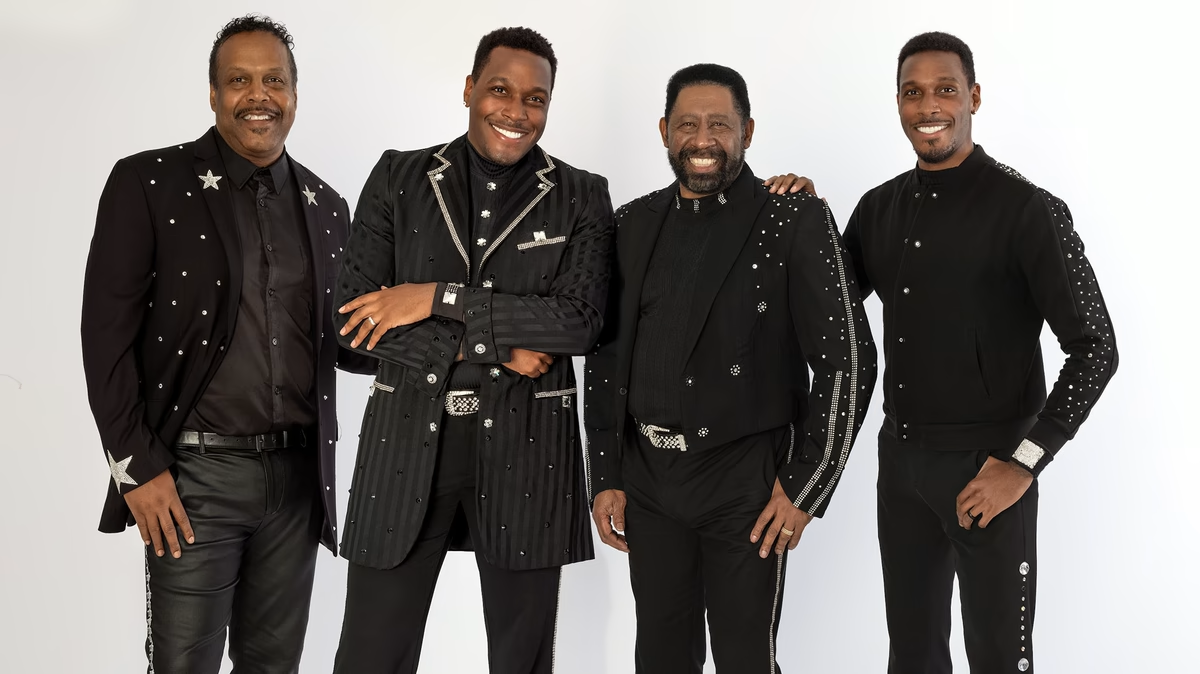
That brings us to now. The current touring lineup of the Commodores carries a detail that King clearly takes deep satisfaction in: the Orange twins. Walter "Clyde" Orange, original member, the man who sang "Brick House" into existence, told King a few years back that he was thinking about retiring. "I said, this can't happen." But King knew he meant it. What he didn't know was that Clyde's son Cody had been quietly attending nearly every show for two or three years, absorbing everything from the wings. When King finally heard Cody sing at a rehearsal, the decision made itself. Cody was brought in while his father was still on stage, learning the songs Clyde was handing down to him — literally, generationally. Then Cody's twin brother Colin came in on guitar, arriving at almost the exact moment the band's previous guitarist was moving on. Colin plays with the precision of someone who learned every transition from the original recordings, who never had the luxury of forgetting the exact breakdown in "Easy" because he had to teach himself from the record.
"They knew our songs better than we did," King says, laughing. The twins had spent their childhoods playing Commodores songs on their instruments, which means they had memorized the album arrangements while the original members had evolved their live versions away from them over decades. The young men were, in a way, the keepers of the canonical text.
Add to that a third young voice — Brent Carter — and the Christmas album King has been planning for five years finally has the right cast to pull it off. Ten or eleven songs, mostly standards, plus a couple of new originals. The Commodores almost never record outside material, not because of any rigid policy but because, as King explains with quiet pride, "we've been able to create great songs within the group." A Christmas tour is planned alongside the album, which the group has never done before. For a band that runs on tradition and structure, that is a genuinely new move.
But it is not without its anxieties. King is candid about the fact that he has given himself roughly two more years on stage. His wife is already asking him to retire. "Maybe in a year or so," he allows, before adding, with a laugh, that he probably has "another 30 years" in him. The laugh matters here — he knows that the stage version of himself and the person who wakes up the next morning are two different animals, and he is wise enough to let the person win eventually. What he is not ready to do is leave until he is certain that the Commodores on stage without him know how to be Commodores. How to move. What to say. How to reach across the lip of the stage and pull the crowd in with nothing but feel.
That is not a small standard. For a band that started with choreography in their DNA, that learned stagecraft from the Jackson 5, that spent decades in the same Motown studio with the same engineers until the sessions felt like home — "how to be Commodores" is a complete education in itself.
The critique that any honest review of a legacy act must make is this: the emotional weight of what King describes — the transfer of knowledge, the family succession, the Christmas album — is not yet proven on record. We have King's passion and his conviction, both of which are considerable. What we do not yet have is the album. Whether Colin and Cody Orange and Brent Carter can deliver on a studio recording what they apparently deliver on stage is a question only the finished product can answer. King says he is very high on it. We'll see.
What is not in question is the live experience. Standing backstage at a Commodores show right now, in this short window before King steps back, is a specific privilege. The Niagara Falls date this season offers exactly that chance — choreography, guitar work that runs off the original vinyl like a blueprint, and the man who has been holding this thing together since 1968 standing at the edge of the stage, feeling it explode. "As long as I can feel that," King says, "I think I'm okay."
He will be 80 in two years. The plan, such as it is, is to leave before then — to hand over something complete, not something half-built. Sixty years of that same feeling at the edge of the stage, and he still does not take it for granted. That, more than any catalogue of hits, is the actual legacy William King is trying to pass on.
Catch them while you can. This one means it.
---
The Commodores
OLG Stage at Fallsview Casino
Saturday, May 16, 2026
8:00 p.m.